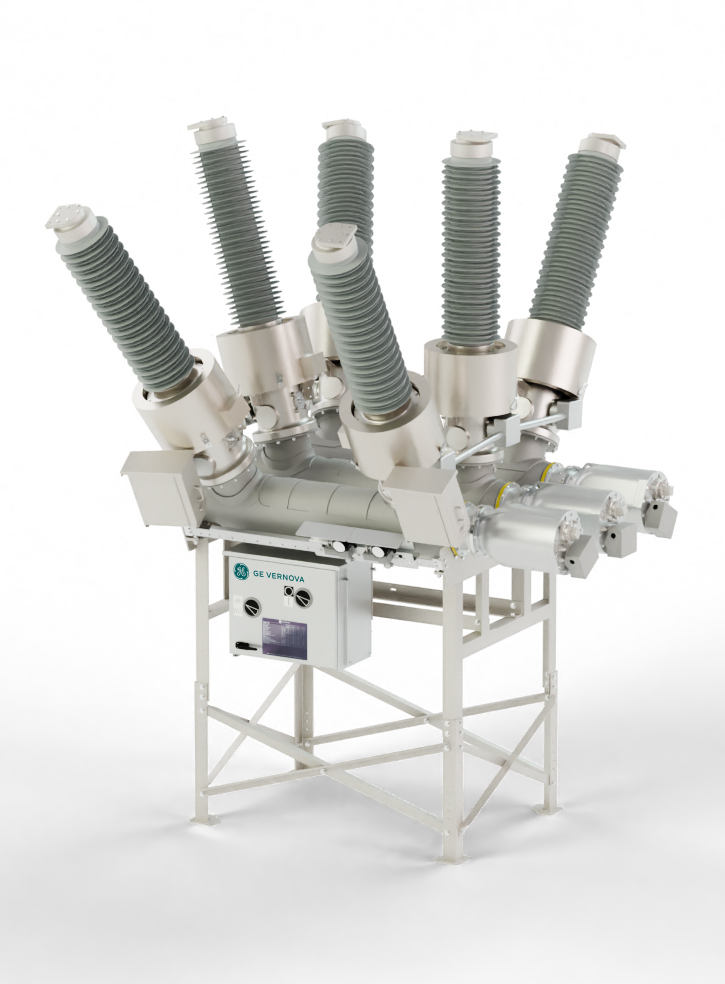
GE Vernova has introduced a high-voltage switchgear unit designed to occupy at least half the space of a conventional air-insulated substation arrangement while eliminating sulfur hexafluoride (SF₆) from its insulating gas. Announced November 17, 2026, in Cologne, Germany, the HYpact-145g targets utility substations that need more electrical capacity but have little land available for expansion.
The new device is rated for 145 kilovolts (kV) and a 40-kiloampere (kA) short-circuit interruption duty. Those figures describe the voltage class and fault-clearing capability, not electricity production, normal operating current, or a 40 kA continuous load. GE Vernova says orders are open and plans manufacturing at its Kassel, Germany, factory. The launch is not evidence of completed commercial installations.
GE Vernova’s official video shows installation of an earlier g³ circuit breaker in Switzerland. The equipment is related but is not the newly announced HYpact-145g.
Why ordinary substations consume so much space
An air-insulated substation separates energized conductors by large distances to reduce the risk of electrical discharge. Disconnect switches, circuit breakers, grounding equipment, instrument transformers and busbars occupy additional land. GE’s hybrid approach encloses selected switching and conductor components in gas-insulated housings while retaining air-insulated connections, reducing the installation footprint.
The manufacturer claims a 50% or greater reduction in required area compared with a conventional air-insulated substation. The baseline is important: the figure does not establish that HYpact-145g is 50% smaller than every existing compact switchgear product. Our report on land requirements for a UK high-voltage substation illustrates why compact equipment matters for transmission upgrades.
How a different gas can protect the grid
Traditional high-voltage equipment often uses SF₆ because the gas provides electrical insulation and helps extinguish arcs during switching. Escaped SF₆ also has an extremely high climate impact: the U.S. Environmental Protection Agency cites a 100-year global warming potential of 23,500 times carbon dioxide under its referenced assessment.
HYpact-145g instead uses GE’s g³ gas mixture, based on carbon dioxide, oxygen and approximately 3.5% fluoronitrile (C₄F₇N). GE reports about a 99% reduction in the insulating medium’s global-warming contribution relative to SF₆. That is a manufacturer-reported comparison of the gas, not a verified 99% reduction in the complete substation’s lifetime emissions. The substitute retains a fluorinated additive and still requires appropriate gas handling and end-of-life controls.
Switchgear protection and digital instrumentation
When a transmission fault occurs, a circuit breaker must interrupt an enormous short-circuit current before electrical and thermal damage spreads. The 40 kA specification defines the device’s rated interrupting duty at the appropriate system conditions. It is distinct from relay pickup settings and normal power transfer. Readers can compare medium-voltage designs in our coverage of 38 kV switchgear for data centers.
GE also offers optional low-power instrument transformers (LPITs) to measure voltage and current for digital monitoring. Accurate measurements can support protection and control, but a digital sensor does not independently increase a transmission line’s physical power capacity. Our coverage of grid monitoring sensors explains a separate approach to gaining operational visibility.
Official GE Vernova interview with an SSEN Transmission engineer about earlier SF₆-free g³ installations. The discussion is background on field adoption, not a HYpact-145g field test.
What remains unproven at commercial scale
The product announcement contains equipment ratings and design targets, but no independent HYpact-145g fleet reliability dataset, installed price, measured fault-interruption campaign, or long-term maintenance record. Factory tests and established experience with other g³ products are relevant technical foundations; they do not replace years of operation for the newly introduced model.
Additional grid capacity still requires transformers, conductors, protection coordination, interconnection approvals and utility investment. GE’s equipment is part of the broader supply chain addressed in our reporting on transformer shortages and manufacturing support and new transmission corridors. The next meaningful evidence will be named customer deployments, commissioning results, environmental monitoring and service-life performance.
Sources and verification
- GE Vernova, November 17, 2026 product announcement and official photograph
- GE Vernova, HYpact-145g technical product specifications
- U.S. EPA, fluorinated gas emissions and SF₆ global warming potential
- Switchgear Magazine, November 18 independent industry coverage
- GE Vernova, earlier g³ installation video and GE Vernova, SSEN field interview
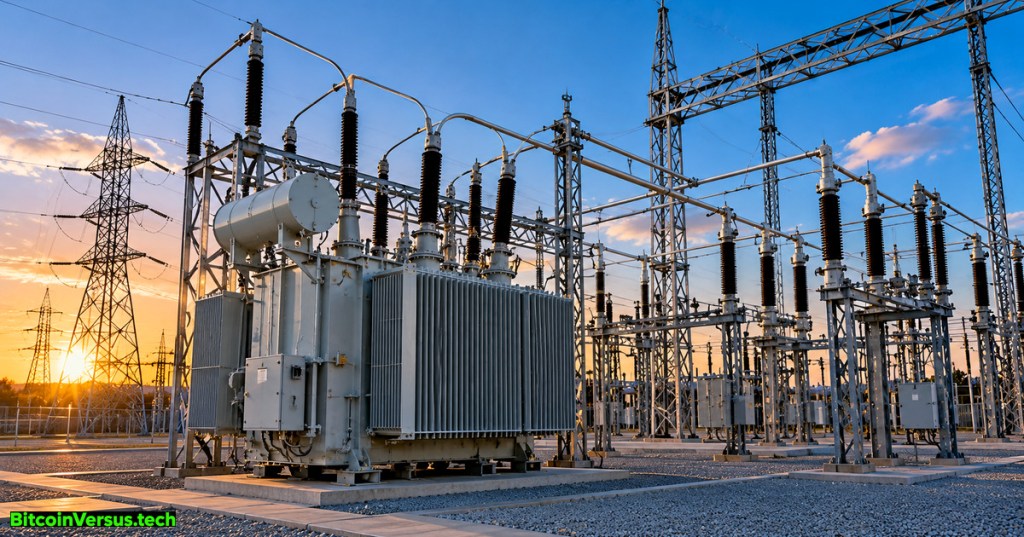
Cover disclosure: The featured cover is an original photorealistic illustration of a generic high-voltage substation with an approved BitcoinVersus.tech watermark; it is not a photograph of GE Vernova’s announced unit. The separate in-story image is the manufacturer’s actual HYpact-145g press photograph.


Leave a Reply