A robot can see an obstacle, plan a route and still lose its balance because a controller fails to account for the way motion, friction and contact interact. Researchers at the University of Michigan reported on November 10, 2026, that a redesigned neural-network input layer substantially improved simulated humanoid walking and physical robot manipulation. The method, called PRISM, changes how an AI system represents mechanics rather than simply increasing model size.
In controlled simulated walking tests, PRISM completed 92.5% of 24-second trials without falling, compared with 51.0% for the standard multilayer-perceptron controller. The result is a 41.5-percentage-point gain, not proof that commercial humanoids can achieve comparable reliability on public streets. The work was presented at the Conference on Robot Learning in Austin, November 9–12.
Why robot motion challenges ordinary AI
A conventional multilayer perceptron, or MLP, learns relationships between inputs and outputs using weighted layers and nonlinear activations. Robotic mechanics introduce interacting variables: joint position changes the effect of velocity, payload changes balance, and friction changes how commanded motion translates into traction. Standard MLPs can approximate such relationships, but often must infer them indirectly from large amounts of training data.
PRISM stands for Polynomial Representations for Interaction-Structured Motor Control. Its input module learns useful multiplicative combinations of state variables and commands. The research team’s open-source implementation illustrates the principle with a learned quadratic term, allowing a network to represent coupled physical effects without an exhaustive hand-written physics model. The rest of the learning policy can remain largely unchanged.
More parameters were not enough
A critical control experiment increased the standard MLP’s parameter count to approximately match PRISM: 1.321 million parameters. Walking survival then reached only 52.3%, versus PRISM’s 92.5%. The researchers therefore attribute much of the improvement to network representation rather than parameter count alone. The reported walking tests are simulations, and results depend on the specific task definition and training protocol.
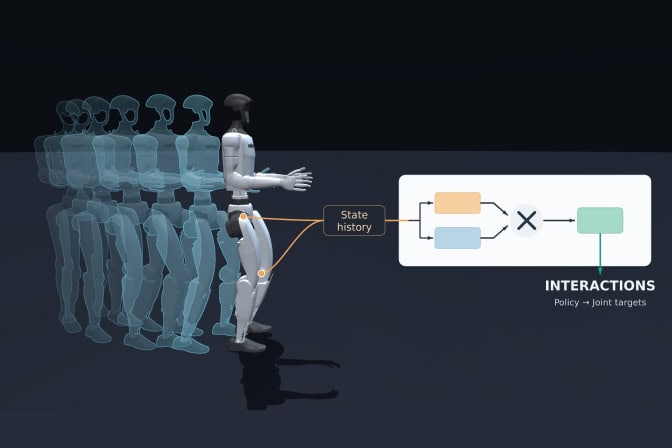
The improvement also appeared when robots encountered conditions outside training ranges. Across six changed-dynamics settings on flat terrain, PRISM survived 92.3% of trials versus 78.3% for a matched standard MLP. On rough terrain, the figures were 87.1% and 80.0%. Friction, mass and payload changes were evaluated without retraining, making generalization a central finding rather than merely a higher benchmark score.
A real robotic arm provides a second test
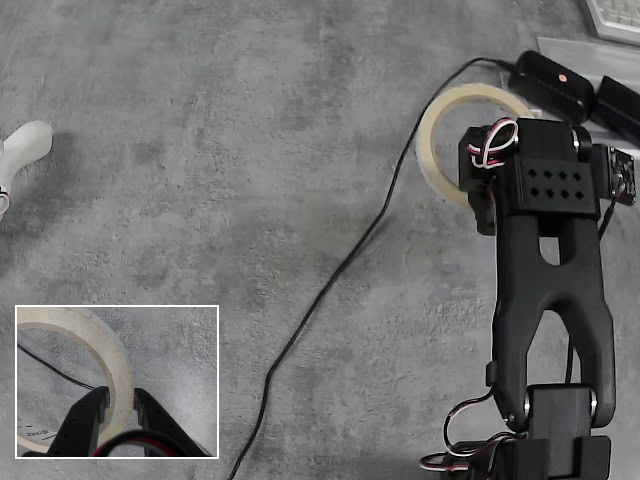
The team also evaluated an actual SO-101 robotic arm tasked with picking up a roll of tape. Under the same demonstration-training conditions, PRISM completed 47 of 50 attempts, or 94%; the conventional method completed 34 of 50, or 68%. Physical testing matters because simulation can miss compliance, contact behavior and imperfections in real actuators. Nevertheless, fifty attempts on one pickup task do not establish production-wide reliability.
In a separate simulated cube-stacking recovery benchmark, PRISM recovered from an induced drop in 52.3% of trials versus 40.9% for the comparison policy. The researchers also observed compliance-like responses without dedicated force sensors, although such responses are not substitutes for validated safety systems in shared workspaces.
What changes for robotics engineering
PRISM adds a potential software-level improvement to the broader robotics stack. BitcoinVersus.Tech has covered NVIDIA’s GR00T 2 robot-learning claims, 400 Hz tactile fingertip sensing, 800 Hz robotic touch electronics, and legged manipulation experiments. Better sensors, more representative data, mechanical design and stronger policy architectures solve different parts of one difficult problem.
The researchers released their project demonstrations and benchmark tables alongside a research manuscript. Independent reproduction across different robots, longer missions, contact materials and safety-critical scenarios remains important. PRISM is a promising research module, not an autonomous controller ready for unrestricted deployment. The lesson is practical: understanding which physical relationships deserve explicit representation may matter more than buying a larger neural network.
Sources: Michigan Engineering release, November 10, 2026; Lee and Yu, PRISM research manuscript; research project, demonstrations and evaluation protocols. Featured photograph and in-article research graphic credited to Yu Laboratory, University of Michigan. Benchmarks reported by the research team; no independent replication claimed.
We volunteer daily to ensure the credibility of the information on this platform is Verifiably True. If you would like to support to help further secure the integrity of our research initiative, please scan the QR code below.


Leave a Reply