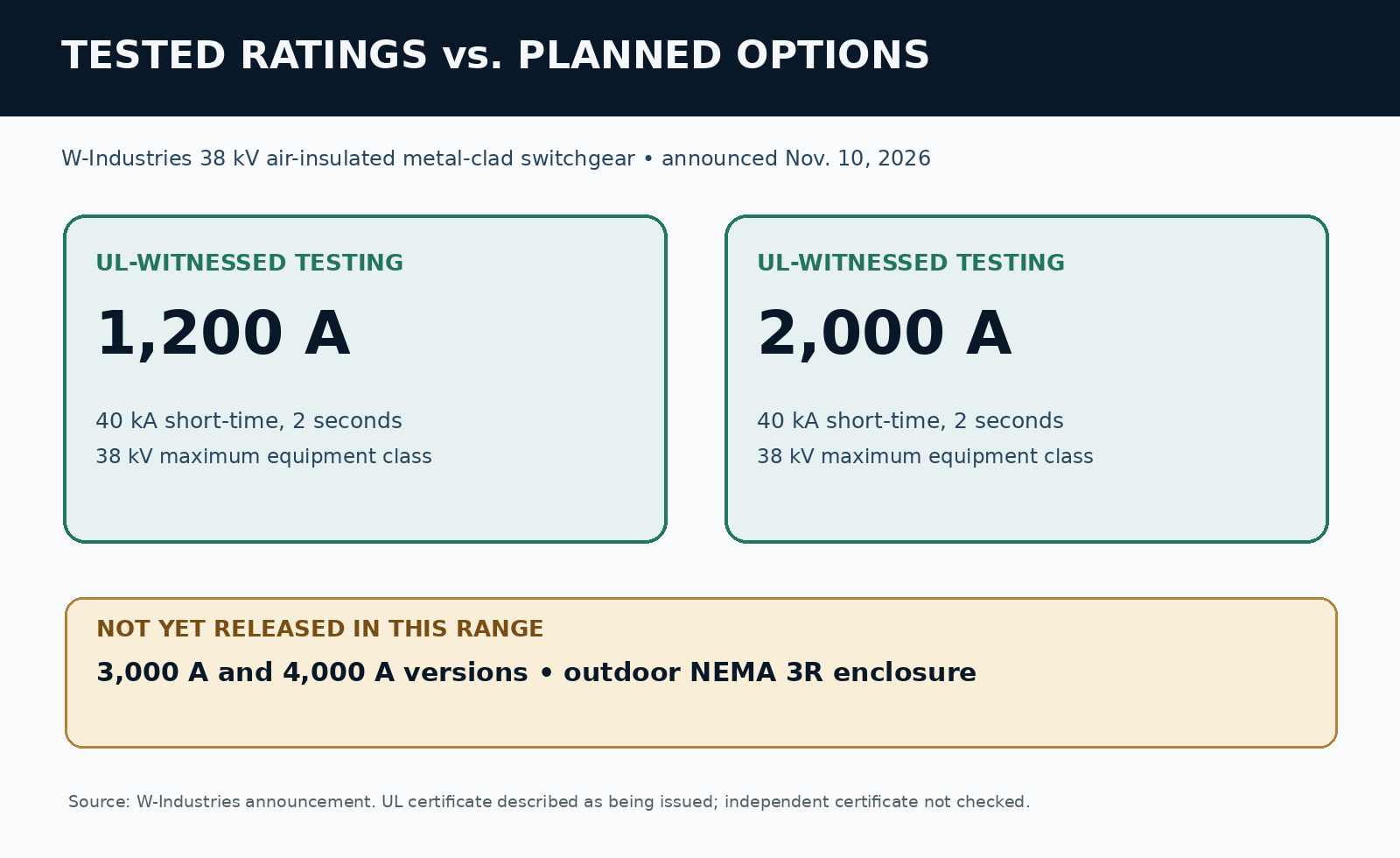
W-Industries has launched a U.S.-engineered 38 kV metal-clad switchgear lineup for data centers, behind-the-meter power plants and utilities. Announced November 10, 2026, the equipment is designed and assembled in Houston, Texas, around ABB ADVAC draw-out circuit breakers. The company reports completed Underwriters Laboratories-witnessed testing for 1,200-ampere and 2,000-ampere configurations, both with a 40-kiloampere short-time withstand rating. Its UL certificate was still being issued when the announcement appeared.
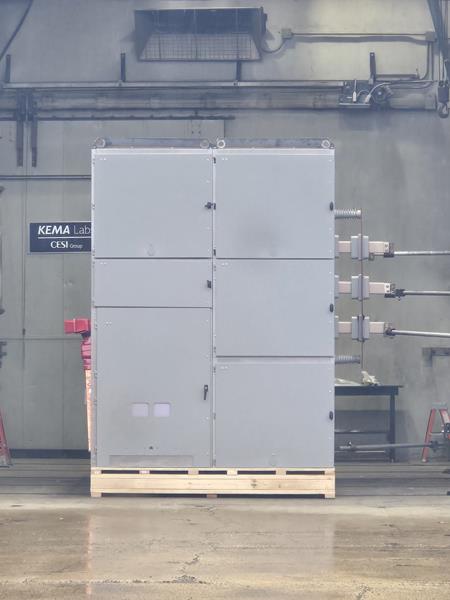
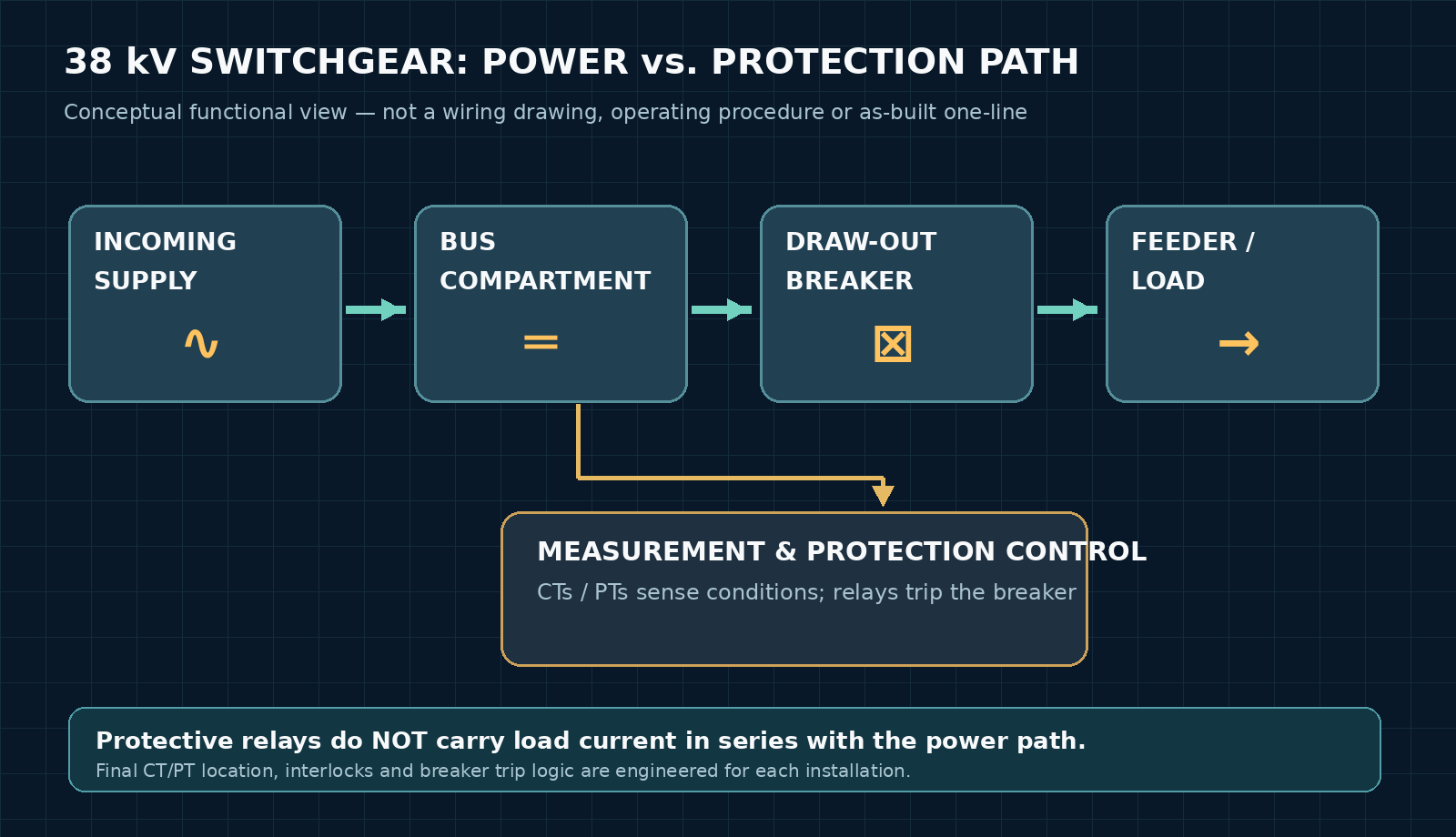
Medium-voltage switchgear connects and protects high-capacity electrical circuits feeding substations, industrial plants and large computing campuses. Metal-clad designs enclose major components in grounded metal compartments, allowing breakers, bus sections, instrument transformers and relays to be organized for maintenance and protection. A 38 kV equipment class is a maximum voltage rating, not proof that a customer operates every feeder at exactly 38 kV.
What the witnessed tests establish
The manufacturer specifies a 40 kA short-time withstand for two seconds, 150 kV basic impulse insulation level and an 80 kV, 60-second power-frequency withstand. W-Industries says tests were witnessed by UL at its facilities and at KEMA Labs in Pennsylvania and the Netherlands, with the dielectric sequence passed without flashover. Testing covered the lineup and newly designed potential-transformer and fuse trucks.
A withstand rating describes what a specified assembly can endure under defined fault conditions; it must not be automatically equated with the breaker’s independently verified short-circuit interrupting rating. Engineers must check both ratings, system available fault current, relay settings and the applicable standards. BitcoinVersus.Tech previously explained protection coordination and trip curves and power-quality measurements.
Why 38 kV equipment matters for AI campuses
The company says demand for 16–75 kV switchgear in the United States increased 95% from 2019 to 2025, citing Wood Mackenzie; the underlying forecast and demand model were not independently audited for the article. New data-center campuses and private generation systems require high-current distribution equipment as well as transformers, protection systems and utility connections. Switchgear lead times can constrain the energization schedule even after buildings and servers are ready.
The new assembly uses ABB ADVAC 38 kV draw-out breakers and can integrate customer-selected protection relays. Its design includes hard-bussed potential-transformer connections, automatic discharge during rack-out and insulated bus bars intended to resist electrical tracking. Remote monitoring and IEC 61850 support are integration services rather than evidence that every installation has identical digital controls.
What is available—and what is still planned
W-Industries describes the 1,200 A and 2,000 A products as available, with 3,000 A and 4,000 A versions and an outdoor NEMA 3R enclosure still under development. It has not published independent lead-time statistics, list prices, delivered customer quantities or a dated UL certificate number in the release. Availability therefore does not establish completed field installations or unrestricted configurations.
Electrical engineers should request final listing documentation, type-test scope, detailed one-lines, arc-flash studies and coordination settings before specifying the lineup. Earlier BitcoinVersus.Tech reporting on electrical drawings, large substation development and grid connection requirements for computational loads provides relevant context.
Bottom line: The November release adds a tested U.S.-built option for a bottleneck in medium-voltage power distribution. The claimed ability to shorten project schedules still needs customer-specific evidence, while the certificate and higher-current variants require continued status checks.
Primary sources: W-Industries official November 10 product announcement; manufacturer power-equipment portfolio and specification resources; original corporate press release and KEMA test photograph; Data Center Intelligence reporting, November 11. Ratings, testing, delivery aims and market-demand estimates are manufacturer statements rather than independently replicated results.
Editor’s Note: The announced 38 kV metal-clad switchgear passed manufacturer-reported UL-witnessed testing to IEEE C37.20.2-2025 at 1,200 A and 2,000 A. The release says a UL certificate was being issued; an issued certificate number or installation acceptance was not independently verified. The 40 kA two-second withstand rating is not presented as a separately established breaker interrupting rating. The 3,000 A, 4,000 A and outdoor NEMA 3R configurations remain in development. The original 1200 × 630 oil-painted cover features one editorial title and the required watermark; it is conceptual, not a product photograph. The KEMA Labs photograph is authentic corporate media, while the technical graphics are original illustrations. No relevant, verified official YouTube or social video player was established. Live mobile layout and playback have not been independently tested.

BitcoinVersus.Tech is volunteer-run and publishes independent educational technology reporting. An optional 5,000-satoshi donation supports ongoing research. Scan the original QR from a second screen with a compatible Bitcoin wallet; on mobile, use a wallet that supports scanning a saved image. Independently verify the recipient address 3C9o19EH5HSiwEPyCTmEKzxhNCbo2X6TTb and the payment amount before sending. Bitcoin transfers are generally irreversible.
We volunteer daily to ensure information on the BitcoinVersus.Tech platform is Verifiably True. Coverage is educational and informational and does not constitute financial or investment advice.


Leave a Reply