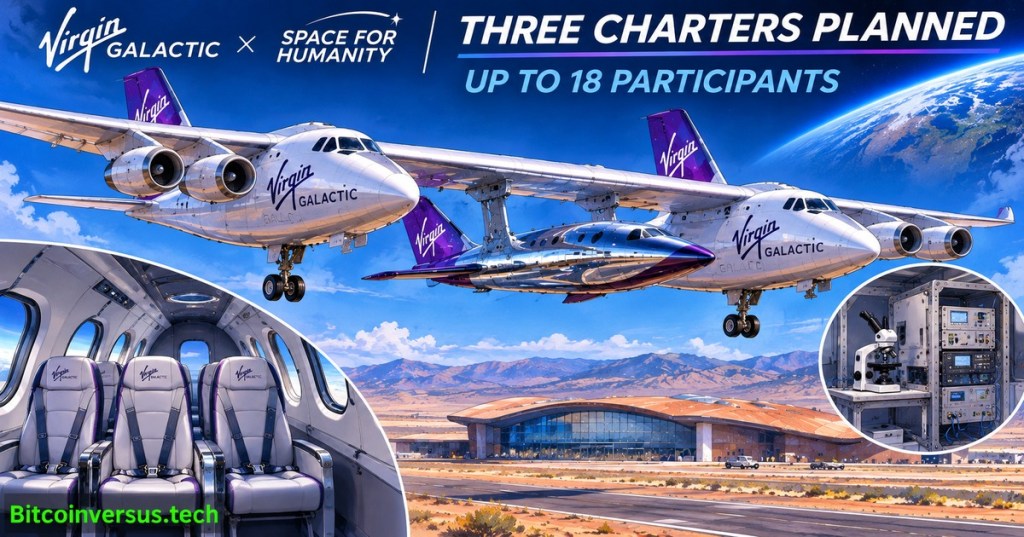
Virgin Galactic announced a three-year agreement with nonprofit Space for Humanity on November 5, 2026, covering three planned dedicated suborbital charter flights. Each Delta-class spaceship cabin is designed for six seats, creating a maximum of 18 participants across the arrangement. The actual number could be lower: the nonprofit may replace seats with research racks. Neither organization disclosed charter prices, passenger names or mission dates, and no flight under the new agreement has yet taken place.
One agreement, two mission types
Space for Humanity plans to recruit educators, artists, scientists and community leaders through its Citizen Astronaut Program. It also launched Space for Humanity Labs, intended to create opportunities for microgravity research. The nonprofit will manage the international application and selection process and specialized preparation; Virgin Galactic is responsible for spaceflight readiness training at Spaceport America, New Mexico.
The payload option creates an important tradeoff. A specialized rack occupies cabin space otherwise available to a passenger. Consequently, three charters do not guarantee 18 astronaut seats will be used. The companies describe intended research opportunities but have not specified experiment manifests, hardware interfaces, budgets or how much usable microgravity time individual projects will receive. Earlier reporting on space-medicine researcher Shawna Pandya provides background on scientific questions motivating human-suborbital experiments.
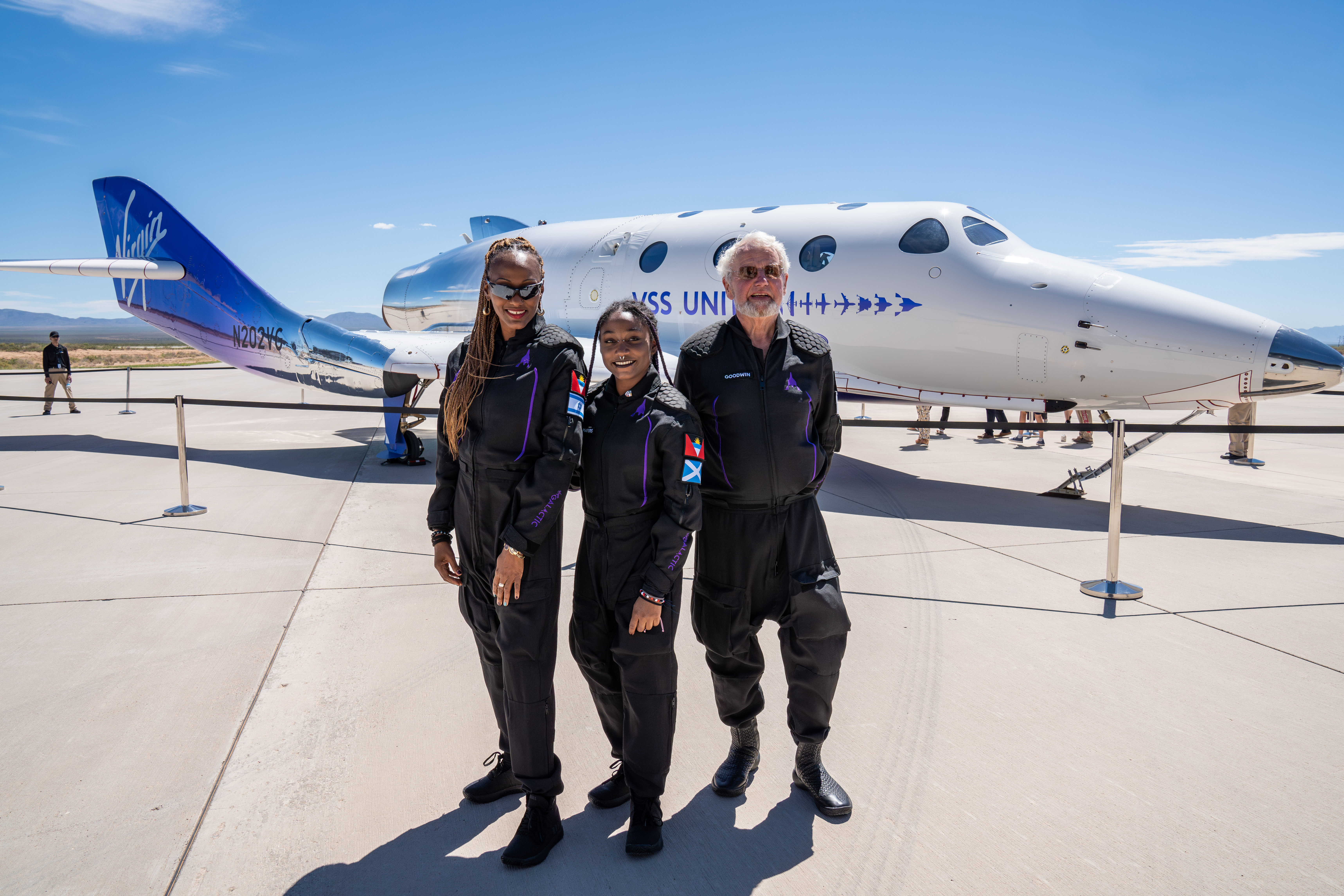
Official Virgin Galactic video, July 17, 2023: “Meet the Galactic 02 Crew.” The historical crew included Keisha Schahaff and Anastatia Mayers, whose seats came through a fundraising draw benefiting Space for Humanity. Background on the organizations’ earlier connection, not footage of a 2026 charter.
A previous Space for Humanity connection already flew
The organizations are not starting from zero. In August 2023, Virgin Galactic carried Keisha Schahaff and her daughter Anastatia Mayers aboard the Galactic 02 mission. Schahaff took part in Space for Humanity’s Citizen Astronaut training, and both passengers secured seats through a fundraising draw benefiting the nonprofit. Their completed journey was an individual mission, not one of the newly announced charter flights.
Virgin Galactic says it has previously carried research experiments on seven suborbital flights, including autonomous and crew-assisted payloads. Yet opportunities to conduct experiments are not equivalent to demonstrated research outcomes. Investigators would need documented experimental protocols, suitable controls and published results before claiming scientific breakthroughs from future missions.
The spacecraft and financing deadlines
Space for Humanity’s agreement depends on Virgin Galactic completing its restart. The company’s first Delta-class spaceplane, Apeiron, reached its New Mexico base in October. An independent glide flight is targeted for January 2027, followed by initial commercial service in early Q2. BitcoinVersus.Tech’s Apeiron report details the difference between the completed captive-carry delivery and uncompleted flight tests.
Virgin Galactic’s official August 11, 2023 Galactic 02 recap. Authentic footage of an earlier suborbital passenger flight, offered solely as historical context—not evidence that the newly contracted charters have launched.
Virgin Galactic’s most recent quarterly report recorded $184 million in cash and marketable securities against $99 million of quarterly free-cash-flow outflow. Delivery of the proposed charter missions therefore depends on testing, flight readiness and sufficient financing. Unlike orbital Starship development, the planned missions use an air-launched suborbital spaceplane; rocket-staging fundamentals help illustrate the different operating architecture.
The collaboration establishes a potential nonprofit charter customer and a pathway for research payloads, rather than evidence of imminent flights or broad affordability. Its success will be measured by named participants, published schedules, completed Delta-class certification, executed missions and substantive research results.
Sources checked November 15, 2026: Virgin Galactic November 5 partnership announcement; Space for Humanity October 26 primary announcement; Virgin Galactic November 12 earnings update; Space for Humanity’s 2023 record of Schahaff’s training. Numbers describing future missions are company plans, not observed commercial results.
Editor’s Note: The confirmed event is a charter agreement, not three completed missions. The potential 18-participant count assumes every available seat is used, while planned research racks can reduce passenger capacity. No identities, flight dates, financial terms or completed outcomes are verified. The original 1200 × 630 anime-style cover with a neon-green Bitcoinversus.tech watermark is a conceptual editorial illustration, not real footage, a cabin blueprint or a photo of actual charter crews. The 2026 partnership graphic originates with Virgin Galactic, while the 2023 crew photograph and two official Virgin Galactic videos are explicitly archival. Saved Gutenberg markup and server-rendered players can be inspected, but actual playback and device-specific mobile layouts require separate browser testing.

BitcoinVersus.Tech is a volunteer-run publication. A voluntary 5,000-satoshi contribution helps support independent technology journalism. Scan the QR with a compatible Bitcoin wallet using another screen; if reading on the same phone, use the wallet’s import-from-image feature when available. Verify recipient 3C9o19EH5HSiwEPyCTmEKzxhNCbo2X6TTb and transaction amount before submitting. Bitcoin transfers are generally irreversible.
We volunteer daily to ensure information on BitcoinVersus.Tech is Verifiably True. Content is informational and educational, not a promise of flight safety, an endorsement, or personalized financial guidance. Reader donations are entirely optional.


Leave a Reply