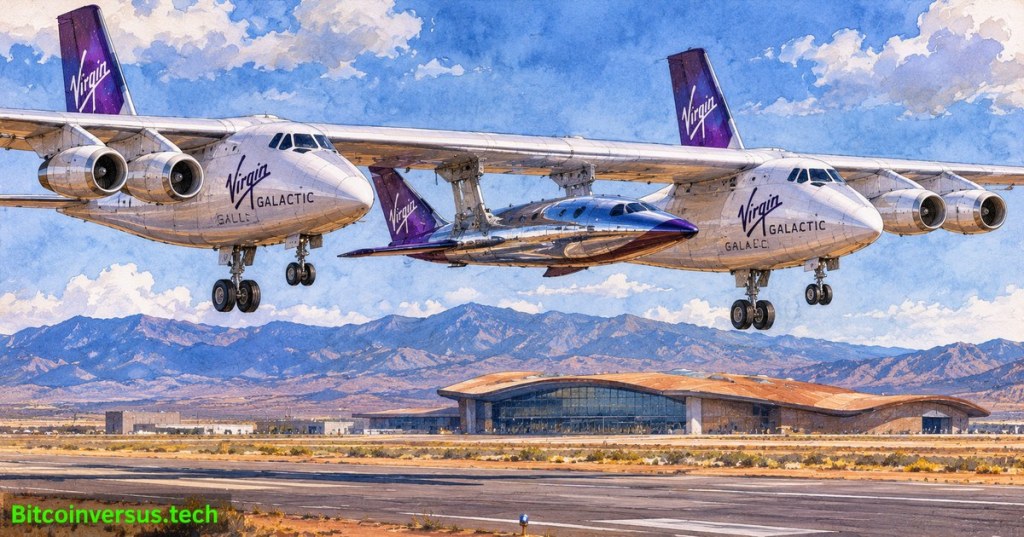
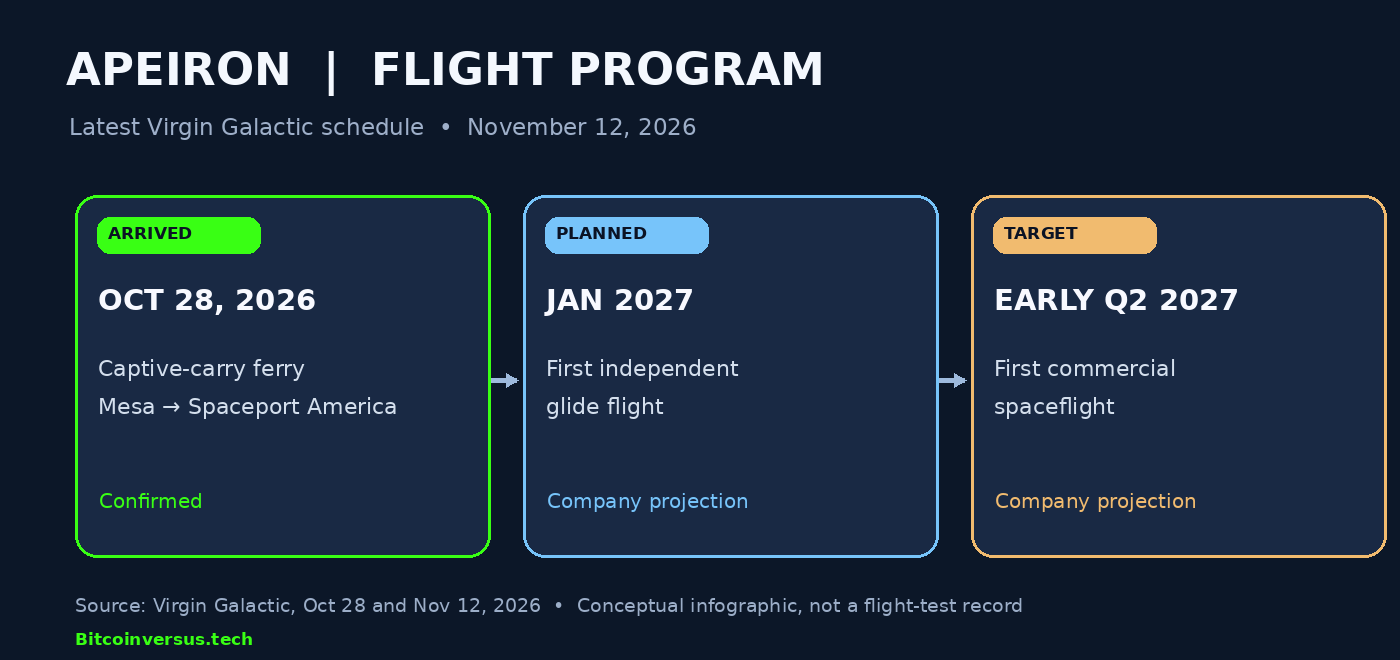
Virgin Galactic’s first next-generation Delta-class spaceship, Apeiron, reached Spaceport America in New Mexico on October 28, 2026, marking a concrete milestone in the company’s attempt to restart commercial space tourism. On November 12, the company said Apeiron’s first independent glide flight is expected in January 2027, followed by an initial commercial spaceflight targeted for early in the second quarter. The new vehicle has arrived; it has not yet independently flown or carried paying customers.
Virgin Galactic, October 28, 2026: “Meet Spaceship Apeiron,” the company’s official naming and spacecraft reveal video. Footage provides an authentic look at the new Delta-class spacecraft; the naming reveal is separate from a powered spaceflight.
A first flight carried beneath VMS Eve
The October 28 trip was a captive-carry ferry flight: the twin-fuselage carrier aircraft VMS Eve transported Apeiron from Phoenix-Mesa Gateway Airport in Arizona to its permanent New Mexico operating base. Virgin Galactic reported departure at 10:29 a.m. Mountain Standard Time and arrival at 12:59 p.m. Mountain Daylight Time. Michael Masucci and Dan Alix piloted Eve, with flight-test engineer Tori Crichton aboard. Calling the transport a free glide or a spaceflight would misstate the engineering milestone.
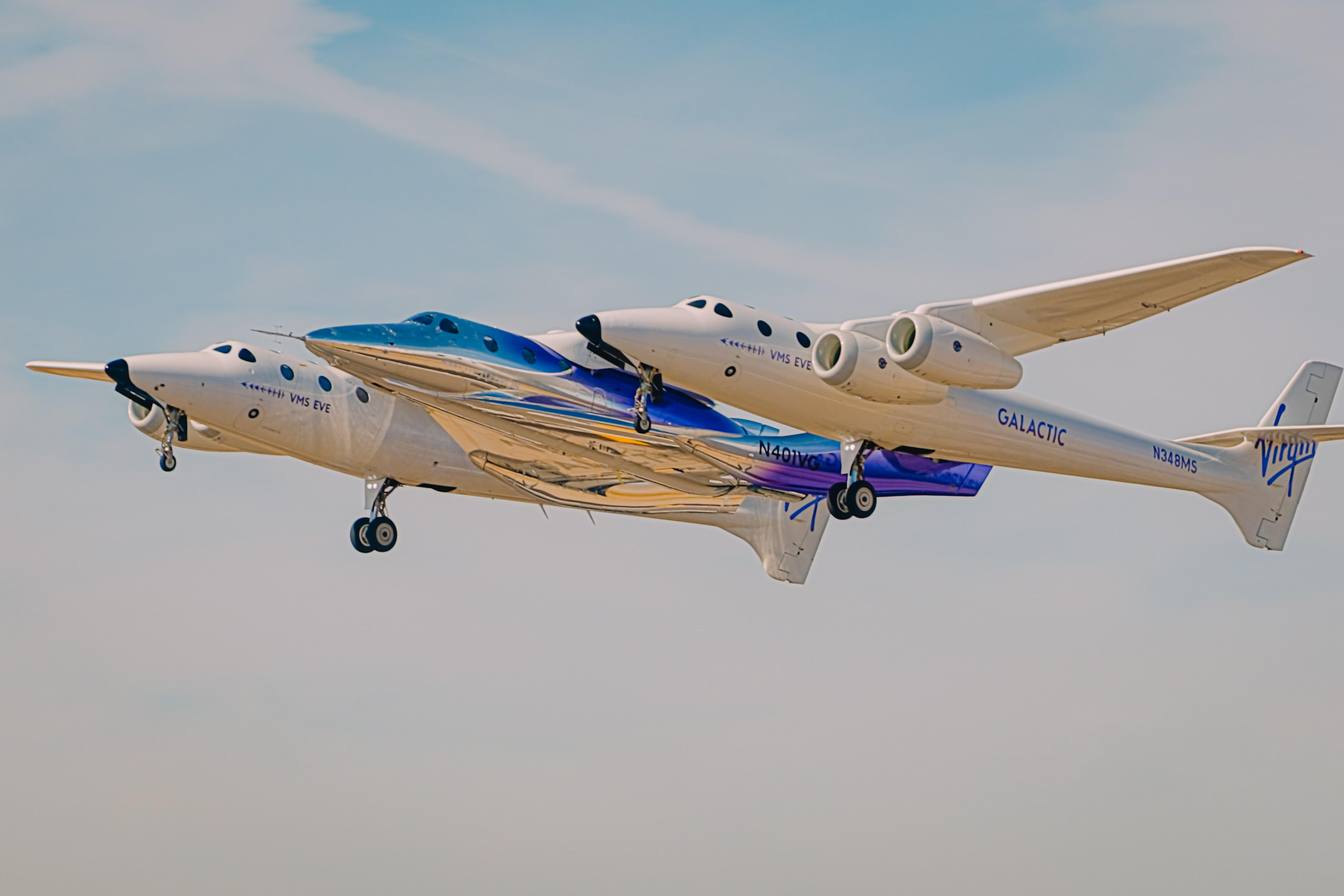
The spacecraft was named after a public vote involving participants from 83 countries. The Greek name means “boundless.” More consequentially, the delivery moves the program from assembly toward operational readiness: the team must finish avionics software integration and validation before proceeding through flight tests. A November 12 company update puts the first glide in January, following additional captive-carry functional checks.
How the Delta-class flight sequence works
For a customer mission, Eve will lift Apeiron to high altitude before releasing it. The spaceplane must then ignite its own rocket motor, climb along a suborbital trajectory, return through the atmosphere and land on a runway. The vehicle is not an orbital spacecraft. Unlike rockets carrying satellites to orbit, such as SpaceX’s recently tested Starship, Apeiron targets short flights beyond the dense atmosphere and a return to the departure spaceport.
Virgin Galactic, October 29, 2026: “We Build Spaceships: Spaceship Apeiron’s first day in the sky.” Official footage follows the aircraft’s departure from Mesa and arrival in New Mexico, rather than showing an unpowered glide or rocket-powered flight.
Virgin Galactic says Delta-class spacecraft are designed for two flights per week and more than 500 missions per vehicle. Those are design targets, not demonstrated turnaround times or proven service lives. Engineers must still validate flight controls, software, propulsion, structural margins, release procedures and recovery under the flight-test program. The company expects a second spaceship to enter commercial operations in late Q2 or early Q3 2027.
A return requires more than a completed airframe
Virgin Galactic paused commercial passenger flights after Galactic 07 in June 2024 while preparing a faster-turnaround fleet. Delta-class operations may support more frequent research missions, including those involving space-medicine researcher Shawna Pandya, but flight schedules and individual mission assignments remain subject to vehicle readiness.
Financing is a substantial constraint. Virgin Galactic ended September with $184 million in cash, cash equivalents and marketable securities, while third-quarter free cash flow was negative $99 million. The company also opened a limited new booking tranche at $850,000 per seat. Commercial reservations and announced capacity are not the same as completed revenue flights. Broader commercial-space infrastructure plans face related certification and funding tests, although orbital stations and suborbital tourism involve different mission profiles.
Virgin Galactic plans to increase annual flight capacity to 150 through new hangar and fueling infrastructure by the end of 2028. The roadmap is ambitious, but its decisive milestones remain the January glide, subsequent powered trials, safe passenger operations and repeatable turnaround. Rocket-flight engineering fundamentals help explain why a completed airframe and a validated operating system are very different achievements.
Primary reporting: Virgin Galactic’s October 28 delivery release; November 12 earnings and schedule update; SEC exhibit of the company’s quarterly announcement; Virgin Galactic official YouTube uploads dated October 28 and 29. Company projections and design specifications remain unverified in commercial service as of November 15, 2026.
Editor’s Note: The October 28 captive-carry flight is a confirmed ferry movement, not Apeiron’s independent maiden glide or first rocket-powered mission. January and second-quarter 2027 dates are Virgin Galactic targets subject to software validation, flight testing, safety and financing. The original 1200 × 630 watercolor-and-ink featured cover is an illustrative interpretation of the spacecraft and VMS Eve, not documentary photography. The in-story photo is an authentic, credited manufacturer image; both video embeds identify official Virgin Galactic uploads. The original timeline distinguishes completed and projected milestones. Actual playback and layout on individual mobile devices require independent browser testing.

BitcoinVersus.Tech is volunteer-run. An optional donation of 5,000 satoshis supports independent technology reporting. Scan the original QR code using a compatible Bitcoin wallet from a second screen; when using the same phone, try your wallet’s import-from-image feature, if supported. Verify recipient 3C9o19EH5HSiwEPyCTmEKzxhNCbo2X6TTb and the amount before transferring. Bitcoin payments are generally irreversible.
We volunteer daily to ensure the information on BitcoinVersus.Tech is Verifiably True. Reporting is for informational purposes and is not an endorsement of Virgin Galactic, a spaceflight safety guarantee or personalized investment advice. Reader contributions are voluntary.


Leave a Reply