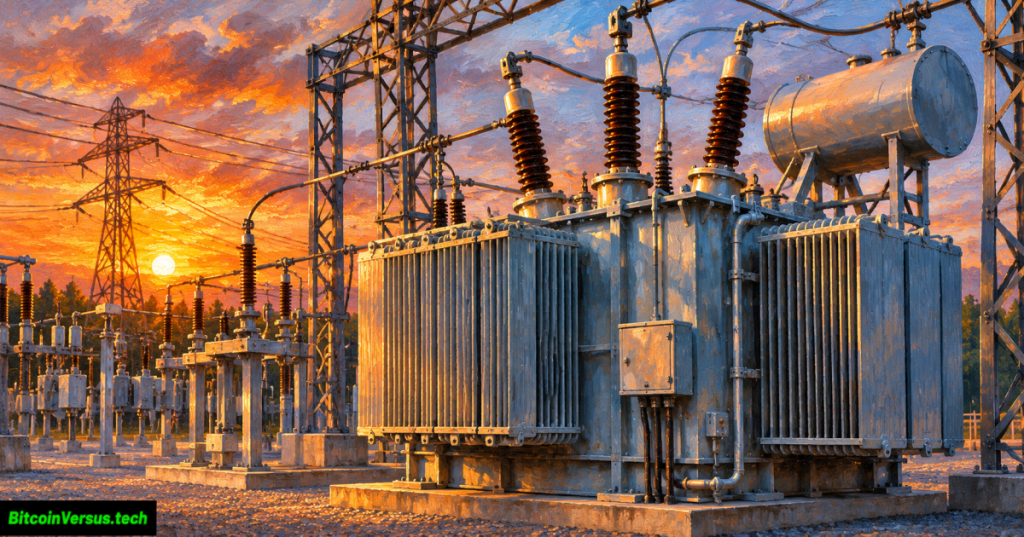
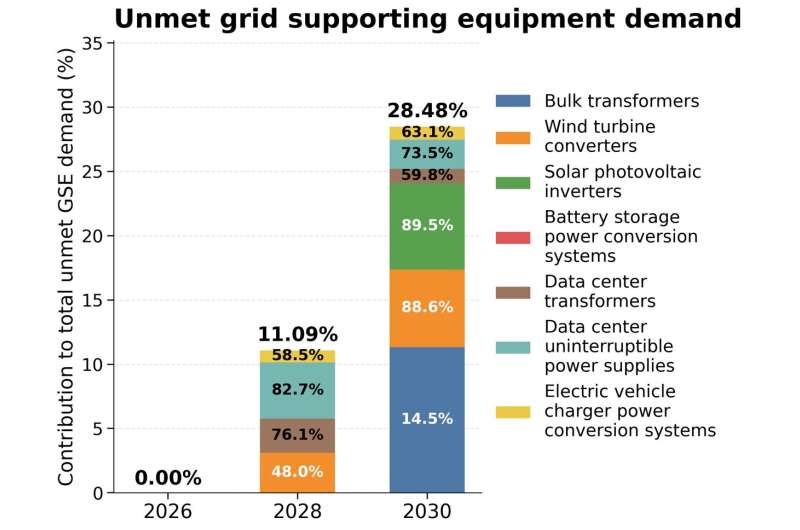
A new supply-chain model from Johns Hopkins University suggests that American electricity infrastructure could face a shortage of essential equipment even when funding and generation resources are available. The research, published November 17, 2026, in Cell Reports Sustainability, examines the materials and manufacturing constraints facing transformers, converters and other equipment required to expand the grid. Under a high-demand scenario, the researchers project a 14.5% shortfall in bulk transformer demand by 2030.
Why transformers determine when power becomes available
An electrical transformer transfers energy between circuits through electromagnetic induction. In a transmission network, increasing voltage allows a given amount of power to move at lower current, reducing resistive losses. Substations subsequently reduce voltage to levels appropriate for distribution and customer equipment. A new generating facility or computing campus therefore requires more than a sufficient power source. It must also obtain equipment rated for the electrical conditions at its connection point.
Manufacturing a large transformer involves wound conductors, a magnetic core, electrical insulation, cooling equipment and high-voltage terminals. Its design must account for voltage ratio, apparent power, thermal limits, insulation coordination and fault conditions. A unit designed for one application cannot necessarily substitute for another, even if their nominal power ratings match. Engineering approvals, factory tests and transportation further complicate procurement. Related infrastructure examples include Britain’s 400 kV battery-factory substation and Cambridge’s underground substation.
Reading the modeled shortages
The university’s research announcement reports a modeled total equipment gap of 11.09% in 2028 and 28.48% in 2030 in the high-growth case. Bulk transformers are only one category. The accompanying figure identifies a considerably larger percentage shortfall for dedicated data-center transformers, at 59.8% in 2030. Those percentages use different equipment-specific denominators and cannot simply be added. A modeled deficit also does not establish how many individual projects will be delayed.
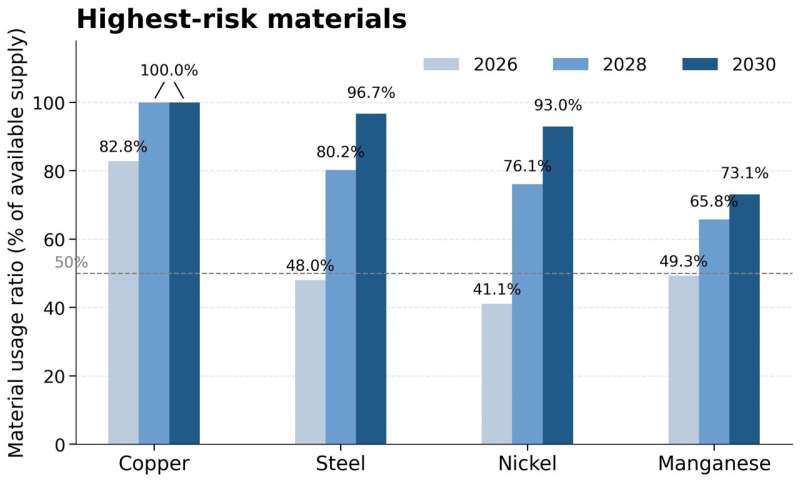
The materials analysis shows copper reaching its modeled supply limit by 2028, while steel and nickel approach 97% and 93% of available supply, respectively, in 2030. Transformer Magazine’s November 26 coverage notes that weaker demand would alleviate transformer constraints, whereas trade disruptions could worsen them. The forecasts are conditional on the model’s assumptions, rather than measurements of future availability.
Reducing pressure on the equipment supply chain
Utilities have several potential responses. Temperature monitoring and load-dependent ratings can help determine whether existing equipment has additional usable capacity. Standardized specifications could reduce dependence on bespoke units, while refurbishment and recycling may recover valuable materials. None of those measures eliminates the need for new manufacturing capacity, and equipment must remain within applicable electrical and thermal limits. Similar utilization questions arise in dynamic transmission line ratings and advanced conductor upgrades in Ohio.
For infrastructure developers, procurement schedules deserve the same scrutiny as generation capacity and construction budgets. A campus can finish its buildings before its electrical connection is ready. The most informative indicators over the next several years will be actual transformer order backlogs, factory expansions, material availability and commissioning dates. Those observations will show whether the modeled supply constraints materialize or whether industry investment changes the trajectory.
Featured cover: conceptual oil-painted editorial illustration.
We volunteer daily to ensure the credibility of the information on this platform is Verifiably True. If you would like to support to help further secure the integrity of our research initiative, please scan the QR code below.

BitcoinVersus.tech is not a financial advisor. This media platform reports on financial subjects purely for informational purposes.


Leave a Reply