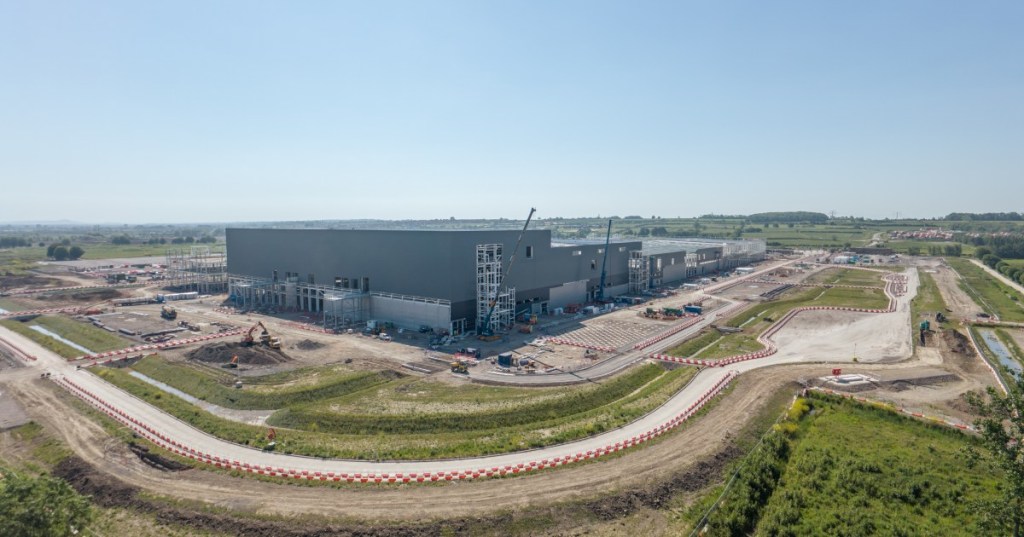
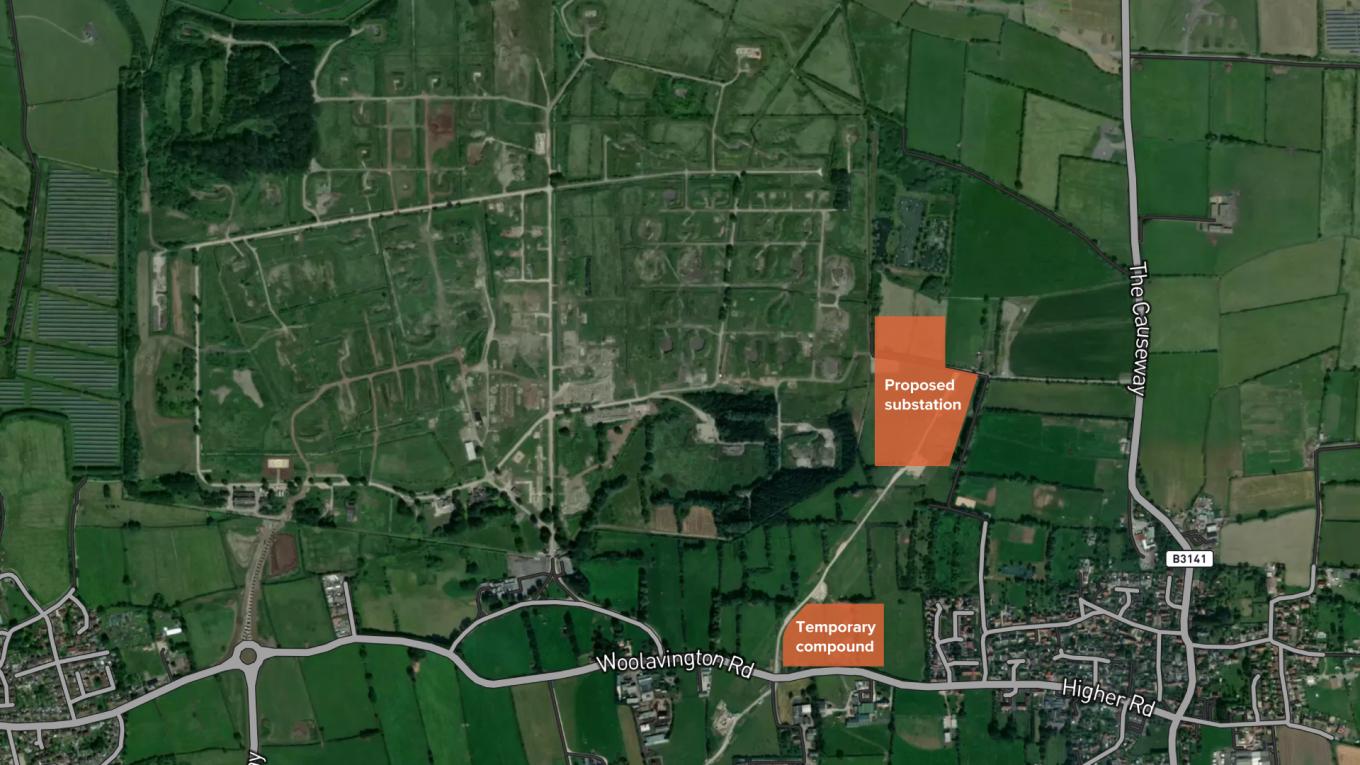
National Grid announced on November 18, 2026, that main construction had started on a new high-voltage substation at Woolavington in Somerset, England. The 400/132 kV installation will connect the Gravity Smart Campus, including Agratas’s electric vehicle battery factory, to Britain’s transmission network. The grid connection is a major infrastructure milestone, although neither the completed substation nor full factory production has been established. National Grid’s announcement identifies three supergrid transformers scheduled for delivery in early 2027.
National Grid’s project video explains the industrial connection. The video is linked rather than embedded because playback could not be independently tested.
Why a battery factory needs transmission infrastructure
Battery manufacturing requires electrical energy for mixing and coating electrode materials, drying, environmental control, formation cycling and other production processes. Building the factory does not automatically create the grid capacity needed to operate it. National Grid installed two temporary 33 kV connections to support construction before the permanent transmission connection becomes available.
At equal power factor and transferred power, three-phase current is inversely proportional to line-to-line voltage. As an illustrative comparison, transferring 100 MW at unity power factor requires about 1,750 A at 33 kV, versus 144 A at 400 kV. The relationship follows P = √3 × V × I × power factor. Neither value represents the actual factory demand or equipment rating. Higher voltage reduces current for the same power transfer, enabling efficient bulk delivery while increasing insulation and clearance requirements.
Transformers then reduce voltage for downstream distribution, while circuit breakers, protection relays and switchgear isolate faults. The official project page specifies 400/132 kV. Transformer MVA ratings, actual factory demand and redundancy arrangements are not established by the November announcement. Compare our coverage of Cambridge’s underground substation and compact 145 kV switchgear.
40 GWh of batteries is not a 40 GWh grid battery
The manufacturer’s plan targets annual cell production equivalent to 40 GWh of rated battery capacity at full buildout. Assuming 80 kWh per vehicle battery pack and ignoring manufacturing yield losses, that corresponds to approximately 500,000 packs per year. It is a manufacturing output target, not the amount of grid electricity consumed or stored on site. By contrast, Massachusetts’s Energizar project is designed to store and discharge electricity directly.
A grid milestone with industrial execution risk
National Grid projects approximately 4,600 direct factory jobs and more than £700 million in annual regional economic value once fully operational. Those estimates depend on successful industrial commissioning. On November 23, The Guardian reported the departure of a second major factory contractor in five months; Agratas maintained that its customer requirements remained on track.
Woolavington belongs to a wider grid investment programme. The utility also plans a £530,000 community fund. As with New York’s underground transmission expansion, the critical milestones are equipment installation, testing and energization. The ultimate industrial benefit will depend on both the electrical connection and the factory’s ability to ramp production.
Featured photograph: Agratas aerial view of the Somerset battery factory under construction, May 20, 2026. The photograph shows the industrial facility served by the substation, not a completed substation.
We volunteer daily to ensure the credibility of the information on this platform is Verifiably True. If you would like to support to help further secure the integrity of our research initiative, please scan the QR code below.


Leave a Reply