
Research synthesis and extension of Matthan Burton’s Power Efficiency Theory, developed through BitcoinVersus.Tech from 2023 to 2026.
Bitcoin provides a measurable technological environment in which biological power projection, efficiency projection and economic valuation can potentially be studied within a unified mathematical framework. The objective is to establish a relationship between physical technological progression and anticipated economic value, while accounting for the inevitable but unpredictable disruptions that occur along the way.
Jason P. Lowery’s 2023 MIT thesis, Softwar: A Novel Theory on Power Projection and the National Strategic Significance of Bitcoin, examines biological competition and the projection of physical power to secure resources and establish control. Power Efficiency Theory is intended to extend and further substantiate the biological power projection thesis through technological efficiency. Competitive organisms and technological systems have incentives not only to project more power, but also to become increasingly efficient at projecting that power.
The complete theoretical relationship
Lowery establishes the conceptual foundation. Burton’s research proposes a measurable extension to that foundation, with an experimental mathematical method for evaluating the technological system’s progression.
| Concept | Role in the proposed framework |
|---|---|
| Biological competition | The evolutionary incentive to compete for resources and improve survival. |
| Power projection | Lowery’s thesis concerning the projection of physical power. |
| Efficiency projection | Competition incentivizes obtaining greater output from available energy and resources. |
| Measurable technological progression | Bitcoin provides quantifiable hashrate, energy efficiency and hardware performance metrics. |
| Power Efficiency Theory | Mathematically modeling technological progression, its constraints and its potential economic value. |
| Power Efficiency Index (PEI) | Comparing model-implied economic value with observed market prices. |
Biological competition supplies a conceptual starting point, not a claim that every organism competes in the same way or that humans are genetically programmed to adopt Bitcoin. Cooperation also contributes to survival and technological development. Bitcoin’s proof-of-work mechanism creates an engineered competitive environment in which miners have explicit economic incentives to improve their resource utilization. The hypothesis is that efficiency projection is an extension of power projection, not a competing theory.
Hashrate measures computational output per second, while electrical power measures joules consumed per second. Efficiency measured in J/TH describes energy required to perform a terahash. A miner can project more computational work at the same electrical power by improving its efficiency. Greater efficiency can therefore amplify the practical computational capacity of physical power, without necessarily increasing electricity consumption proportionally.
The chronology of the original research
The earlier BitcoinVersus.Tech publications establish the intellectual foundation for the argument. The original purpose of the research was to predict technological progression. Predicting Bitcoin’s monetary value was a subsequent discovery arising from that research, as explicitly stated in the March 15, 2026 article.
| Original publication | Contribution to the thesis |
|---|---|
| Power Is Money — December 2023 | Economic physics and the relationship between energy and money. |
| The Bitcoin Mining Singularity — May 2025 | Predicting measurable hardware efficiency milestones. |
| Thermoeconomic Capitulation — June 2025 | Accelerating innovation versus diminishing efficiency returns. |
| Landauer’s Principle — July 2025 | Fundamental thermodynamic constraints. |
| Upgrading the Power Efficiency Equation — January 2026 | Predicting value while accounting for unpredictable external events. |
| Designing a Realistic Equation — February 2026 | Conservative valuation and the problem of anticipating disruptions of unknown timing. |
| Designing a Realistic Equation, Part 2 — March 2026 | Introducing the mathematical contraction-decay variable. |
| Clarifying the Methodology — March 2026 | Establishing individual ASIC machines as precise, testable measurement points. |
| Designing a Realistic Equation, Part 3 — March 2026 | Connecting hardware progression to anticipated Bitcoin valuation. |
| Power Efficiency Index Explained — September 2026 | Establishing a practical comparative valuation index. |
The original questions concerned when ASIC mining machines would reach specific hashrate and efficiency milestones, such as 1 PH/s, 10 PH/s and 1 J/TH. Those questions involve measurable engineering variables rather than purely speculative economic assumptions. The subsequent insight was that the progression of physical properties might also provide meaningful valuation reference points for the entire proof-of-work system.
The empirical evidence for efficiency projection
The hardware progression is consistent with the efficiency projection hypothesis. Participants are not merely competing to acquire more energy. They are competing to accomplish more computational work with each unit of energy they acquire. That creates an observable engineering dimension to the biological power projection thesis.
| Year | Selected machine benchmark (J/TH) |
|---|---|
| 2016 | 100 |
| 2017 | 90 |
| 2018 | 57 |
| 2020 | 30 |
| 2022 | 28 |
| 2024 | 15 |
| 2025 | 9.7 |
| 2026 | 8.9 |
Using the rounded 100 J/TH and 8.9 J/TH endpoints, the energy requirement per terahash declined by 91.1%, while computational output per joule increased approximately 11.24-fold. These are selected historical hardware benchmarks and manufacturer ratings from the original Singularity research and subsequent updates, not measured fleet averages. The November 5 ASIC comparison uses a more precise 2016 endpoint and reports approximately 11-fold improvement. The BITMAIN S23 XP Hyd. specification lists 600 TH/s at 5,340 W, equivalent to 8.9 J/TH.
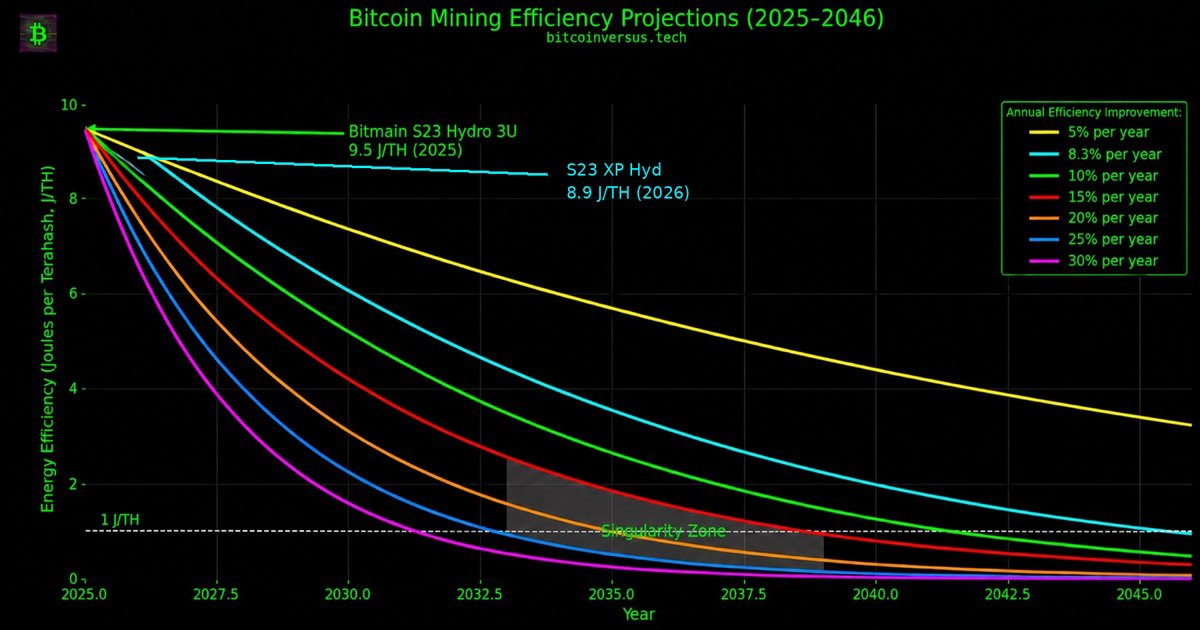
The 1 J/TH milestone is a proposed engineering threshold, not a universal thermodynamic limit. The October 2026 8.3% scenario illustrates why slowing improvement rates matter; later research distinguishes simulated chip efficiency from complete mining machines and places the fixed 8.3% scenario’s annual-step crossing near 2052. Milestone dates remain conditional on technological progress.
The original Power Efficiency Equation
The March 2026 publications established the following experimental valuation equation:
V(t) = V0 [(1 + p)/(1 − e)]x [1 − L0(1 − d)x]
| Variable | Definition |
|---|---|
| V0 | Starting or unadjusted baseline valuation. |
| p | Computational power growth rate. |
| e | Energy efficiency improvement rate, expressed as a fractional annual reduction in J/TH. |
| x | Elapsed time in years. |
| L0 | Initial contraction factor. |
| d | Contraction decay rate. |
The first component, [(1 + p)/(1 − e)]x, represents technological progression. The second component, 1 − L0(1 − d)x, represents the anticipated interference with economic value realization. The second component is particularly important because it recognizes that technological development and economic valuation do not necessarily progress at the same speed.
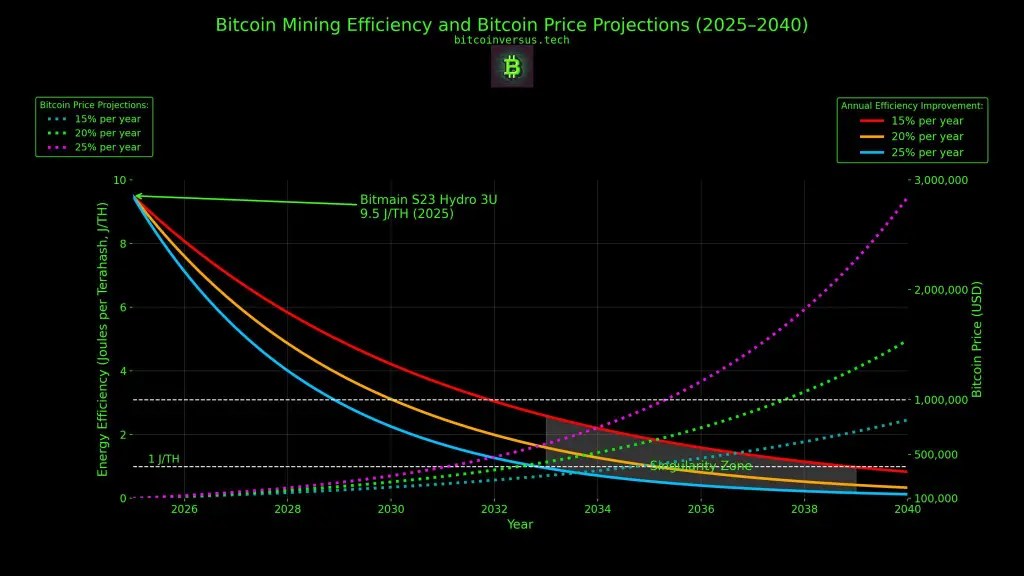
The original January equation introduced a market-recognition delay; the February research explicitly considered the lowest valuation point within a four-year lag. The March version incorporated a decaying contraction factor. Rather than predict when a recession, liquidity crisis, natural disaster or technological setback will happen, the framework attempts to anticipate the existence of such disturbances. The timing and magnitude of future shocks are unknown.
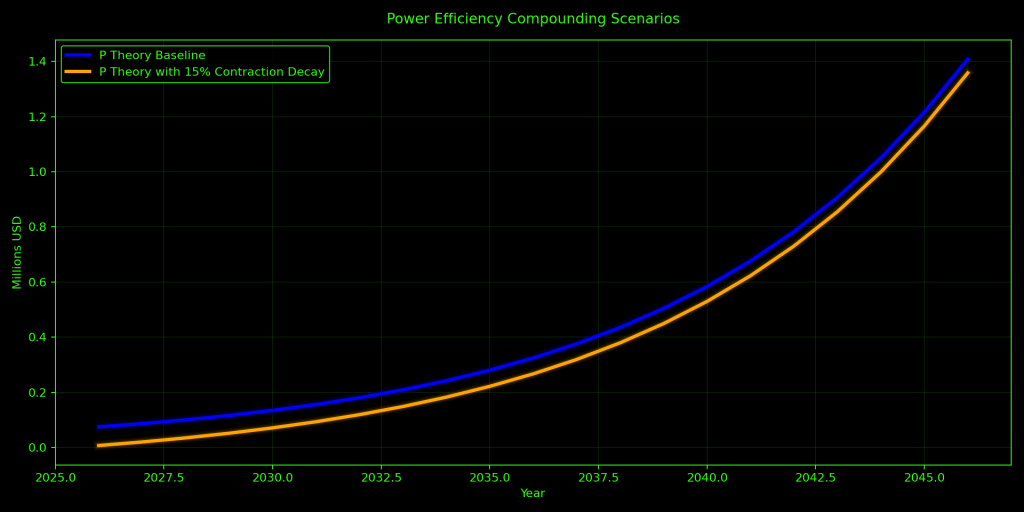
There is a mathematical refinement worth preserving for future research: the original contraction term models a diminishing discount over time, rather than predicting the actual timing of individual recessions or disruptions. At x = 0, the expression equals V0(1 − L0), not V0, unless L0 is zero. Consequently, V0 is the unadjusted baseline in the original equation; a normalized version would require separate calibration if it must begin at the observed baseline. No revision to the published equation is being asserted here.
Two distinct forms of decay
The previous articles address two different kinds of interference that should not be confused. Thermoeconomic Capitulation addresses diminishing technological returns. The Power Efficiency Equation’s contraction-decay variable addresses economic contraction and delayed value realization. Both can influence anticipated valuation, and neither can be forecast perfectly.
| Technological decay and friction | Economic contraction and friction |
|---|---|
| Diminishing semiconductor efficiency gains | Recessions |
| Thermodynamic constraints | Liquidity contractions |
| Manufacturing complexity | Regulatory disruptions |
| Increasing capital requirements | Market speculation |
| Hardware obsolescence | Delayed price realization |
The original Thermoeconomic Capitulation concept describes the interaction between accelerating technological returns and diminishing efficiency returns. New architectures, semiconductor processes and engineering breakthroughs push the performance frontier forward, while cost, heat, complexity and physical limits resist progression. Efficiency may continue to improve even when its rate of improvement declines.
The economic contraction term concerns a separate uncertainty. Technical gains may be recognized by the market late, partially or not at all. Although the original model hypothesizes declining contraction severity as the system matures, that assumption requires testing; it cannot guarantee the size or timing of a future downturn. A useful future extension would model variable hardware progression and stochastic market disturbances independently, rather than assume both decay mechanisms are identical.
Establishing measurable valuation points
The September research establishes three distinct valuation references:
| Valuation reference | Definition |
|---|---|
| Physical price | Observed market low used as the baseline. |
| Relative price | The implied valuation following measured power and efficiency progression. |
| Actual price | The currently observed market price. |
The physical price is not a direct measurement of the replacement cost of mining equipment or a guaranteed price floor. It is an observable market reference point. The relative price is the implied valuation calculated from that reference point using the comparative Power Efficiency Index (PEI).
VPEI = V0 × (Ht/H0) × (J0/Jt)
H represents the selected hashrate measurement, J the selected energy-per-terahash measurement, and the subscripts 0 and t indicate baseline and later observation dates. The divergence between relative price and actual price becomes another measurable research point. When V is expressed in dollars per bitcoin, the result is a per-coin valuation estimate; an implied total network market capitalization would additionally require multiplying by circulating supply.
Consider an illustrative reconstruction using the research baseline of 805 EH/s, 15 J/TH and $74,612, compared with 912 EH/s and 9.5 J/TH. The compounded progression multiplier is (912/805) × (15/9.5) = 1.7888. Applying the multiplier gives an illustrative relative price of approximately $133,467, or 78.88% progression. The inputs are rounded historical examples, not current live market readings.
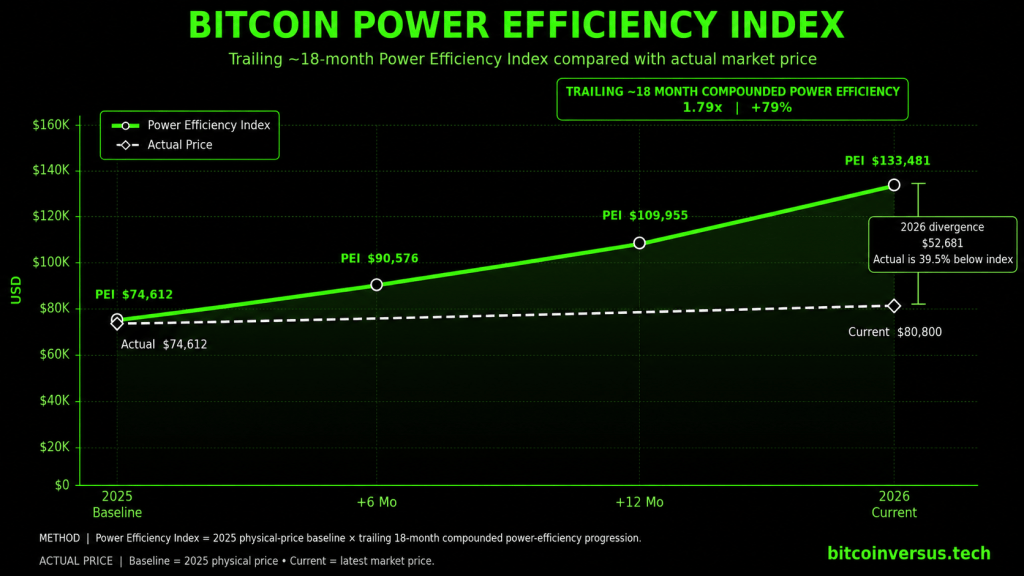
The 18-month PEI study provides an example of the methodology. A difference between model-implied price and market price is evidence of divergence relative to the model, not independent proof of intrinsic undervaluation.
The March methodology emphasizes individual ASIC machines because their hashrate and energy consumption can be measured precisely. Network hashrate is estimated statistically and the full fleet’s efficiency is not directly observable. Combining a network hashrate estimate with a leading hardware specification therefore requires clear disclosure of the measurement boundaries. An individual-machine analysis, a frontier-hardware index and a fleet-weighted network analysis should be identified separately rather than treated as interchangeable.
The revised central thesis
Biological competition incentivizes both power projection and the increasingly efficient projection of power. Bitcoin provides a quantifiable technological environment in which both phenomena can be observed through computational output and energy efficiency. Power Efficiency Theory seeks to mathematically anticipate that technological progression, establish corresponding economic valuation points, and account for the foreseeable existence of unforeseeable disruptions that may delay or diminish the realization of value.
The natural-money hypothesis follows from the proposed relationship: if competitive biological systems have incentives to improve how they project power, a monetary protocol whose security depends on competitive physical computation may express that tendency in a measurable technological form. The thesis does not claim biological evolution determines a particular currency choice. It proposes that Bitcoin’s physical substrate gives the research community a set of observable variables with which to examine the hypothesis.
The strongest scientific contribution would be to demonstrate that the proposed valuation relationship holds across future, previously unseen measurement periods. Hardware progression supports the efficiency projection hypothesis, while the monetary valuation relationship remains independently testable. Price can also influence mining investment, making causality potentially bidirectional. A robust test would specify hardware and network measurements in advance, account for adoption and market conditions, and compare out-of-sample errors against simpler benchmarks.
Power projection is the foundation. Efficiency projection is the extension. Bitcoin mining is the measurable technological environment in which both can be investigated. The Power Efficiency Equation and Power Efficiency Index are proposed tools for evaluating the resulting progression and its potential relationship with value, while acknowledging the uncertainty inherent in technological and economic evolution.
Research disclosure: The theoretical extension and experimental valuation framework are attributed to Matthan Burton and BitcoinVersus.Tech. Lowery’s thesis is the conceptual foundation; no endorsement by Lowery or MIT of Power Efficiency Theory is implied. The historical charts are preserved from the original research archive. BitcoinVersus.Tech is not a financial advisor. Research is provided for informational purposes.
Editor’s Note: We volunteer daily to ensure the credibility of the information on this platform is Verifiably True. If you would like to support to help further secure the integrity of our research initiative, please scan the QR code below.



Leave a Reply