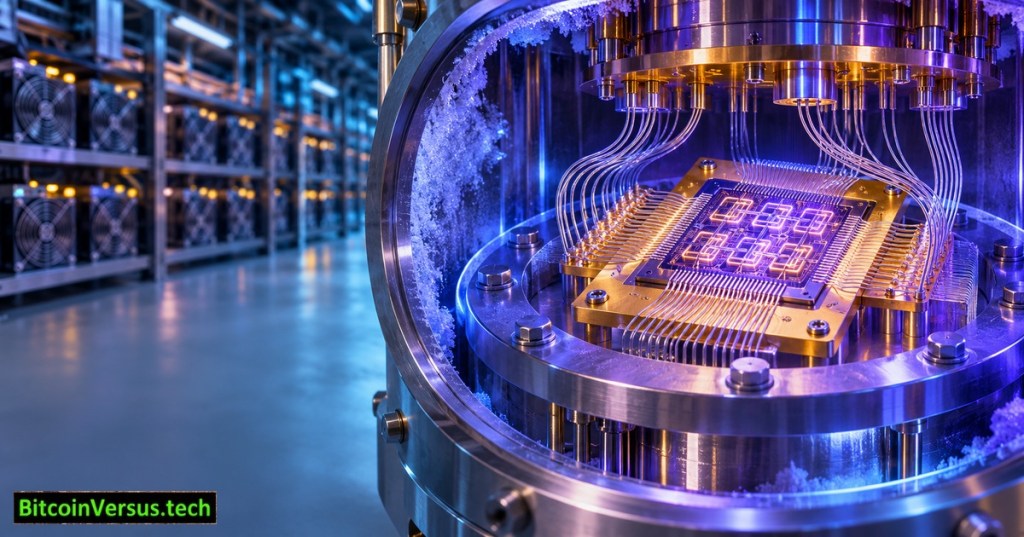
A superconducting SHA-256 accelerator simulated by researchers at Stellenbosch University offers a striking glimpse of how much less energy cryptographic computation could require. In a peer-reviewed IEEE paper published online May 15, 2026, the team estimated 548.35 terahashes per joule (TH/J) at a 2 GHz clock. Converted into the mining industry’s familiar reciprocal unit, the figure equals approximately 0.001824 joules per terahash (J/TH). No Bitcoin mining machine achieved the result in a physical test.
Video background: a September 2024 HyperComplex Seminar on AQFP superconducting logic. The recording predates the 2026 SHA-256 simulation and does not show a working miner.
What the researchers actually modeled
The study describes a full SHA-256 accelerator assembled from adiabatic quantum-flux-parametron (AQFP) superconducting logic, rather than conventional complementary metal-oxide-semiconductor transistors. AQFP circuits manipulate magnetic flux using Josephson junctions and carefully controlled switching. Such operation can dissipate exceptionally little energy per logic transition, but practical circuits need cryogenic refrigeration.
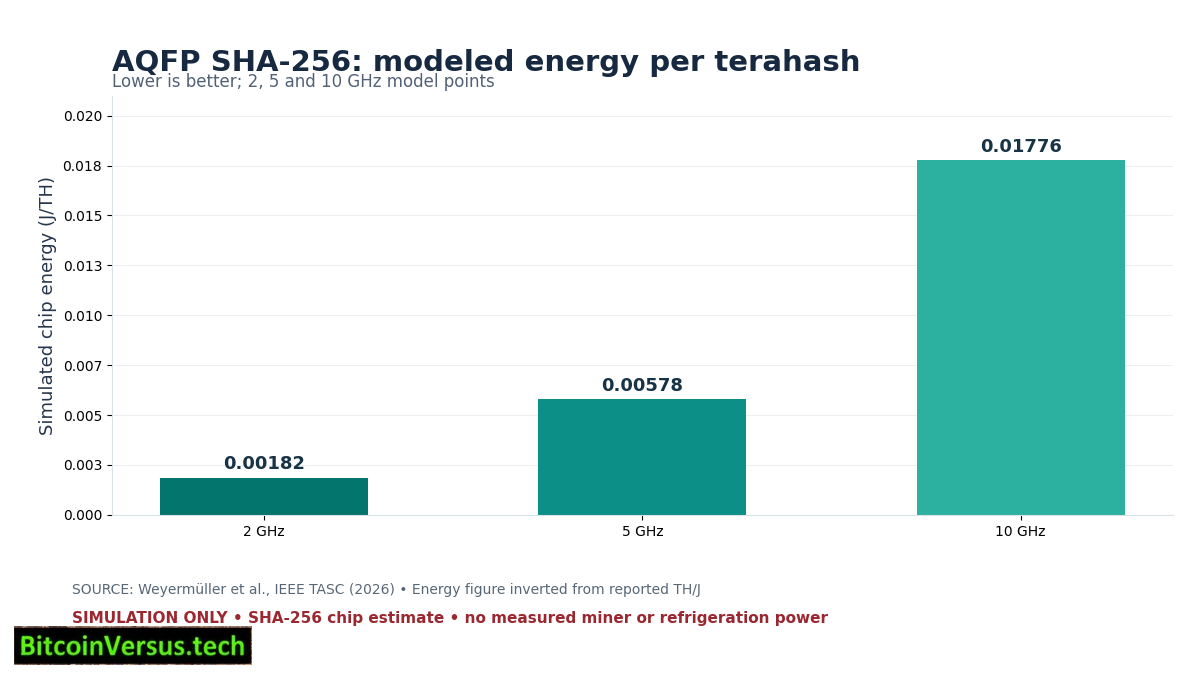
The authors modeled energy consumption across three operating frequencies. Each value represents a computer-simulated chip design, not verified hardware throughput. Lower estimated J/TH at 2 GHz reflects a different operating trade-off from the faster simulations.
| Modeled clock | Efficiency reported (TH/J) | Converted chip energy (J/TH) |
|---|---|---|
| 2 GHz | 548.35 | 0.001824 |
| 5 GHz | 173.08 | 0.005778 |
| 10 GHz | 56.32 | 0.017756 |
Why Bitcoin mining is a harder comparison
Bitcoin mining uses Double SHA-256 for each candidate block-header hash. The IEEE abstract refers to a full SHA-256 accelerator, not an independently demonstrated, cooling-inclusive Double SHA-256 mining system. Consequently, its TH/J figures cannot automatically be compared hash-for-hash with commercially rated Bitcoin miners. Pipeline design, repeated hashing, control circuitry, power conversion and a physical chip’s achievable clock all affect the comparison.
The 8.9 J/TH manufacturer-rated miner reference used in BitcoinVersus.Tech’s decade-long ASIC efficiency comparison is a whole-machine specification. Dividing 8.9 by 0.001824 produces an approximately 4,880-fold numerical ratio, but not a defensible 4,880-fold improvement in real miner efficiency: the two values have different calculation boundaries and may not count equivalent hashing work.
Refrigeration could decide the outcome
Superconducting circuits typically require temperatures near liquid-helium conditions, around 4 K. Cooling a large computing installation consumes electricity, and removing one watt of heat at the cold stage can require substantially more than one watt from the grid. The researchers conclude that their design could remain competitive after cooling overhead, but no measured refrigeration budget for a complete mining installation accompanies the reported chip efficiencies.
Researcher Coenrad Fourie described the simulated design publicly as involving 4.25 million AQFP cells and about 9.3 million Josephson junctions. His remarks explicitly acknowledge its simulation status. The cell count highlights manufacturing, interconnect and yield challenges still facing a physical accelerator.
What the result means for PEI
The finding expands the range of physical architectures worth tracking in Power Efficiency Improvement (PEI) research, without changing established commercial benchmarks. Earlier BitcoinVersus.Tech analysis examined whether CMOS mining ASICs could reach 1 J/TH and how to compare compute per joule across technologies. AQFP offers a possible alternate route, not a demonstrated timeline to either milestone.
A credible breakthrough for miners would require a fabricated accelerator repeatedly processing actual Bitcoin Double SHA-256 work, with independent hashrate and electrical input measurements, plus refrigeration, power conversion and maintenance loads. Electricity-cost modeling should then use a consistent power boundary and account for operating economics. Until those measurements exist, 0.001824 J/TH belongs in the simulated research column—not the production miner leaderboard.
Research basis: “Energy Analysis of an AQFP Logic SHA-256 Hash,” IEEE Transactions on Applied Superconductivity, vol. 36, issue 8 (November 2026); online publication May 15, 2026. Background video predates the paper.


Leave a Reply