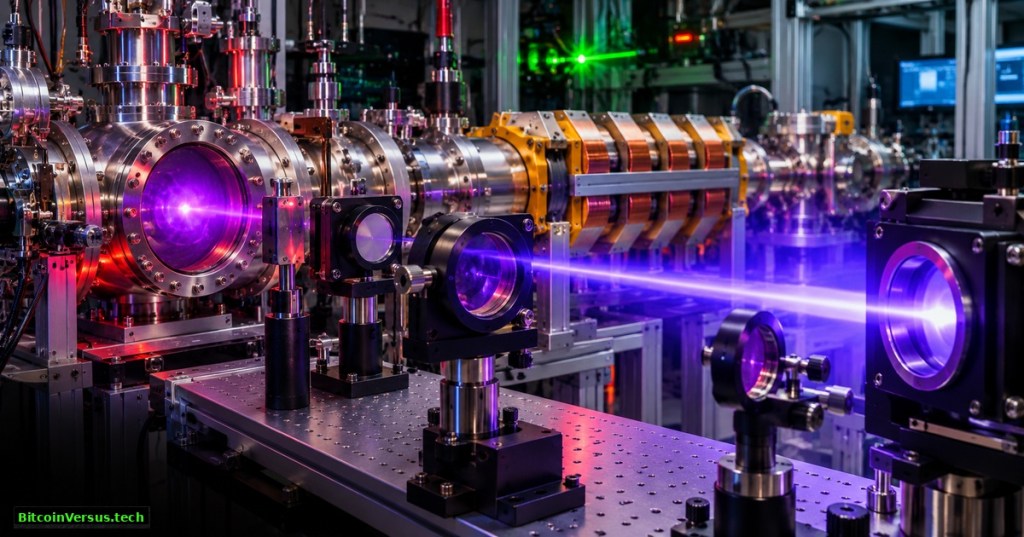
The plasma accelerator behind Berkeley Lab’s earlier 1,000-fold optical-gain experiment later powered a free-electron laser for more than eight hours without an operator intervening. The achievement was published April 7, 2026, in Physical Review Accelerators and Beams, months before a November 12 Department of Energy spotlight revisited the earlier one-hour experiment. The longer run is an extension of the same research program, not a new November laboratory trial.
At Lawrence Berkeley National Laboratory’s BELLA Center, scientists working with TAU Systems and university collaborators stabilized a roughly 100-terawatt drive laser that accelerates electrons through plasma. The paper reports approximately 100 MeV electron beams at one shot per second for over 10 hours, supporting more than eight hours of continuous free-electron-laser operation without operator input. The generated light remained at 420 nanometers, in the visible violet region, not at an X-ray wavelength.
Berkeley Lab’s original “Basics2Breakthroughs: Accelerating Particles in Plasma” video explains plasma wakefields. Archival background, not a recording of the April 2026 experiment.
How engineers stopped the laser drifting
The central challenge was not producing one exceptionally powerful pulse. Temperature shifts, air turbulence, vibrations and optical movement can shift a laser’s focus relative to the gas target. Tiny changes alter the accelerated electron bunch, which affects coherent light generation inside the undulator.
To control drift, the team tracked a lower-power, faster-repeating ghost beam alongside the main laser. A wavefront sensor measured the curvature linked to focal position; a motorized optical telescope corrected it through a feedback loop. A camera and motorized mirror also compensated for sideways movement. Berkeley Lab reports the system largely eliminated long-term longitudinal drift and reduced pointing-position jitter by 40%. The improvement refers to alignment fluctuations, not a 40% energy saving.

What eight hours does and does not prove
The earlier BitcoinVersus.Tech report covered the July 29, 2025 paper demonstrating greater than 1,000-fold optical gain and lasing on more than 90% of shots during a one-hour measurement. The April 2026 publication instead addresses sustained operation. An eight-hour run is a longer demonstrated operating window, but not a measured eightfold improvement in wall-plug efficiency, equipment lifetime or per-shot laser reliability.
A scientific light source must maintain alignment across a realistic experiment rather than reach peak output briefly. Nevertheless, the 2026 paper does not establish a finished X-ray user facility, commercial cost parity, or independent performance over years of service. Researchers still need to improve beam control, photon extraction and facility integration.
Carl B. Schroeder’s 2020 University of California, Berkeley lecture on compact accelerators and photon sources, Part 1. The university links the original talk, which predates the extended run.
Next target: shorter wavelengths, higher energy
Berkeley Lab identifies free-electron-laser saturation and higher electron energy as objectives. The researchers discuss increasing beam energy toward 500 MeV and moving the output toward 20–30 nm. Both are future goals rather than results from the eight-hour test. Even the proposed 20–30 nm range is substantially shorter than 420 nm and would require new verification of stable lasing.
Compact photon sources could eventually assist materials studies and chip research, but relevant technologies are not interchangeable. Semiconductor fabrication requires the precision and uptime examined in our manufacturing-equipment review. Atomic-force microscopes measure surfaces by a different mechanism, while nanoscale lasers and integrated photonic chips pursue separate applications.
The verified advance is operational stability: a sensitive plasma-driven electron source and free-electron laser continued working for an extended unattended period. Lower equipment cost, compact X-ray operation and industrial deployment remain promising but unproven.
Primary sources and media
- Kohrell et al., Physical Review Accelerators and Beams, April 7, 2026
- Berkeley Lab technical report on beam control and future milestones
- Barber et al., Physical Review Letters, July 29, 2025
- DOE Office of Science, November 12, 2026 retrospective
- UC Berkeley original lecture listing and Berkeley Lab video archive
Editorial verification: The paper establishes operating durations, electron energy, wavelength and repetition rate. The cover is original photorealistic editorial illustration, not a photo of the actual beamline. The archived videos provide technical background, not footage of the April 2026 trial.
Editor’s Note: We volunteer daily to ensure the credibility of the information on this platform is Verifiably True. If you would like to support to help further secure the integrity of our research initiatives, please scan the QR code below

For mobile scanning, open the article on another display and scan the QR code with a Bitcoin wallet. The voluntary donation amount is 5,000 sats. Verify the receiving address 3C9o19EH5HSiwEPyCTmEKzxhNCbo2X6TTb before sending.
BitcoinVersus.Tech publishes technology and financial journalism for informational purposes and does not provide financial, investment, or legal advice.


Leave a Reply