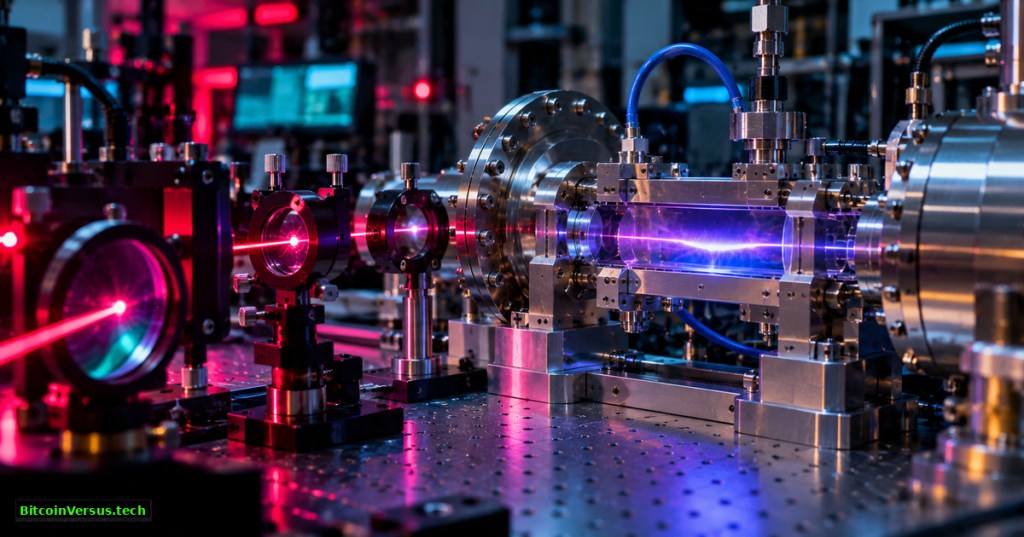
Scientists in Italy have used a laser-generated plasma filament to accelerate electron bunches with a field exceeding 250 megavolts per meter, reporting successful acceleration in 95% of observed events. Their peer-reviewed experiment, published November 2, 2026 in Physical Review E, also measured root-mean-square electron energy jitter below 0.5%. The result addresses a crucial problem for compact accelerators: making plasma stages reproducible, not merely powerful.
The research was led by M. Galletti and colleagues at INFN’s Frascati National Laboratories, with collaborators at the University of Rome Tor Vergata and Hebrew University of Jerusalem. It extends the laboratory’s work on plasma wakefield acceleration without claiming that a new X-ray laser was built. The team demonstrated electron acceleration; light amplification inside a free-electron laser was not the measurement under investigation.
INFN Frascati’s official 2022 presentation by researcher Gemma Costa explains compact plasma accelerators. Italian-language archival research context, not footage of the November 2026 experiment.
How a laser creates an accelerator channel
Conventional beam-driven plasma accelerators often rely on a gas discharge or other preparatory system to ionize material before charged-particle bunches arrive. The new method sends an ultrashort laser pulse through low-pressure nitrogen, where nonlinear optical effects create a narrow, self-guided plasma filament. A leading electron bunch then drives an electric-field wake in the plasma; a following witness bunch rides the wake and gains energy.
A journal paper by Galletti and coauthors documents an accelerating gradient above 250 MV/m. In a related 2026 conference account, the investigators described roughly 8 MeV of gained energy through a plasma stage about 3 centimeters long. A dimensional check gives 250 MV/m × 0.03 m = 7.5 MeV, consistent with the reported approximate measurement. Neither figure is a claim that the entire accelerator has become three centimeters long.
What the 95% reliability figure actually measures
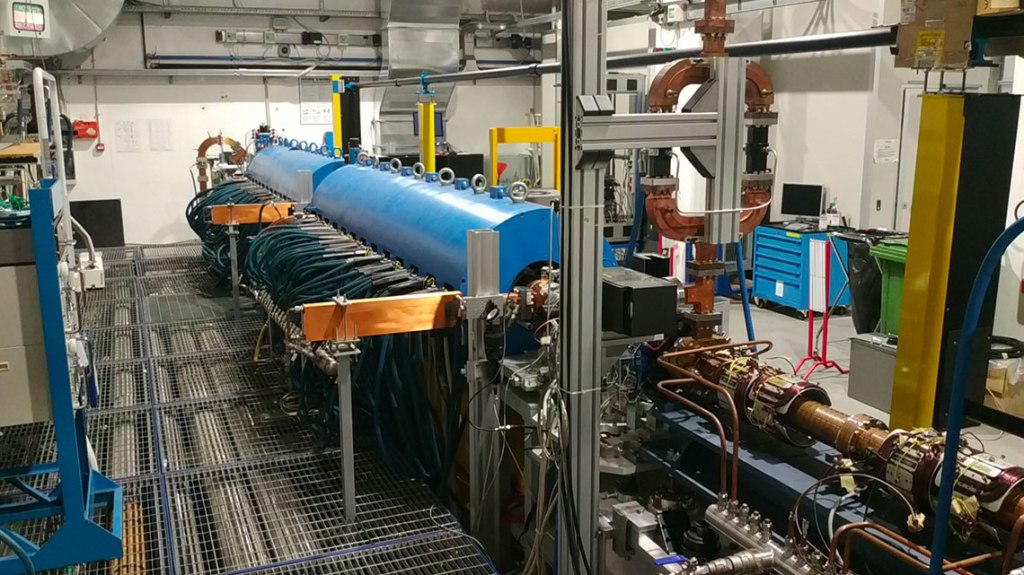
The published 95% represents the proportion of events in which the witness electrons accelerated successfully. The RMS energy jitter below 0.5% characterizes shot-to-shot fluctuations in the accelerated beam. Researchers report preserving witness charge and relative energy spread. Those metrics do not establish 95% facility uptime, 95% wall-plug efficiency or commercial manufacturing yield; the study did not report all of those quantities.
The original Berkeley Lab 90%-reliability and 1,000-fold gain article measured whether a free-electron laser produced gain on successive shots, whereas the Frascati 95% measures whether an electron bunch gained energy in a plasma stage. Both are valuable, but combining them into one reliability ranking would misrepresent the experiments.
Riccardo Pompili’s October 2025 seminar, “Beam manipulations with a plasma accelerator,” discusses INFN Frascati and EuPRAXIA@SPARC_LAB. Earlier institutional research, not a demonstration of the November 2026 publication.
Why the result matters for future compact light sources
Creating the plasma channel with a self-guided laser filament could reduce reliance on specialized discharge circuits and complex beam-shaping hardware. Lower plasma-source energy requirements may also support higher repetition rates in future machines. However, the paper offers a proof-of-principle acceleration stage, not a verified measurement of facility-wide electricity savings, cost reduction or kilohertz-scale operation.
The broader program connects to Berkeley Lab’s eight-hour laser operation and computer modeling of compact water-window X-ray lasers, but each achievement uses distinct accelerator methods and performance tests. Researchers pursuing nanometer-scale optical sources face different physical constraints.
Frascati’s EuPRAXIA@SPARC_LAB technical design targets a one-gigaelectronvolt accelerator and a future free-electron laser. Building and operating that facility remains separate from showing an 8 MeV gain in a three-centimeter test. The immediate scientific advance is a practical way to create a stable plasma acceleration channel.
Primary sources and media
- Galletti et al., Physical Review E 114, 055201, November 2, 2026
- Hebrew University peer-reviewed publication record
- Advanced Accelerator Concepts 2026 conference abstract, 3 cm and approximately 8 MeV
- INFN Frascati EuPRAXIA design report, March 2026
- INFN official compact-accelerator lecture; Pompili seminar on plasma accelerators
Editorial verification: The 95% success and sub-0.5% RMS energy jitter apply to witness-electron acceleration, not laser emission. Cover artwork is illustrative, not an actual photograph of the experiment. The two videos and the institutional photograph predate the November publication and are clearly labeled as technical context.
Editor’s Note: We volunteer daily to ensure the credibility of the information on this platform is Verifiably True. If you would like to support to help further secure the integrity of our research initiatives, please scan the QR code below

For mobile scanning, open the article on another display and scan the QR code with a Bitcoin wallet. The voluntary donation amount is 5,000 sats. Verify the receiving address 3C9o19EH5HSiwEPyCTmEKzxhNCbo2X6TTb before sending.
BitcoinVersus.Tech publishes technology and financial journalism for informational purposes and does not provide financial, investment, or legal advice.


Leave a Reply