
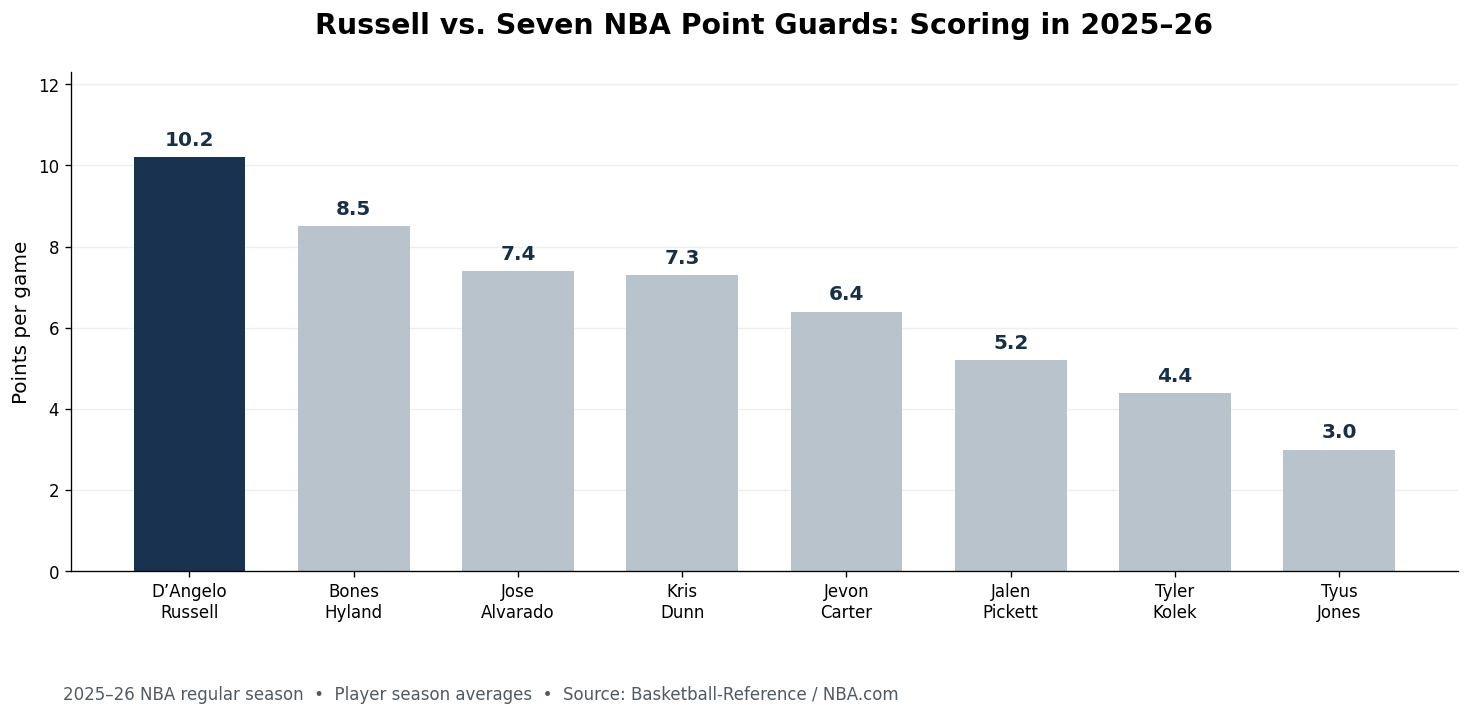
D’Angelo Russell is no longer on an NBA roster, yet his last NBA season shows higher scoring and assist averages than seven point guards currently employed around the league. Russell averaged 10.2 points and 4.0 assists over 26 games with Dallas in 2025–26. The contrast raises a legitimate NBA-politics question: why can a more accomplished offensive player lose his place while less productive guards remain?
The 30-year-old former All-Star was waived by Memphis on September 25, 2026 and subsequently signed with the Shanghai Sharks in China. He averaged 17.0 points and 5.6 assists across 655 NBA regular-season appearances, but career reputation alone cannot settle his present-day value.
ESPN’s Inside the NBA discussion, October 2025: analysts argued for giving Russell the point-guard role in Dallas. Watch the verified NBA on ESPN video.
Seven current NBA guards Russell outproduced
The comparison below uses 2025–26 regular-season per-game statistics, not mixed seasons or career totals. Russell exceeded every listed guard in both points and assists per game. Players on multiple teams have full-season averages; team affiliations show 2026–27 NBA rosters.
| Player | 2026–27 team | PPG | APG | MPG |
|---|---|---|---|---|
| D’Angelo Russell | Shanghai (CBA) | 10.2 | 4.0 | 19.0 |
| Bones Hyland | Minnesota | 8.5 | 2.6 | 16.6 |
| Jose Alvarado | New York | 7.4 | 3.4 | 19.9 |
| Kris Dunn | LA Clippers | 7.3 | 3.6 | 27.2 |
| Jevon Carter | Orlando | 6.4 | 1.6 | 16.4 |
| Jalen Pickett | LA Clippers | 5.2 | 2.3 | 16.1 |
| Tyler Kolek | New York | 4.4 | 2.7 | 11.7 |
| Tyus Jones | Denver | 3.0 | 2.4 | 14.6 |
In 2023–24, Russell posted 18.0 points, 6.3 assists and 41.5% three-point shooting over 76 Lakers games. Earlier offensive production reinforces the scoring argument, although a stronger past season cannot guarantee future NBA effectiveness. Our ball-handling rankings also illustrate why creating offense is only one component of evaluating guards.
Where NBA politics enters the picture
Coaching authority. Against the Lakers in November 2025, Dallas coach Jason Kidd used Ryan Nembhard and Brandon Williams ahead of Russell. Kidd said the organization wanted to evaluate its younger guards and establish rotation consistency. The public explanation supports a strategic decision, not a proven personal dispute.
Russell’s own November 2025 Dallas documentary discusses preparation, teammates and the pressure of competition. Watch Russell’s original video.
Roster economics. Salary commitments, guaranteed contracts, development plans and luxury-tax restrictions shape hiring. A franchise may prefer an inexpensive younger guard even when a veteran offers more immediate offensive creation. Our young-guard scouting comparison explores how potential influences roster decisions.
Defensive specialization. Kris Dunn averaged 1.6 steals and shot 37.4% from three in 2025–26 while starting 68 games. Russell outscored Dunn, but Dunn supplies point-of-attack defense and low-usage versatility. Jose Alvarado likewise offers on-ball pressure. Team fit can outweigh scoring totals; our player-impact analysis distinguishes box-score production from broader contributions.
NBA’s 2015 draft announcement, preserved in X’s official draft recap, recalls Russell’s arrival as the No. 2 overall selection. View the original NBA social post.
What the scoring argument cannot prove
Russell shot only 29.5% from three and recorded a 51.1% true-shooting percentage in 2025–26. His 1.9 turnovers per game also matter. A player who scores more is not automatically more efficient, defensively reliable or suited to a reduced role. The comparison establishes specific offensive advantages, not an objective overall ranking.
Front-office relationships and reputation can matter in professional sports, but no verified evidence establishes that Russell’s departure followed favoritism, retaliation or coordinated exclusion. Club decisions should not be recast as allegations without supporting documents or on-record testimony.
The larger NBA-politics lesson
A franchise does not employ players through a single scoring leaderboard. Coaches choose rotations; executives manage contracts; front offices balance present production against developmental opportunity. Russell’s move overseas after an All-Star career demonstrates how NBA opportunity depends on more than outscoring the next guard. For a related example of record versus underlying performance, see our seven-team standings analysis.
Primary statistical references: Russell’s season-by-season record; 2025–26 player averages; NBA report on the Memphis waiver; and September 30 report on his Shanghai signing.
We volunteer daily to ensure the credibility of the information on this platform is Verifiably True. If you would like to support to help further secure the integrity of our research initiatives, please scan the QR code below



Leave a Reply