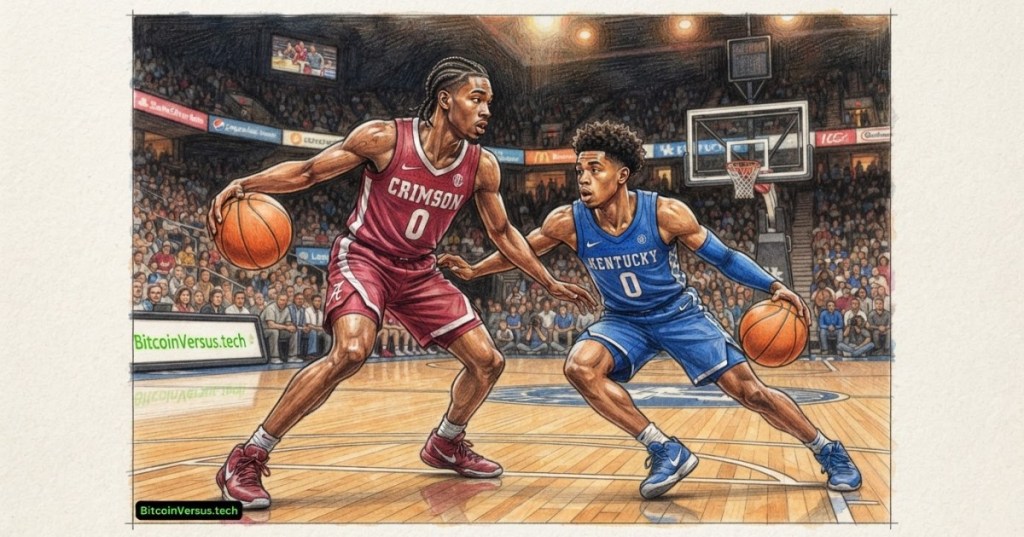
Two highly skilled SEC guards entered the NBA with opposing reputations. Labaron Philon Jr., Philadelphia’s No. 22 selection in June 2026, projects as a methodical pick-and-roll creator with useful defensive length. Rob Dillingham, selected eighth in 2024, offered dazzling isolation scoring but now faces a career reset after NBA stops with Minnesota and Chicago.
The comparison acquired a timely twist on November 14, when the Westchester Knicks announced the acquisition of Dillingham’s G League returning-player rights. The move does not give him an NBA roster spot with New York. Philon remains with the 76ers, where early opportunities have been limited. Evaluating their abilities requires separating collegiate production from NBA performance.
College production: Dillingham’s freshman advantage, Philon’s sophomore leap
Kentucky’s official 2023–24 record shows Dillingham averaging 15.2 points and 3.9 assists in just 23.3 minutes, with a scorching 44.4% three-point accuracy. Alabama’s 2024–25 numbers put freshman Philon at 10.6 points, 3.8 assists and 31.5% from deep. Dillingham was comfortably ahead as a freshman scorer, while Philon produced more steals, 1.4 against 1.0.
| College measure | Philon, 2025–26 sophomore | Dillingham, 2023–24 freshman |
|---|---|---|
| Points per game | 22.0 | 15.2 |
| Assists per game | 5.0 | 3.9 |
| Minutes per game | 30.9 | 23.3 |
| Field goal percentage | 50.1% | 47.5% |
| Three-point percentage | 39.9% | 44.4% |
| Three-point attempts per game | 6.2 | 4.5 |
Philon’s sophomore growth is substantial. The 76ers’ draft profile records 22.0 points, 5.0 assists and 39.9% three-point shooting across 33 games. Normalizing playing time yields approximately 25.6 points per 36 minutes for Philon against 23.5 for Dillingham in their respective final college seasons. The calculation is points divided by minutes per game, multiplied by 36. Pace, role and defensive quality remain unadjusted.
Shot creation and playmaking
Dillingham wins the handle and spontaneous-shot-creation categories on scouting judgment. His abrupt pace changes, deep pull-ups and ability to shoot after complex dribble combinations pressure defenders beyond the arc. Yet a difficult jumper remains a difficult jumper, and NBA opponents can recover faster than college defenders. His ability to sustain efficiency while operating against stronger, longer guards is the central offensive question.
Philon attacks with a less frantic rhythm. He probes ball screens, uses hesitation to manipulate a big defender, then finds floaters, layups or passing windows. His 2025–26 three-point rate improved by 8.4 percentage points over his freshman 31.5%, an encouraging development rather than proof of automatic NBA shooting translation. Readers following Philadelphia’s guard hierarchy can compare our Tyrese Maxey and Stephen Curry statistical analysis for a wider look at elite guard scoring.
Size, defense and NBA fit
The draft combine supplied a meaningful physical distinction. Philon measured 6 feet 2.5 inches without shoes with a 6-foot-6.25 wingspan; Dillingham measured 6 feet 1 inch with a 6-foot-3 wingspan. Philon’s additional length provides a larger margin for contesting jumpers and disrupting passing lanes. Neither guard has overwhelming NBA size, and defensive improvement requires positioning, strength and avoiding screens, not wingspan alone.
Dillingham remains dangerous when creating space, but his narrow frame allows bigger offenses to hunt switches. Philon’s steadier defensive profile offers a plausible path to complementary minutes alongside an established scorer. Our 2026 rookie draft-value comparison examines how opportunity and draft position diverge; the NBA’s evolving camera and replay technology also shows why observable game context matters when studying individual possessions.
Where both guards stand in November 2026
Westchester’s November 14 release lists Dillingham at 6.3 points and 2.2 assists in 14.9 minutes across 65 NBA games in 2025–26. His strong Chicago stretch included 9.6 points in 30 appearances. Philon’s early Philadelphia sample is far smaller, making definitive professional rankings premature. A G League assignment also differs from having NBA control or an NBA contract.
Scouting verdict: Philon has the better projected two-way NBA fit and the stronger evidence of year-to-year development. Dillingham retains the more explosive isolation-creation ceiling, particularly if his jumper and decision-making translate consistently against NBA defenders. Neither outcome is settled. For another prospect comparison emphasizing sample size, see our LeBron James and Cooper Flagg analysis.


Leave a Reply