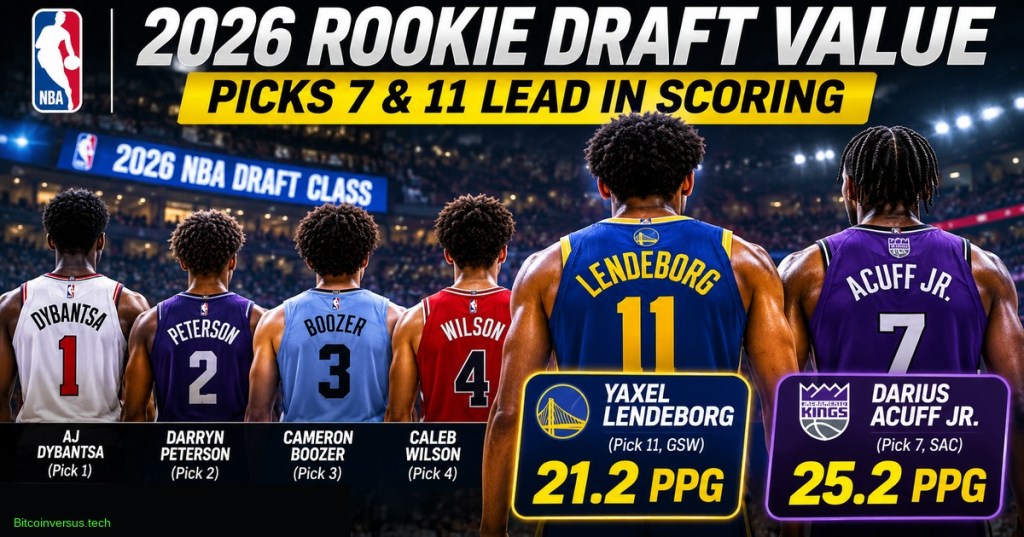
Golden State’s No. 11 pick Yaxel Lendeborg averages 21.2 points, 7.2 rebounds and 4.0 assists through ten games. Sacramento’s No. 7 pick Darius Acuff Jr. leads rookies with 25.2 points and 7.1 assists per game. Both are outscoring all four selections made ahead of them in the 2026 NBA Draft.
The NBA’s draft record shows Washington chose AJ Dybantsa first, Utah selected Darryn Peterson second, Memphis took Cameron Boozer third and Chicago picked Caleb Wilson fourth. The comparison measures early production relative to draft position, not long-term career value.
NBA draft-night footage featuring the top four selections. Credit: NBA/YouTube, June 30, 2026.
The first four picks versus the scoring leaders
Through November 8, Dybantsa has 16.0 points, 5.8 rebounds and 2.3 assists in six games. Peterson averages 13.6, 3.8 and 3.9 in nine; Boozer averages 15.6, 10.0 and 5.2 in nine; Wilson averages 19.3, 6.3 and 2.1 in nine. Figures are points, rebounds and assists per game, respectively. Dybantsa missed four games with an ankle injury.
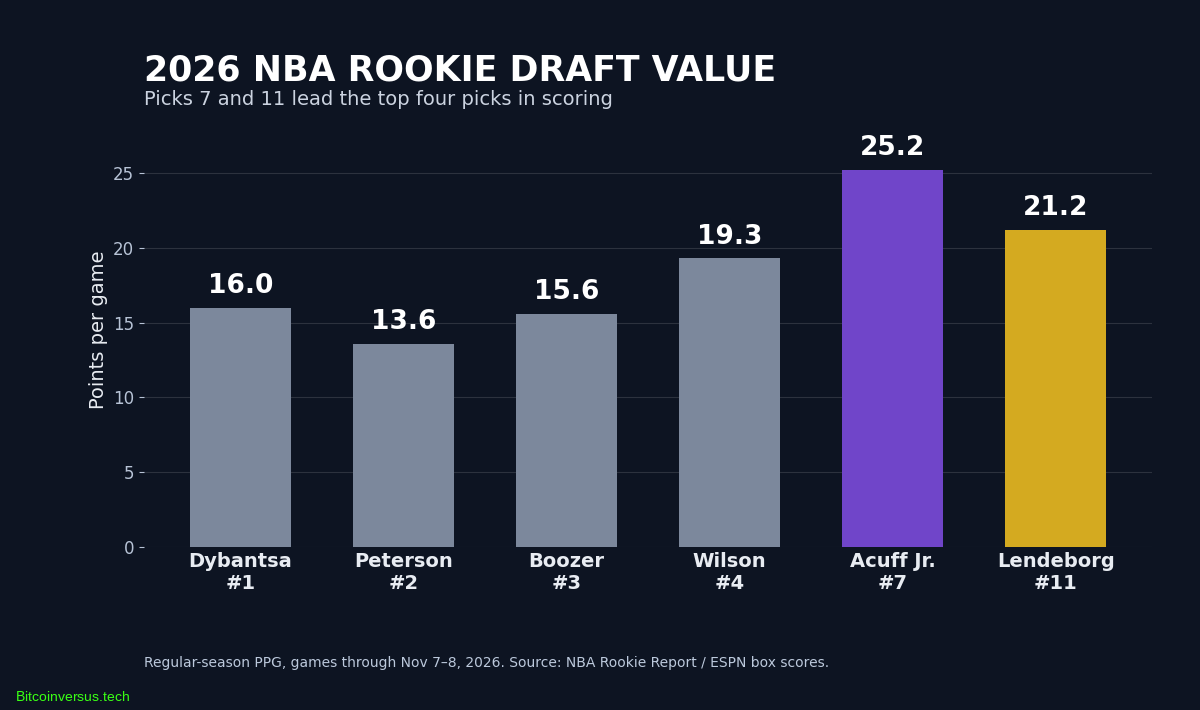
Acuff outscored Wilson, the most prolific top-four selection, by 5.9 points per game; Lendeborg leads Wilson by 1.9. Against No. 1 Dybantsa, the gaps are 9.2 and 5.2. Scoring rates are informative but not comprehensive draft rankings. The site’s NBA player rankings offer broader comparison context.
Why Lendeborg looks like the early value pick
Lendeborg combines 21.2 points with 50.4% field-goal and 40.4% three-point shooting. On November 1, he scored 37 on 13-for-19 shooting, including six three-pointers, in Golden State’s win over the Clippers, according to the official game report. The site’s shooting-accuracy analysis similarly distinguishes attempts from percentages.
Yaxel Lendeborg’s NBA Summer League highlights, July 2026. Credit: NBA/YouTube.
Lendeborg held second on the NBA’s November 4 Rookie Ladder. The NBA also identified him as the sixth player ever with at least 100 points, 40 rebounds and 20 assists through five career games. The production is striking for an 11th pick, although lineup context and defense deserve further study.
Acuff leads in production; Boozer retains the official lead
Acuff makes 3.0 threes per game but shoots 40.2% overall, leaving room for efficiency gains. Against Memphis on October 31, he scored 38 and matched the NBA rookie single-game record with nine three-pointers in an NBA-documented game. The league ranked him third on November 4, below Boozer and Lendeborg.
Boozer leads rookies with 10.0 rebounds and adds 5.2 assists. He recorded an 18-point, 12-rebound, 12-assist triple-double against Portland. The NBA’s ladder values his passing and contribution to wins despite 34.1% field-goal shooting in the later snapshot. Scoring and efficiency require separate treatment, as the site’s Maxey–Curry comparison illustrates.
Other rookies exceeding their draft position
Atlanta’s No. 8 pick Kingston Flemings averages 4.4 assists and shoots 52.9% overall. Cleveland’s No. 34 pick Meleek Thomas averages 12.3 points on 45.0% three-point accuracy. Denver’s No. 35 selection Trevon Brazile averages approximately 6.1 rebounds. Lower draft positions make all three noteworthy, although minutes, role and small samples remain confounding factors.
An impact algorithm is not the same as the Rookie Ladder
The RotoWire Impact Index, through November 2, scored Acuff 80.66, Wilson 74.37, Dybantsa 73.62, Lendeborg 69.15, Boozer 67.88 and Peterson 65.54. Its formula weights minutes share (35%), minutes trend (25%), production percentile (25%) and usage percentile (15%). Scores are modeled evaluations, not official NBA impact measurements.
The NBA’s November 4 ladder instead ranked Boozer first, Lendeborg second, Acuff third, Wilson fourth, Dybantsa fifth and Peterson sixth. Algorithmic scores, editorial ladders and fantasy ADP measure different concepts. Similar to the site’s analysis of LeBron James at 16, early achievements cannot establish eventual career value.
Sources and methodology
Sources: NBA draft results; NBA Rookie Report, updated November 9 at 01:54 UTC (November 8 Pacific); ESPN-derived RookieRanks; and RotoWire’s November 2 modeling cutoff. Regular-season per-game values are rounded to one decimal; rankings and statistical windows differ.
Editor’s Note: Early-season statistics cover a limited and changing game sample. The featured cover is an original editorial illustration, not a documentary photograph of the pictured athletes or uniforms. The comparative chart uses rounded per-game values, and no outcome should be interpreted as a final evaluation of the 2026 draft class. Streaming video and social posts provide context rather than statistical verification.
Support BitcoinVersus.Tech
For an optional 5,000-satoshi contribution, scan the original BitcoinVersus.Tech QR code with a compatible Bitcoin wallet. On mobile, save the QR image and open it through a wallet’s image-scanning option when supported, or use another device to scan. Verify the recipient and amount before approving a transfer.

We volunteer daily to ensure the information on this platform is Verifiably True. If you would like to support the research, please scan QR code.
Sports statistical analysis is informational and does not constitute gambling advice.


Leave a Reply