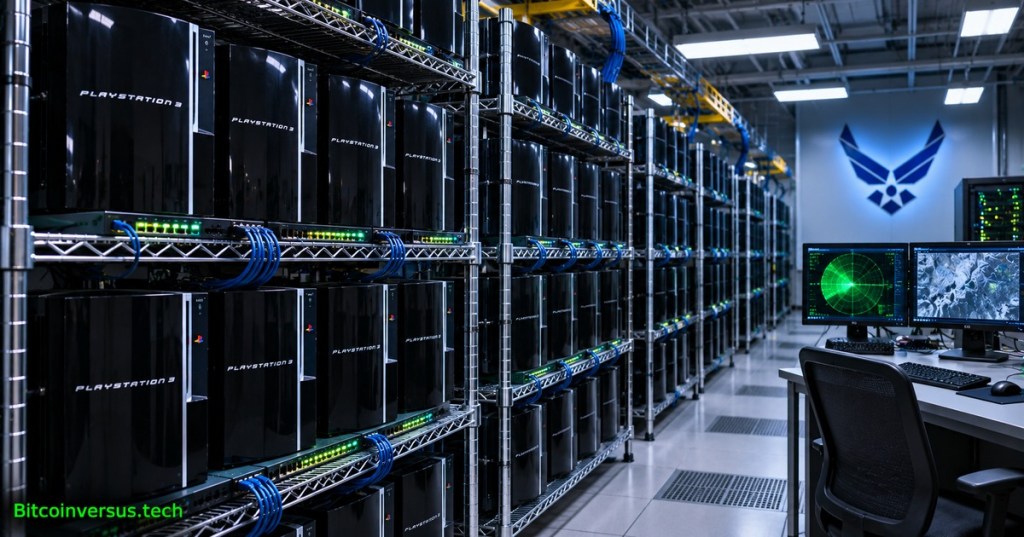
In December 2010, the U.S. Air Force Research Laboratory unveiled a supercomputer assembled from PlayStation 3 consoles, conventional servers and graphics processors for approximately $2 million. Called Condor, the machine was advertised at 500 teraflops and designed for image processing, radar research and artificial-intelligence experiments. The project demonstrated a remarkable use of consumer hardware—and exposed the risks of relying on a console manufacturer’s software decisions.
Reader-supplied documentary exploring Condor, Sony’s 2010 firmware change and the PS3’s Cell processor. Video URL supplied for editorial context; channel, upload date and actual playback could not be independently confirmed before publication. Credit: linked YouTube creator.
Why Air Force records disagree on the console count
A December 1 Air Force announcement described 1,760 PS3 processors, 168 general-purpose GPUs and 84 dual six-core server processors. A later December 6 Air Force account identified 1,716 consoles. The laboratory’s own 2012 video likewise listed 1,716 PS3s, alongside 156 GPUs. The published sources do not establish a common counting date or explain the differences. Neither number should be silently presented as an uncontested final inventory.
Condor was a heterogeneous cluster, not 1,760 bare consoles operating alone. Servers managed jobs, GPUs accelerated suitable workloads, and hundreds of Ethernet connections linked the PS3 nodes. Officials described 500 teraflops as system capability, not an independently reproduced sustained benchmark across every application. BitcoinVersus.Tech’s supercomputing history explains why reported peak FLOPS must be distinguished from benchmark scores.
Air Force Research Laboratory, “Condor Supercomputer, The Air Force Research Laboratory,” published February 9, 2012. Original AFRL channel footage reports 1,716 PS3s, 156 GPUs and 84 dual-Xeon processors. Credit: AFResearchLab / YouTube.
The Cell chip was fast, but difficult to program
The PlayStation 3 used the Cell Broadband Engine, developed by Sony, IBM and Toshiba. A general-purpose Power Processing Element coordinated specialized Synergistic Processing Elements. Although the chip architecture contained eight SPEs, only six were available to PS3 Linux applications. Each used a small, software-managed local memory, requiring programmers to schedule data transfers rather than assume conventional CPU cache behavior.
Regular mathematical and image-processing workloads could exploit the parallel design. Complex game engines, however, required substantial development work to distribute tasks efficiently. Modern processor taxonomy and CPU-versus-accelerator comparison illustrate the enduring tension between specialized throughput and software flexibility.
The cost advantage came with qualifications
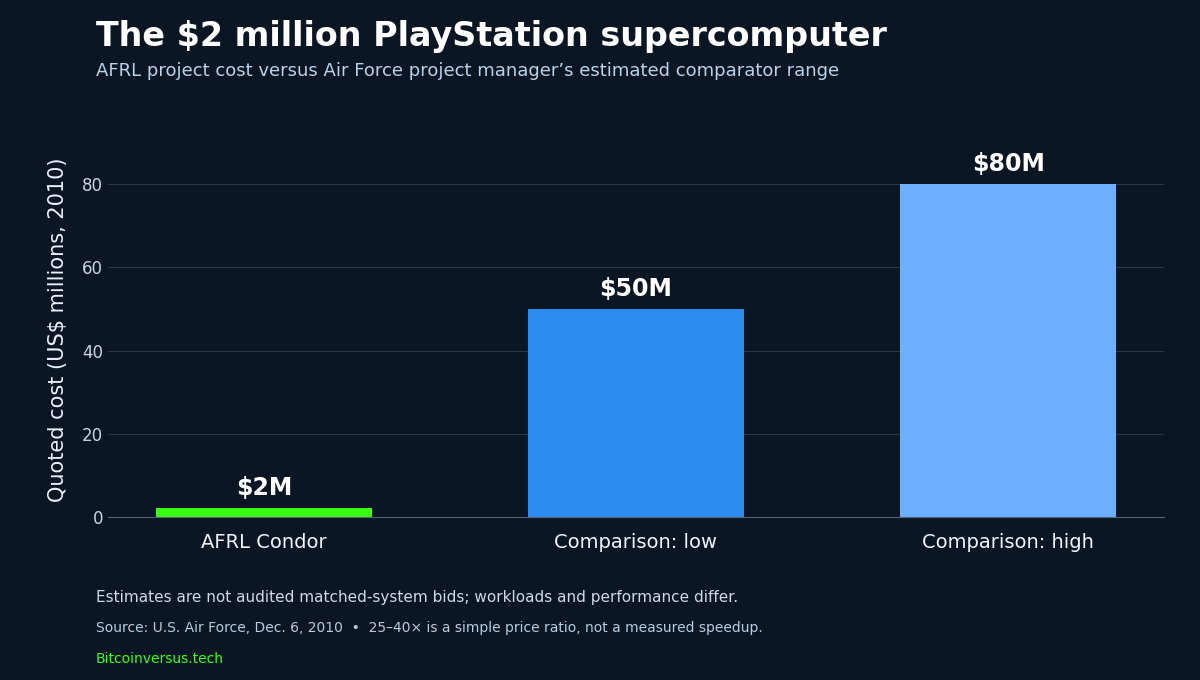
Air Force project director Mark Barnell estimated that comparable supercomputers cost $50 million–$80 million. Dividing those quotations by Condor’s $2 million price gives a simple 25–40-times cost ratio. The comparison was an official estimate, not a set of audited equivalent bids. Different systems have different memory, networking, precision, reliability and application requirements; the ratio does not demonstrate a 25–40-times performance gain.
Sony’s firmware change threatened maintainability
Sony announced on March 28, 2010 that firmware version 3.21 would remove the older PS3’s Install Other OS feature on April 1, citing security. Updating an existing Linux-enabled console could therefore eliminate the software path Condor needed. Refusing the update let existing consoles continue operating but complicated replacements, repair returns and future expansion. The update did not automatically wipe every installed Condor node.
The lesson extends beyond gaming: an apparently low-cost hardware platform can depend on a single vendor’s firmware, licensing and replacement inventory. Research groups and data-center operators now consider software maintainability alongside raw performance; see the site’s CUDA software-ecosystem explanation and gaming hardware evolution analysis.
What Condor actually demonstrated
The Air Force listed synthetic-aperture radar enhancement, image reconstruction, pattern recognition and neuromorphic research among Condor’s intended workloads. Officials reported a demonstration reading 20 pages of partially damaged text per second, but the publicly described test is not an independent, reproducible modern AI benchmark. Condor’s historical achievement was showing that inexpensive, specialized consumer processors could be integrated into useful military research infrastructure—provided engineers accepted substantial programming and operational trade-offs.
Primary sources: Air Force announcement, December 1, 2010; Air Force technical account, December 6, 2010; Sony firmware notice, March 28, 2010; AFRL’s official 2012 video; peer-reviewed Cell architecture study.
BitcoinVersus.Tech Editor’s Note
Published November 8, 2026, as a historical retrospective of a 2010 Air Force project. The original 1,760-console announcement and subsequent 1,716-console reports are preserved as separate records. The 500-TFLOPS figure is historical advertised capability, not a newly measured benchmark. Cost comparisons are attributed estimates. The main video was supplied by a reader and its uploader/date and playback were not independently confirmed; the 2012 video is sourced from AFRL’s official channel. The cover is a conceptual reconstruction, not archival photography, and the in-story chart is an original graphic distinct from the cover.
We volunteer daily to ensure the information on this platform is Verifiably True. If you would like to support the research, please scan QR code.

For an optional 5,000-satoshi contribution, scan the original QR with a Bitcoin wallet using a second screen. On mobile, save the QR image and use a compatible wallet’s saved-image scanning feature. Verify destination 3C9o19EH5HSiwEPyCTmEKzxhNCbo2X6TTb and the payment amount before confirming.


Leave a Reply