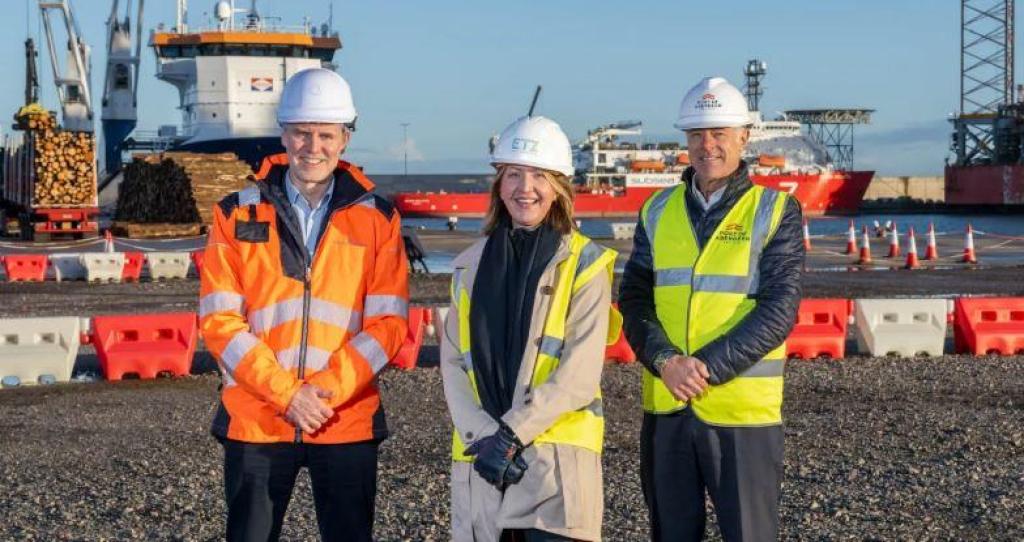
Floating offshore wind developers are preparing industrial infrastructure capable of handling turbines that each exceed 15 MW. On November 24, the Port of Aberdeen announced two agreements associated with Green Volt, an offshore wind project approximately 50 miles from Peterhead, Scotland, with permission for up to 560 MW of generation.
Green Volt reserved manufacturing and engineering capacity with Siemens Gamesa for 28 turbines. A separate letter of intent establishes Aberdeen South Harbour as the intended location for preparing and loading anchor and mooring components. The port expects the arrangement to support around £15 million of spending on facilities and supply-chain activity.
Why floating wind requires a different port
Fixed-bottom wind turbines transmit structural loads through foundations attached to the seabed. Floating installations instead support the towers on buoyant platforms restrained by anchoring systems. Mooring lines resist wind, waves and currents, while dynamic cables must tolerate the motion of the platform and carry electricity toward collection infrastructure.
Large components require deep berths, substantial storage space and specialized handling equipment. Preparing anchoring systems ashore can simplify offshore logistics, although installation still depends on marine conditions, vessel availability and engineering tolerances. The port agreement is an important procurement milestone, not proof that offshore construction has commenced.
Understanding the project’s capacity
Twenty-eight turbines rated at exactly 15 MW would total 420 MW. The turbines in the agreement are described as capable of exceeding that rating. The project’s 560 MW consent ceiling should not be interpreted as the sum of commissioned turbine capacity. Exact installed capacity depends on the final configuration and procurement arrangements.
The development previously obtained a 400 MW UK contract for difference, a mechanism that reduces exposure to wholesale electricity-price volatility. The difference between consented capacity, supported capacity and contracted turbine capacity is commercially important. RenewableUK identified the agreements as progress for the floating wind supply chain.
The relationship to electricity-intensive computing
A hypothetical 100 MW data center operating continuously would require 876 GWh annually. A 560 MW wind farm operating at a hypothetical 45% capacity factor would generate roughly 2.21 TWh per year. Actual production would depend on wind conditions, downtime and curtailment. Annual generation cannot establish that the same power is available during every hour of demand.
Green Volt intends to supply the UK grid and help reduce emissions from offshore oil and gas operations. No dedicated Bitcoin or AI offtake has been announced. Its relevance to computing infrastructure is therefore indirect: commercial-scale floating wind may expand regional generation options, while storage, transmission and flexible loads remain important for balancing variable electricity.
The next indicators of execution include finalized turbine orders, platform fabrication, installation contracts, offshore construction and grid commissioning. Each milestone provides stronger evidence of delivery than a reservation alone.
Related: Ecowende offshore wind · Norwegian floating wind · Offshore AI infrastructure · Renewable electricity contracts


Leave a Reply