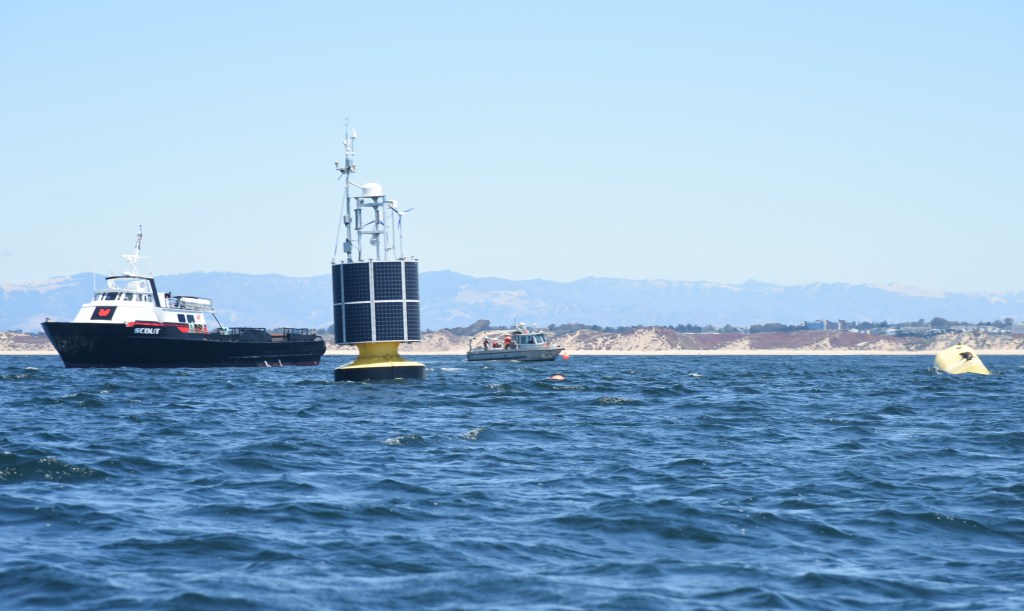
Could a floating renewable-power platform operate advanced AI accelerators without a connection to the electrical grid? On November 24, 2026, Stratum Holdings and Ocean Power Technologies (OPT) announced a signed feasibility agreement to evaluate offshore computing using NVIDIA B300 GPUs and OPT’s PowerBuoy technology. The proposal combines wave, wind and solar generation with local energy storage and aims to investigate edge inference applications.
The agreement advances an October 26 letter of intent into a defined engineering assessment. Importantly, the companies have not authorized hardware fabrication, GPU installation, offshore deployment or sea trials under the initial agreement. A separate demonstration agreement would be required. Data Center Dynamics reported the development on November 25.
A power plant and a data center on the same platform
A wave-energy converter captures relative motion between floating components, transforming mechanical energy into electricity. Wind and photovoltaic generation could supplement that supply. Batteries can buffer fluctuations between generation and computing demand, while power electronics condition the output for server equipment. The feasibility team will need to establish whether the proposed combination can provide adequate average energy, peak power and voltage stability.
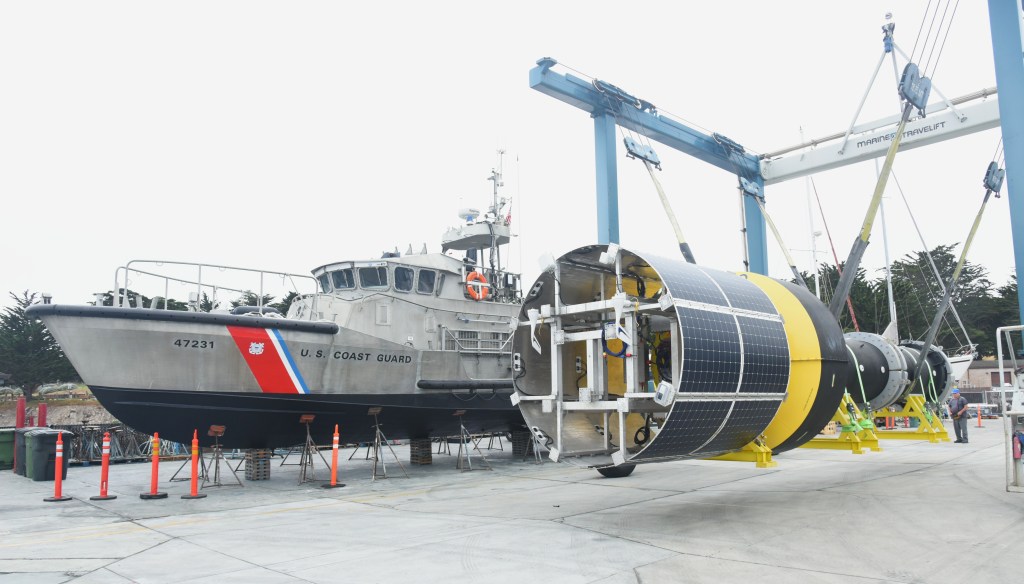
An important precedent exists: in July 2025, the Naval Postgraduate School deployed an OPT buoy near Monterey, California, for environmental research and maritime monitoring with 5G communications. That deployment demonstrates an offshore sensing platform, not a B300 data center.
How much energy would eight GPUs require?
For scale, NVIDIA’s DGX B300 system specifications list eight Blackwell Ultra GPUs, 14.5 kW system power consumption and 2.3 TB of GPU memory. A complete reference system operating continuously at 14.5 kW would consume 348 kWh per day, equivalent to approximately 127 MWh annually. These calculations exclude external cooling, energy conversion losses and communications. Stratum has not disclosed its planned server configuration, platform power rating or GPU count; the reference system is an illustrative benchmark, not a project specification.
Suppose the same reference system required four hours of battery-only operation at full listed power. The IT load alone would require 58 kWh of delivered energy. Actual battery nameplate capacity would be larger once usable depth of discharge, efficiency, reserve margins and auxiliary loads were included. A renewable generator’s peak power rating cannot establish whether it can support such a workload continuously.
Cooling, connectivity and operational risk
Surrounding seawater could provide a thermal sink through a heat exchanger and sealed coolant circuit. However, the thermal design must also address corrosion, marine growth, salt ingress, pumping energy, equipment access and heat discharge restrictions. A cool ocean does not eliminate electrical or mechanical cooling requirements. Remote hardware maintenance, platform motion and storm survival could also add costs that conventional land-based facilities avoid.
Offshore inference may make sense when sensor data can be processed locally rather than transmitted continuously to shore. Large-scale distributed training, by contrast, depends on high-bandwidth, low-latency communication between accelerators and reliable power over long periods. The study will consider connectivity, communications bandwidth, cooling, storage, mooring, platform integration, location and economics. No measured performance or cost advantage has been established.
Where the project fits
Other approaches covered by BitcoinVersus.Tech include Panthalassa’s wave-powered AI nodes, Kalypso’s offshore gas-powered computing plans, NetworkOcean’s floating solar GPU demonstration and Canada’s planned Bay of Fundy tidal-energy project. Each faces different resource, electrical, permitting and reliability constraints.
The next meaningful milestone for Stratum and OPT is a completed feasibility assessment and a separately funded demonstration agreement. Measured renewable output, delivered GPU energy, system uptime, thermal performance and communications reliability would help determine whether offshore AI computing can compete beyond a specialized maritime niche.
Cover photograph: U.S. Navy / Daniel Linehan, July 8, 2025, public domain. Earlier research buoy, not the proposed GPU installation.
We volunteer daily to ensure the credibility of the information on this platform is Verifiably True. If you would like to support to help further secure the integrity of our research initiative, please scan the QR code below.



Leave a Reply