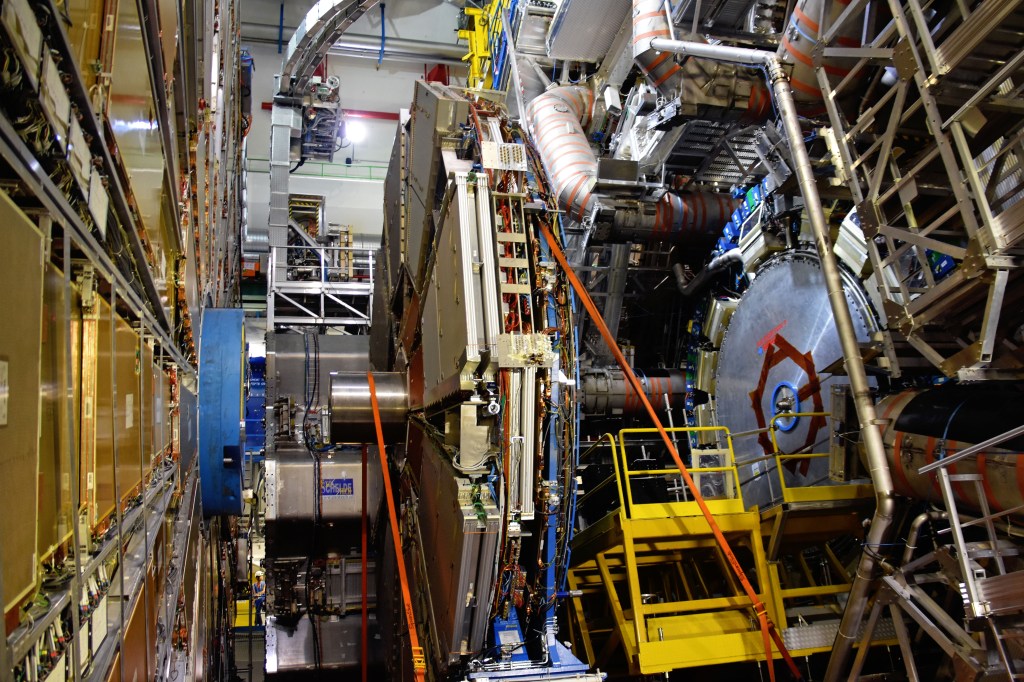
CERN is transforming the world’s largest particle accelerator into a more productive scientific instrument, targeting ten times the cumulative collision data of its original design and a return to operation in mid-2030.
The Large Hadron Collider (LHC) entered Long Shutdown 3 on June 29, 2026. During the four-year shutdown, engineers will install new superconducting magnets, upgrade detectors and expand underground infrastructure. The completed machine will be known as the High-Luminosity LHC (HL-LHC). CERN’s shutdown updates document the ongoing work.
Construction publication The B1M reported on November 25 that the broader upgrade is expected to cost approximately $2 billion. CERN’s 2026–2030 medium-term plan, published in June 2025, separately records a narrower HL-LHC materials budget of 1.077 billion Swiss francs. The two figures have different reporting boundaries and should not be treated as equivalent. Watch The B1M’s documentary on YouTube.
Official CERN video: Milestones & History of the LHC, published June 29, 2026.
Engineering the world’s largest particle accelerator
Founded in 1954, CERN operates a 27-kilometer underground ring near Geneva, along the French and Swiss border. The accelerator sits approximately 100 meters below ground. Its 1,232 main dipole magnets bend particle beams around the ring, while quadrupole magnets focus them. Superconducting equipment operates near 1.9 kelvin, approximately minus 271.3 degrees Celsius. CERN’s LHC specifications describe the machine in detail.
The HL-LHC upgrade introduces niobium-tin focusing magnets, superconducting radio-frequency crab cavities and new electrical transmission links. Crab cavities change the orientation of particle bunches near interaction points, improving their overlap. More concentrated beams increase the probability of collisions inside the ATLAS and CMS detectors. CERN is installing new equipment along approximately 1.2 kilometers of the accelerator. CERN’s technology overview explains the hardware.
The cryogenic operation alone requires warming more than 36,000 metric tons of equipment before technicians can access the machinery. Electrical isolation, helium recovery, equipment installation and subsequent cooling must be coordinated. CERN has also modernized thousands of accelerator control systems.
Billions of collisions per second
CERN targets 140 to 200 interactions per bunch crossing in the upgraded ATLAS and CMS experiments, compared with roughly 60 before the shutdown. The tenfold improvement refers to integrated luminosity relative to the original LHC design, not a tenfold increase in instantaneous collision frequency. The B1M reports a projected rate of around five billion collisions per second. Greater detector capacity and data processing throughput are essential to separate overlapping events.
Official CERN archival video: highlights of the 2012 Higgs boson discovery.
The accelerator’s most celebrated discovery came on July 4, 2012, when the ATLAS and CMS collaborations announced a particle consistent with the Higgs boson. The discovery confirmed a fundamental mechanism through which elementary particles acquire mass. CERN’s HL-LHC media kit estimates that the upgraded facility could produce approximately 380 million Higgs bosons throughout its operational lifetime, compared with around 55 million produced since the LHC began operating.
The additional data will support more precise measurements of the Higgs field and searches for rare interactions. CERN and Mistral are also developing a proposed foundation model for collider physics. Related research at Brookhaven has demonstrated AI-assisted separation of particle jets in simulations. Experimental validation remains essential.
Financing the upgrade and planning a larger collider
CERN’s 2026–2030 medium-term plan identifies 94.4 million Swiss francs in equipment contributions and 14.5 million Swiss francs in cash contributions within the 1.077 billion Swiss franc materials budget. Together, the contributions represent approximately 10.1% of that budget. Detector modernization is accounted for separately.
The proposed Future Circular Collider would occupy a 91-kilometer tunnel averaging 200 meters underground, including a section beneath Lake Geneva. An initial electron-positron collider could precede a later proton collider. CERN aims to seek approval for the first phase in 2028. The proposed construction and operating dates remain contingent on approval and financing.
The LHC’s research extends from fundamental particle physics to practical advances in computing and engineering. Earlier experimental work even demonstrated the transmutation of lead nuclei into gold nuclei at CERN. The next phase will test the limits of precision measurement, magnet manufacturing and scientific computing on an unprecedented scale.
Featured photograph: ATLAS detector, September 2019. Simon Waldherr / Wikimedia Commons, CC BY-SA 4.0. Archival image, not a photograph of current installation work.
We volunteer daily to ensure the credibility of the information on this platform is Verifiably True. If you would like to support to help further secure the integrity of our research initiative, please scan the QR code below.



Leave a Reply