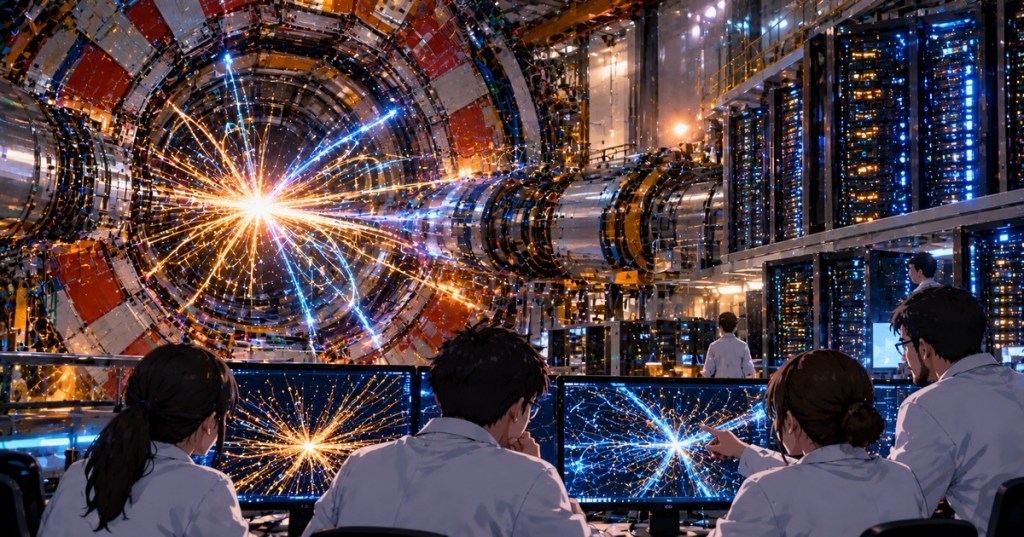
CERN and Mistral have signed a statement of intent to build what CERN describes as the first foundation model for collider physics: a single pretrained Large Physics Model designed to learn from billions of simulated proton-proton collisions.
CERN announced the partnership on October 15. The goal is not simply to add a chatbot to a physics lab. The proposed model is meant to work directly on the structure of particle-collision data and eventually support multiple scientific tasks that are currently handled by chains of specialized algorithms.
A same-day Mistral community discussion tracks CERN’s announcement of the planned Large Physics Model.
CERN says the model could eventually help reconstruct particle collisions, identify particles, flag unexpected signals and evaluate future detector designs. That is a broader workload than a single classifier. In effect, CERN wants one pretrained model to learn across several stages of the physics reconstruction pipeline instead of relying only on separate machine-learning systems for each task.
CERN’s official Large Hadron Collider overview explains the accelerator and the physics environment that produces the collision data behind the new AI effort.
The scale of the data is part of the motivation. CERN says the Large Hadron Collider has already produced roughly one exabyte of experimental data, or about one million terabytes. Collision volumes are expected to rise by roughly tenfold when the High-Luminosity LHC begins operating around 2030.
That makes the project another example of AI moving deeper into scientific computing. BitcoinVersus.Tech recently covered frontier AI models being opened to European researchers, while our latest supercomputer ranking shows how much specialized compute scientific workloads already consume.
The project is still early. Reuters reports that CERN and Mistral disclosed no budget or completed deployment timeline. CERN’s own AI roadmap is more specific about the broader physics-foundation-model effort: it lists first models around 2029, with continued development extending beyond 2030.
This CERN documentary visit shows how researchers already use AI to process LHC data and search for physics beyond established models.
That timeline matters because foundation models are expensive to train and difficult to validate in scientific settings. A physics model cannot simply generate plausible-looking output. Its predictions, uncertainties and failure modes have to survive the standards of experimental particle physics.
CERN also says the work could become shared scientific infrastructure. If a common pretrained model can handle reconstruction, simulation and anomaly detection across experiments, it could reduce duplicated development and give researchers a common foundation for new analysis tools. That would place the effort alongside other attempts to apply AI directly to research infrastructure rather than consumer software. BitcoinVersus.Tech recently covered new AI-supercomputer investment for scientific research.
The important point today is not that CERN already has a finished physics foundation model. It does not. The new development is that CERN and Mistral have formally committed to building one, using one of the world’s largest scientific datasets and a demanding validation environment. If the approach works, collider physics could become one of the clearest tests of whether large pretrained models can become durable scientific instruments.
BitcoinVersus.Tech Editor’s Note:
We volunteer daily to ensure the credibility of the information on this platform is Verifiably True. If you would like to support to help further secure the integrity of our research initiatives, please donate using the QR code provided

For best QR-code scanning results, please scan this donation code from a desktop or larger screen. Mobile screens may prevent camera recognition.


Leave a Reply