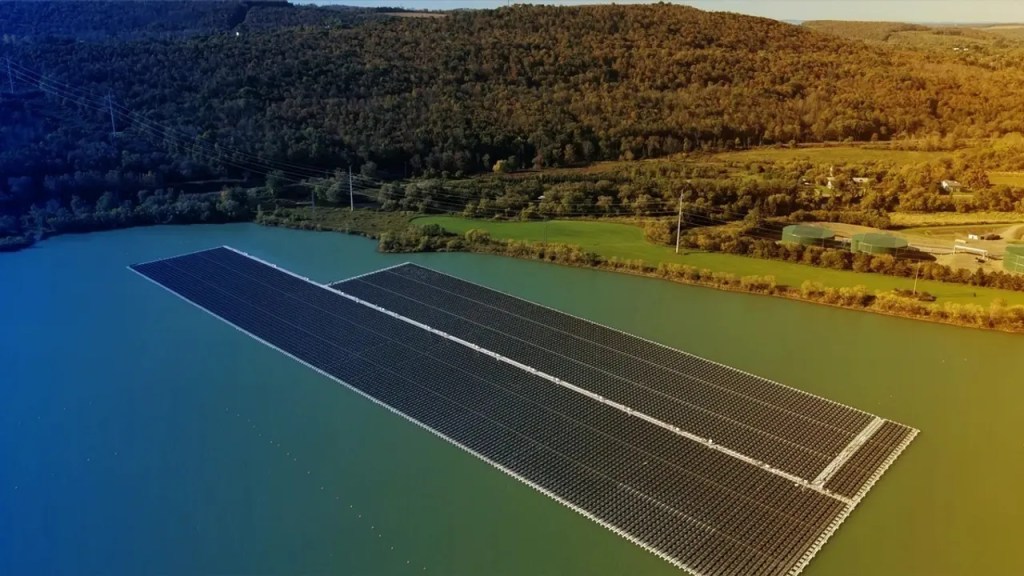
An active aggregate mine in Cortlandville, New York, is gaining a second industrial purpose: electricity generation. On November 17, Third Pillar Power announced construction of Crown City Solar, a 22.5 MW direct-current photovoltaic complex divided into three equal 7.5 MW phases. The project occupies part of a roughly 120-acre flooded excavation at the Polkville Crushed Stone Facility.
The developer expects the first phase to enter commercial service in February 2027, followed by the remaining phases in October. The engineering, procurement and construction contractor, D3Energy, independently lists the development as under construction. The project is intended to supply approximately 1,500 community solar subscribers rather than a dedicated data center.
Electrical equipment on the water
Instead of attaching modules to ground-mounted steel piles, the project uses buoyant platforms with a mooring system that accommodates movement. Elastic moorings from Hazelett Marine help constrain the arrays while allowing displacement as the water surface changes. The developer also intends to mount medium-voltage transformers and switchgear on engineered barges, reducing the area needed for electrical facilities onshore.
A floating transformer installation must address corrosion, grounding, cable movement, access for maintenance, equipment weight and buoyancy. Electrical cables connecting moving platforms and stationary shore infrastructure must remain within their permitted bend radius and tension limits.
Designing for a New York winter
Third Pillar specifies a ground snow-load design condition of 69 pounds per square foot, approximately 3.3 kilopascals. Snow accumulation can reduce output while adding mechanical load to the support system. Ice and freezing temperatures present additional design constraints for floating structures, and site-specific weather assessments are essential.
The 22.5 MW rating describes the aggregate DC nameplate capacity of the photovoltaic modules. Actual AC output depends on inverter capacity, irradiation, temperature, snow cover, system losses and grid restrictions. For an illustrative annual capacity factor of 15%, a 22.5 MW array would generate about 29.6 GWh before any adjustment needed for the difference between DC and AC capacity. The estimate is not a project forecast.
Implications for future computing infrastructure
Water-based generation could help industrial developers evaluate electricity supply without dedicating additional farmland to solar panels. A hypothetical flexible Bitcoin mining facility might be able to adjust its electricity demand alongside intermittent generation, while an AI installation would generally need firm electricity and additional redundancy. No Bitcoin mining or AI customer has been announced for Crown City Solar.
The meaningful next milestones are mechanical completion, inverter commissioning, utility interconnection and measured electricity production. Once operating, the project could provide useful evidence about the cost and reliability of floating equipment through repeated winter seasons.
Related: Solar shading engineering · Solar and storage in New Mexico · Floating solar and GPU compute · Solar-powered Bitcoin infrastructure


Leave a Reply