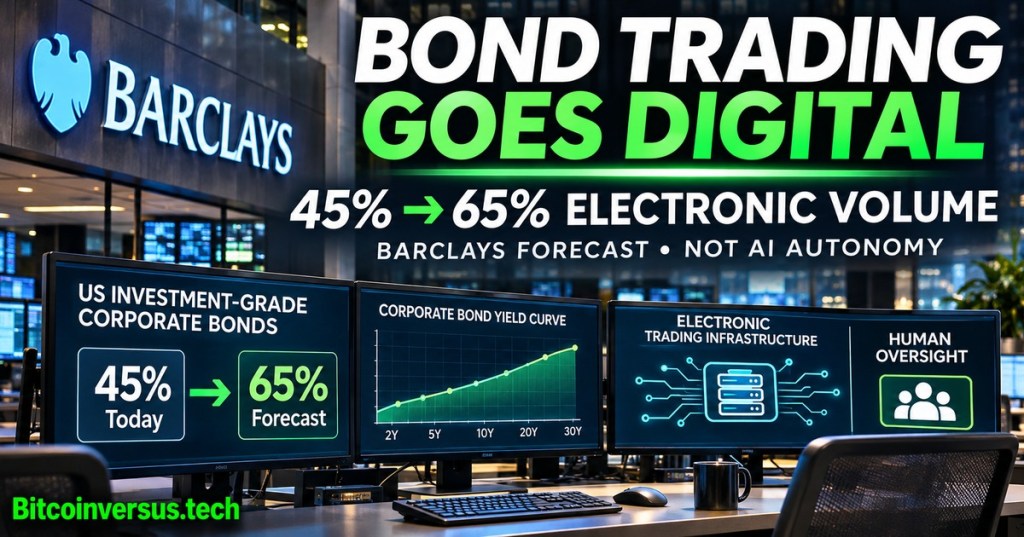
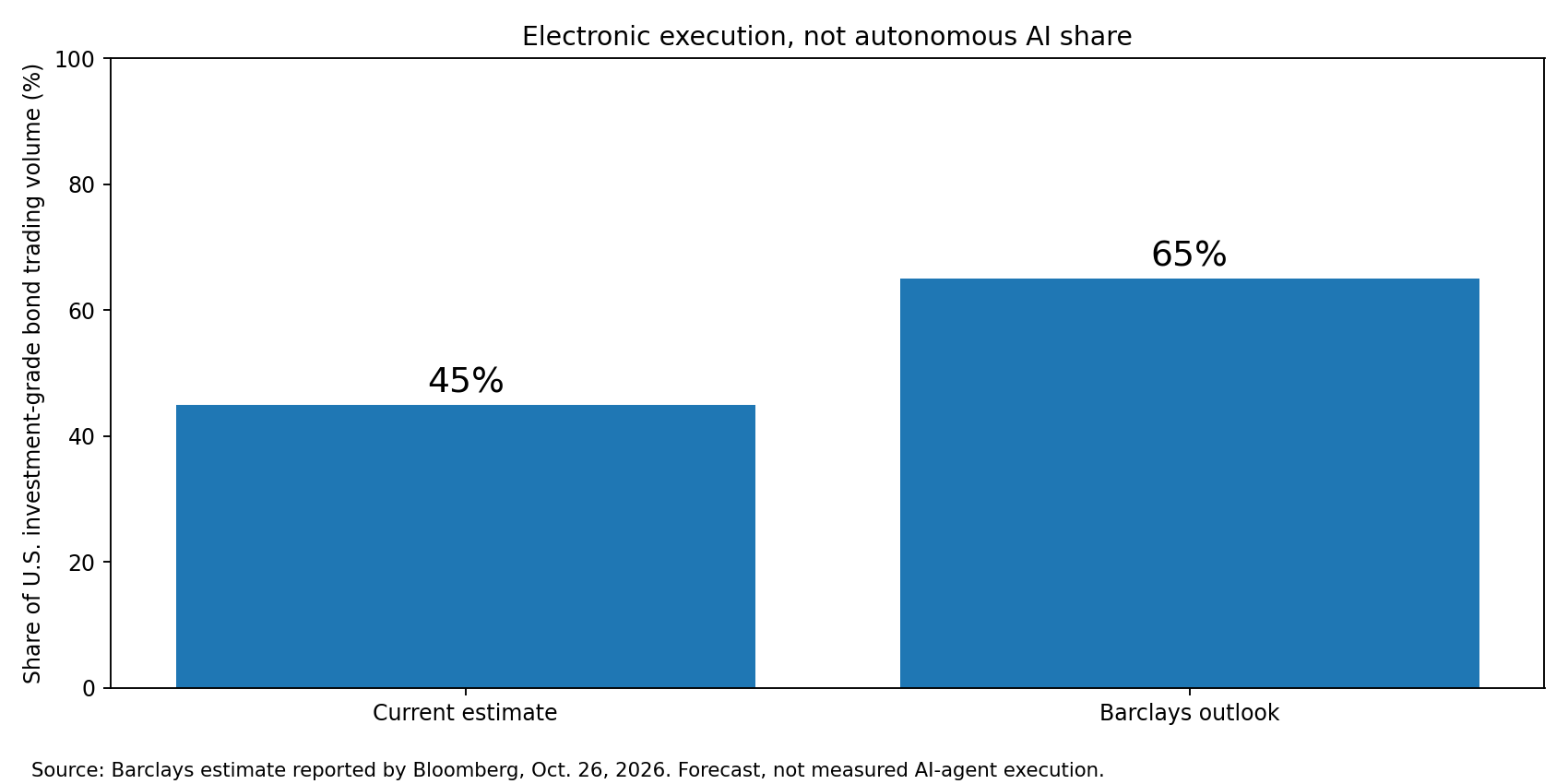
Barclays expects electronic trading to handle as much as 65% of U.S. investment-grade corporate-bond volume in coming years, compared with approximately 45% today, according to an October 26, 2026 Bloomberg report. Artificial-intelligence agents are helping drive the shift, but the forecast measures electronic execution—not the proportion of trades placed autonomously by AI. Confusing the two would substantially overstate what banks have deployed.
The 65% figure measures trading infrastructure
Barclays’ projection represents a gain of 20 percentage points, equivalent to a 44.4% relative increase in the electronic share: (65 − 45) ÷ 45 × 100. The forecast also puts electronic execution of U.S. high-yield bonds at 50%, approximately double the cited current share of 25%. Both numbers are projections without a specified completion year.
Bloomberg cited Crisil Coalition Greenwich data indicating approximately $62 billion of U.S. corporate bonds change hands on an average day. Applying the 20-point increase to the entire $62 billion would imply $12.4 billion more electronically executed volume daily, but such a calculation is not a valid market forecast: the $62 billion includes corporate-bond categories beyond investment-grade securities, and total trading volume can change. A defensible dollar estimate requires an investment-grade-only denominator.
Where agents enter the trading workflow
AI tools already help traders summarize news, examine bond covenants, screen securities, estimate transaction costs and choose counterparties. Tradeweb offers Automated Intelligent Execution, while MarketAxess describes AI-assisted routing and automated execution through Adaptive Auto-X. Neither product proves that all electronically executed transactions originate from autonomous agents. A human can submit an order electronically, and a rules-based algorithm can execute orders without generative AI.
Tradeweb’s corporate-bond platform supports request-for-quote, portfolio trading and automated execution. MarketAxess similarly documents rule-based automation and AI-supported execution pathways. The technical transition is gradual, moving from information gathering toward delegated decisions under defined risk limits. The broader AI accelerator software competition also highlights how software interfaces shape the practical value of computing hardware.
Automation can amplify errors during market stress
HSBC executive Michael Roberts told Bloomberg that experienced traders will remain involved in overseeing AI agents. Models can misread thin markets, respond to misleading data, or accelerate correlated selling. Controls must include maximum order sizes, exposure limits, stale-price detection, kill switches, human escalation and auditable order records.
The Financial Industry Regulatory Authority’s TRACE system reports eligible fixed-income transactions and provides market transparency, but ordinary trade records do not automatically establish whether an AI agent made the execution decision. The distinction matters when evaluating whether automation improves spreads and liquidity or simply shifts operational risk into software.
A growing AI-finance feedback loop
The rise of automated bond trading intersects with the borrowing boom funding AI infrastructure. Barclays Private Bank reports that AI-related credit issuance is reshaping investment-grade markets, while the IMF has warned about financial spillovers from an AI market correction. The market’s adoption of AI for execution therefore overlaps with increasing exposure to AI-sector debt.
A separate Morgan Stanley tokenization initiative illustrates another form of market infrastructure modernization, although tokenized settlement and algorithmic bond execution solve different problems. Meanwhile, Google’s AI infrastructure expansion shows the investment demand underlying part of the debt market.
The strongest test of Barclays’ forecast will be independently measured electronic investment-grade volume, execution quality during volatility, and transparent disclosure of which decisions were automated. A 65% electronic share could coexist with extensive human supervision.
Sources and methodology
Principal reporting: Bloomberg, October 26, 2026, including Barclays estimates and industry interviews. Primary context: MarketAxess automation documentation, Tradeweb product documentation and FINRA TRACE. The 44.4% relative increase is independently calculated; 65% remains a Barclays projection.
Editor’s Note — November 10, 2026: Barclays’ forecast concerns electronically executed investment-grade bond volume, not a measured 65% share of autonomous AI-agent trades. The featured cover is conceptual editorial artwork, not a documentary photograph of Barclays. The chart illustrates reported percentages, not independent trade-volume measurements. The Tradeweb social post provides contextual background and is not a direct Barclays announcement. We volunteer daily to ensure information on our platform is Verifiably True.
Support BitcoinVersus.Tech
Readers may support independent reporting with an optional 5,000-satoshi contribution. Scan the original QR code on a second screen or use a compatible wallet’s saved-image scanning function on mobile. Verify the recipient 3C9o19EH5HSiwEPyCTmEKzxhNCbo2X6TTb and amount before confirming.

BitcoinVersus.Tech is not a financial adviser. Market coverage is provided for informational purposes only.


Leave a Reply