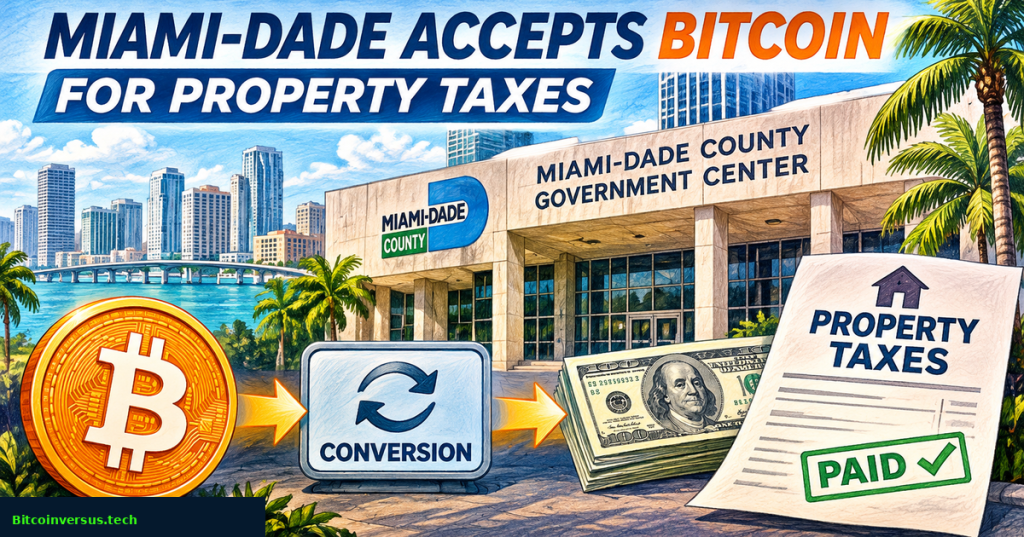
Miami-Dade County began accepting Bitcoin for property-tax payments on November 9, 2026, but the government will not keep the cryptocurrency. Tax Collector Dariel Fernandez announced an online and in-person payment option that converts supported digital assets into U.S. dollars before settlement. The distinction matters: Miami-Dade has added a payment rail, not a Bitcoin treasury.
Social-media report: Andy Slater’s November 9 X post. The claim is independently confirmed by the Tax Collector’s official announcement; the X player could not be verified.
Social-media report shared by Andy Slater on X. The claim is independently confirmed by the Miami-Dade County Tax Collector’s official November 9 announcement. Live X rendering remains subject to platform availability.
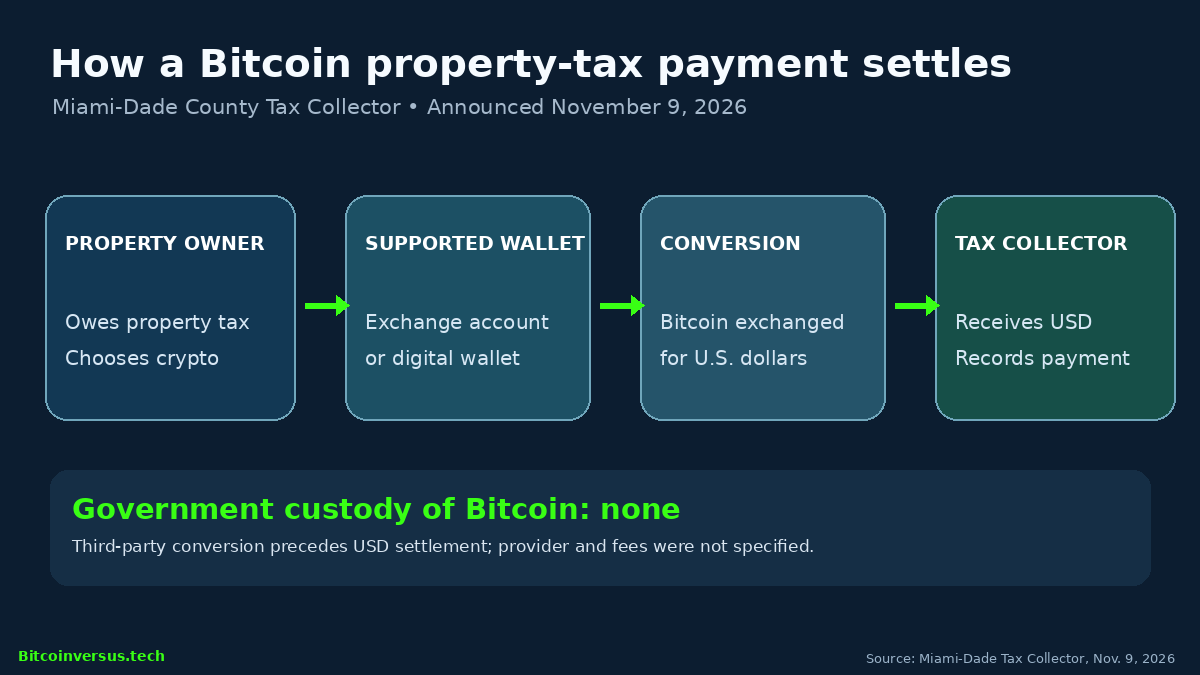
Property owners can choose cryptocurrency at online checkout or request the option in person, then authorize a transaction through a supported wallet or exchange account. According to the Tax Collector’s official announcement, the office receives the full dollar amount owed and records the payment through its existing accounting system. Cash, checks and card payments remain available.
Who holds the Bitcoin, and who bears the risk?
A third-party service handles the conversion before the funds reach county accounts. That arrangement reduces the government’s direct exposure to Bitcoin price movements and eliminates the need for county staff to administer private keys. It does not eliminate every risk: users still need to verify the payment destination, quoted exchange rate, fees and confirmation requirements. The public announcement did not identify the conversion provider or publish a cryptocurrency-specific fee schedule.
The security trade-off resembles broader adoption of intermediated Bitcoin services. BitcoinVersus.Tech recently reported wallet theft risks at older BTCPay installations and Coinbase’s national trust-bank charter development. Neither development establishes a direct connection to Miami-Dade’s chosen processor.
The financial calculation behind paying early
Miami-Dade’s existing property-tax discounts remain relevant regardless of payment method. Under the official early-payment schedule, eligible bills receive a 4% discount in November, 3% in December, 2% in January and 1% in February, with no discount in March. For an illustrative $5,000 gross bill, paying in November saves $200; waiting until March forfeits the entire discount.
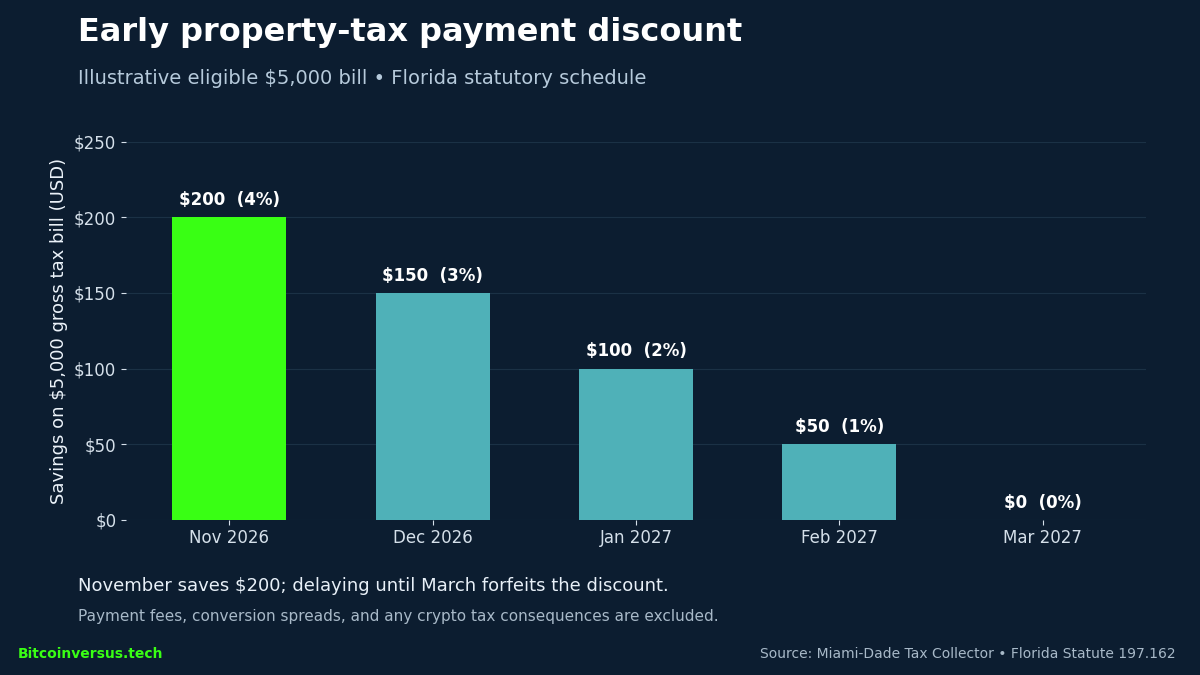
The arithmetic is straightforward: $5,000 × 0.04 = $200, leaving a $4,800 tax payment before any processor charges. A Bitcoin payer must compare the final dollar-equivalent debit with available conventional payment methods. No claim about a cheaper Bitcoin transaction is supported without the provider’s actual rate and fees.
A second tax question for Bitcoin holders
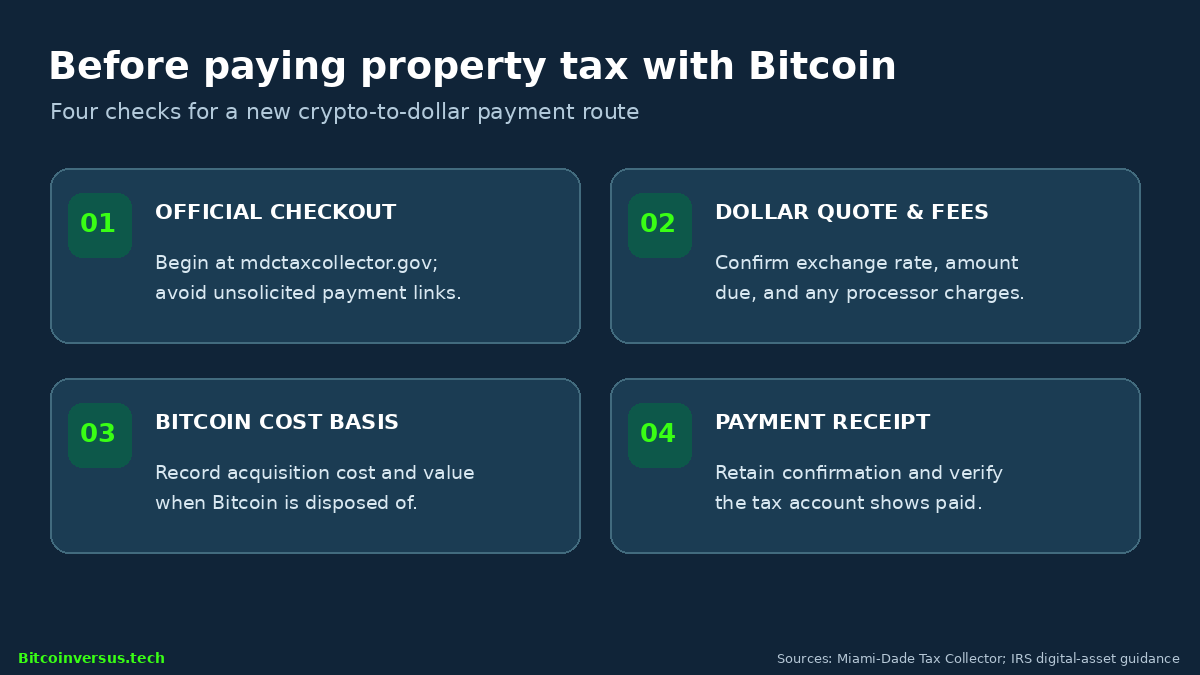
Spending appreciated Bitcoin can also create a separate federal tax event. The Internal Revenue Service treats digital assets as property and generally recognizes gains or losses when cryptocurrency is sold or otherwise disposed of. For example, converting Bitcoin with a $3,000 cost basis into $4,800 could generate a $1,800 capital gain before eligible transaction-cost adjustments. The example is illustrative, not a claim about any Miami-Dade taxpayer.
The tax collector’s announcement does not specify whether the payment flow executes an on-chain Bitcoin transaction, an exchange-account transfer or another supported route in each case. The federal treatment of a particular transaction depends on its mechanics and the taxpayer’s records.
Why the custody debate extends beyond local taxes
In a separate November 9 development, Barron’s reported that BlackRock has recorded approximately $3.6 billion of in-kind conversions from directly held Bitcoin into shares of its IBIT fund since U.S. regulators permitted the process in 2025. Security and peace of mind were prominent motivations cited by BlackRock’s digital-assets leadership. Conversions move existing exposure into an ETF wrapper; they are not equivalent to $3.6 billion of new Bitcoin purchases or net fund inflows.
The contrast is instructive: Miami-Dade accepts Bitcoin while avoiding custody; some large investors seek Bitcoin price exposure while avoiding personal key management. BitcoinVersus.Tech previously covered IBIT’s recent net outflows and wider crypto payment access in iOS apps. Payment acceptance, ETF ownership and direct custody solve different problems.
Miami-Dade’s launch establishes an additional way to settle property-tax bills, not evidence that the county is investing in Bitcoin. The practical test will be transparent fees, dependable settlement, secure customer authentication and documented taxpayer demand.
Sources and verification
Primary sources: Miami-Dade Tax Collector, November 9, 2026; Miami-Dade discount schedule; IRS digital-asset tax guidance. Independent corroboration: CBS Miami, November 9. BlackRock conversion figure attributed to Barron’s, not to county officials.
Editor’s Note: The November 9 county announcement confirms Bitcoin payments online and in person with U.S.-dollar settlement. No government Bitcoin holdings, payment volume, named processor or published crypto fee schedule were independently established. The featured cover is a conceptual illustration rather than a documentary photograph; the two original diagrams use the cited government schedule and payment description. The reader-supplied X post is linked rather than embedded because the attempted Gutenberg embed rendered only as a plain link. A verified official video was not available for inclusion. All calculations are editorial examples, not financial or tax advice.

To donate 5,000 sats, open the article on a separate display and scan the original QR code with a compatible Bitcoin wallet. On mobile, use another screen or a wallet’s supported image-scanning feature. Verify the destination 3C9o19EH5HSiwEPyCTmEKzxhNCbo2X6TTb before sending.
We volunteer daily to ensure the information on our platform is Verifiably True. If you would like to support the research, please scan the QR code.
BitcoinVersus.tech is not a financial adviser. Reporting on cryptocurrency, payments and tax consequences is informational only; consult a qualified tax professional for personal circumstances.


Leave a Reply