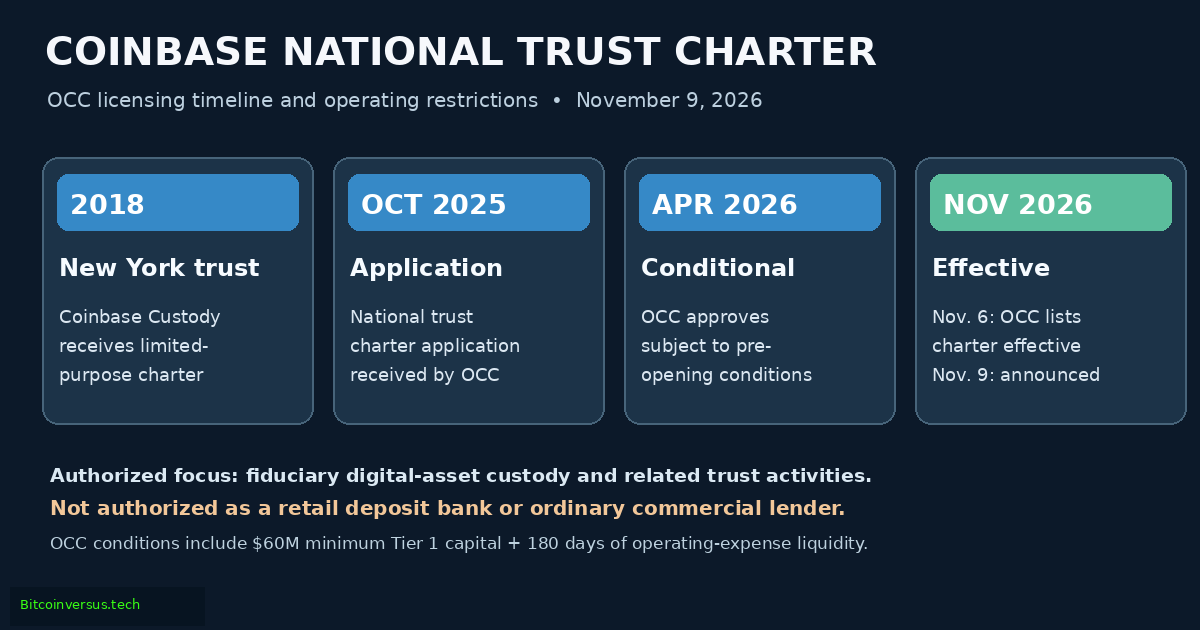
Coinbase National Trust Company has received its final U.S. national trust bank charter, moving the cryptocurrency exchange’s institutional custody operation toward direct federal banking supervision. The Office of the Comptroller of the Currency (OCC) lists the charter as effective November 6, 2026, following conditional approval on April 2. Coinbase announced the milestone on November 9. The decision authorizes a specialized trust institution—not a full-service retail bank.
Coinbase, “Building the Cryptoeconomy, with Brian Armstrong and Fred Wilson,” May 15, 2019. Archival discussion of Coinbase’s early institutional custody strategy, included for historical context. The video does not document the November 2026 OCC decision. Credit: Coinbase official YouTube channel.
What the National Trust Charter Permits
Crypto custody involves safeguarding digital assets and controlling transactions on behalf of clients. The OCC’s April 2 charter decision authorizes the new company to provide fiduciary digital-asset custody, primarily for institutions, and related transfers of customer assets. Coinbase said the new structure builds on state-regulated trust structures already familiar in crypto custody.
The bank’s business plan envisages moving custody work from New York-regulated Coinbase Custody Trust Company into the federal entity over a three-year period. That transition is planned, not evidence that every institutional account has already moved. Customers may access affiliate-provided staking, prime trading and financing, but the new trust bank itself will not directly provide those underlying services.
Coinbase’s existing relationships with conventional financial institutions, including Citi’s stablecoin payment infrastructure, are separate from the chartered trust company’s authorized custody activities. The federal license alone does not establish new customer deposits, lending capacity or payment-network access.
A Bank Charter With Defined Limits
The word “bank” matters legally, but the charter should not be confused with permission to accept ordinary retail deposits or make commercial loans. Coinbase stated during its April approval that it would not become a commercial bank or engage in fractional-reserve banking. The OCC’s approval also says the proposed trust bank does not plan to issue stablecoins under the approved business plan.
The new institution is not an FDIC-insured depository bank. Federal supervision does not convert custodial Bitcoin or other crypto holdings into FDIC-insured cash deposits. Similar distinctions have shaped debates over the SEC’s proposed crypto custody framework and federal stablecoin rulemaking.
Capital, Liquidity and Regulatory Scrutiny
The OCC’s original approval conditions require at least $60 million in Tier 1 capital, with the greater of $30 million or half the institution’s Tier 1 capital held in eligible liquid assets. It also requires a separate pool of eligible liquidity covering 180 days of operating expenses. Both conditions apply during the bank’s first three years and are minimum safeguards, not a guarantee against losses or cyber incidents.
Other crypto and traditional institutions are building competing custody offerings. BitcoinVersus.Tech previously examined Deutsche Bank’s planned custody launch and Standard Chartered’s regulated RLUSD custody service. Coinbase’s approval supplies a federal charter for an existing custody business, rather than proof of additional crypto adoption.
The move remains contested. Banking trade groups have challenged the OCC’s approach to limited-purpose crypto trust charters, arguing that the regulatory treatment differs from conventional insured banking. The OCC has defended its long-standing authority to supervise national trust institutions. Charter effectiveness does not resolve the surrounding legal or policy dispute.
Primary sources: OCC charter status, effective November 6; OCC Corporate Decision 1370, April 2; Coinbase announcement, November 9; Coinbase preliminary approval announcement, April 2.
BitcoinVersus.Tech Editor’s Note
Published November 9, 2026. The OCC’s status record and Coinbase’s announcement independently confirm the effective national trust charter. The company received conditional approval in April; its full charter became effective November 6. The April decision details approved activities and regulatory conditions. No new retail-deposit or commercial-lending authority is implied. The cover and licensing timeline are original editorial illustrations; the featured cover does not depict a real Coinbase office, vault or OCC premises. The embedded 2019 Coinbase video is archival background rather than announcement footage.
We volunteer daily to ensure the information on this platform is Verifiably True. If you would like to support the research, please scan QR code.

Support independent reporting with an optional donation of 5,000 satoshis. Scan the original QR code using a Bitcoin wallet on another screen, or use a compatible saved-image scanner on mobile. Verify address 3C9o19EH5HSiwEPyCTmEKzxhNCbo2X6TTb and payment amount before sending.
BitcoinVersus.Tech is not a financial advisor. Financial coverage is provided purely for informational purposes.


Leave a Reply