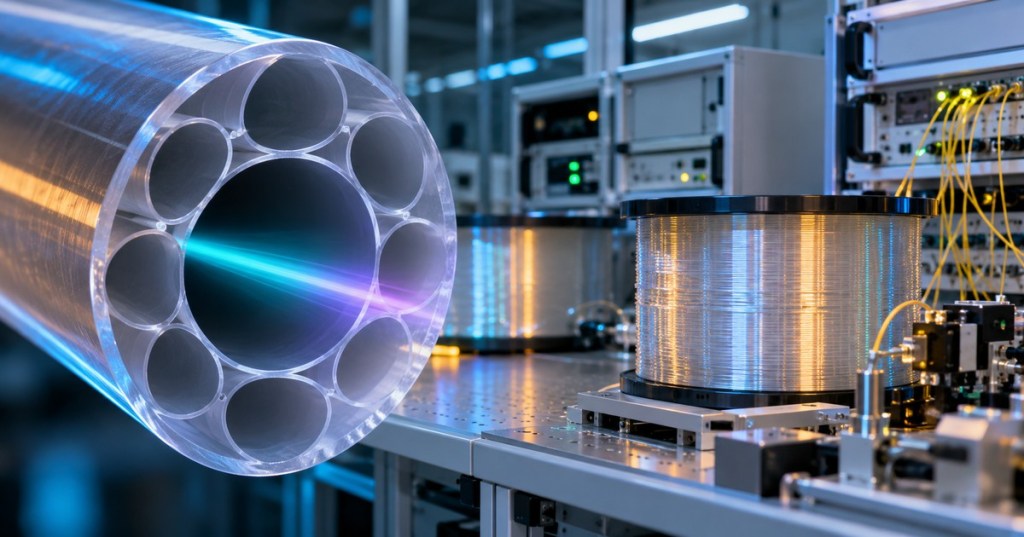
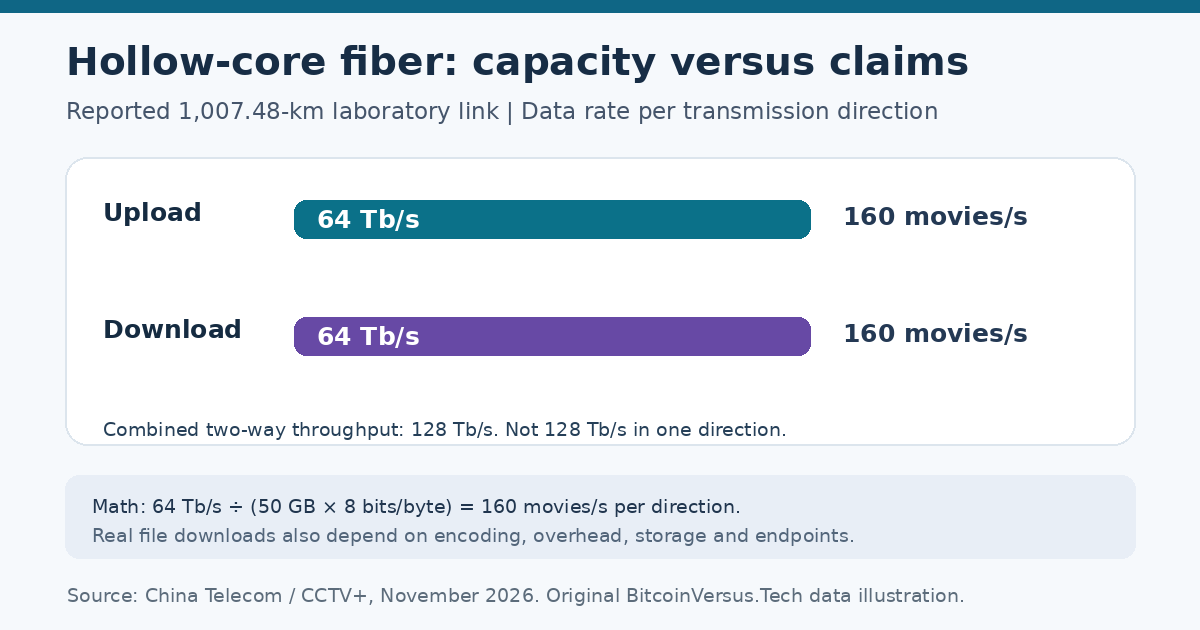
Hollow-core optical fiber guides light through an air-filled center instead of the solid silica core used in conventional telecom fibers. China Telecom Research Institute, fiber manufacturer YOFC and equipment maker ZTE now report a 1,007.48-kilometer point-to-point transmission experiment delivering 64 terabits per second in each direction. The two directions together total 128 Tb/s, while the reported signal-propagation delay across 1,000 kilometers was 3.43 milliseconds. The results concern an experimental link, not a consumer internet service or a deployed thousand-kilometer AI-network route.
The collaboration was publicly described on November 2, 2026, with additional footage and latency figures released by CCTV+ on November 8. Shanghai Securities News, citing China Telecom directly on November 4, reported 800 Gb/s per wavelength using probabilistically shaped 16-QAM modulation across extended C and L bands. Company and broadcaster accounts support the reported test parameters; a separately published, peer-reviewed paper for the specific trial was not located.
What 64 Tb/s Actually Means
A widely circulated social-media statement suggests 20,000 4K films could be downloaded in one second. The reported bandwidth does not support the claim. At an assumed 50 gigabytes per film, one movie contains 400 gigabits. Dividing 64,000 Gb/s by 400 Gb gives 160 movies per second per direction. The 128-Tb/s total counts simultaneous opposite-direction traffic; it is not a 128-Tb/s single-user download. Real transfers also face protocol overhead, storage limits, application performance and network contention. For context, the site’s optical-transceiver engineering guide explains the gap between a wavelength’s line rate and practical system throughput.
The claim was amplified on Coin Bureau’s X account. The supplied wording is included for editorial context, not as evidence for the technical measurements.
CienaCorp, “The role of coherent optics inside the data center,” April 30, 2026. Technical background on coherent optical links, not footage or independent validation of the China Telecom experiment. WordPress renders a YouTube player, but playback could not be independently tested during the audit.
How the Experimental Link Worked
More than 300 fiber spools, each containing roughly two to five kilometers, made up the laboratory link, according to CCTV+. Air guidance reduces the propagation component of delay because light moves faster through a gas-filled channel than through glass. China Telecom engineer Huo Xiaoli cited a roughly 30% reduction in fiber propagation latency relative to conventional fiber. The reported 3.43 milliseconds is one-way signal travel, not round-trip application latency or a measured gain in AI training speed.
The engineering advance extends beyond raw speed. China Telecom reported use of commercially available optical amplifiers, pre-equalization across wavelengths and optimization against absorption by gases including carbon dioxide and carbon monoxide. Each span reportedly retained at least 3 dB of loss margin and the system retained at least 3 dB of optical signal-to-noise ratio maintenance margin. Reflections nevertheless reduced OSNR by 0.5–4 dB, underscoring the importance of optical performance monitoring.
A Qualified Record, Not an Unlimited One
The claimed first concerns a thousand-kilometer, non-loopback, real-time, single-fiber bidirectional experiment. Earlier ZTE laboratory work documented 377.6 Tb/s over 100 kilometers under a different configuration and single-wavelength transmission beyond 10,000 kilometers using a recirculating experimental arrangement. Neither comparison establishes identical conditions. ZTE’s technical review also describes a 10.4-kilometer hollow-core connection between Hangzhou computing facilities. The coherent optical communications lesson explains the modulation and digital-signal-processing tradeoffs.
YOFC previously disclosed hollow-core product attenuation as low as 0.04 dB/km, continuous fiber lengths reaching 91.2 kilometers and more than ten pilot or commercial projects. Its March 2026 announcement describes manufacturing progress, not verification of the new thousand-kilometer test. The site’s recent silicon-photonics analysis similarly distinguishes short-link bandwidth from separately achieved long-haul reach.
Implications for Interconnected AI Data Centers
Long-distance AI clusters could benefit from faster propagation and greater link capacity when data must move between facilities. Yet reduced optical transit time alone does not establish faster model training: compute synchronization, congestion, switching, storage access, error correction and network topology affect end-to-end performance. Manufacturing yield, splicing, field maintenance, operating life and cost per kilometer remain unresolved in the new announcement. A documented full-route installation, independent traffic testing and commercial service-level measurements would provide stronger evidence of deployment readiness. Related operational long-haul cable networks illustrate the distinction between laboratory fiber experiments and customer-serving infrastructure.
Source record: CCTV+ experiment footage and technical account, November 8; Shanghai Securities News account citing China Telecom, November 4; ZTE engineering background; YOFC manufacturer background.
BitcoinVersus.Tech Editor’s Note
Reviewed November 9, 2026. Experimental performance and the record description are attributed to China Telecom, partners and CCTV+. The 160-movie-per-second directional equivalence is an editorial calculation from 64 Tb/s and a hypothetical 50-GB file. No independently measured public internet service, installed thousand-kilometer route, real AI training gain or third-party confirmation of every test condition is claimed. The cover is conceptual art and the capacity graphic is an original calculation, not laboratory photography. The social-media link is provided for context; independently successful YouTube playback was not confirmed.
We volunteer daily to ensure the information on this platform is Verifiably True. If you would like to support the research, please scan QR code.

To support independent research, make an optional donation of 5,000 satoshis. Scan the QR from a second screen with a Bitcoin wallet, or use a compatible saved-image QR scanner on mobile. Confirm destination 3C9o19EH5HSiwEPyCTmEKzxhNCbo2X6TTb and amount before paying.
BitcoinVersus.Tech is not a financial advisor. Financial coverage is provided purely for informational purposes.


Leave a Reply