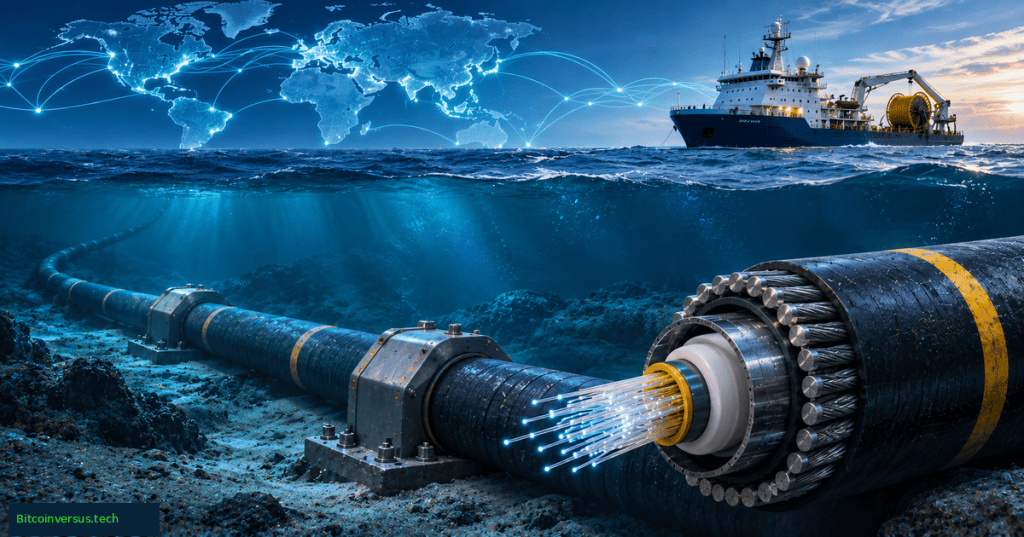
The modern internet depends on optical fibers extending across ocean floors. A submarine cable system combines undersea fiber, powered repeaters, landing stations and sometimes inland links to carry light-encoded traffic between continents. TeleGeography’s submarine cable map, updated October 28, 2026, tracks active and planned systems. A comparison of published system lengths identifies seven enormous networks with operating routes, including Africa’s 2Africa project and long-serving Pacific and Latin American cable rings.
TeleGeography, “Paradox: The Surprising Logic Behind the Submarine Cable Industry,” Submarine Networks World 2026. Official analyst presentation on subsea-network scale and resilience; not direct footage of every ranked cable.
The ranking measures published total system length in kilometers, not fiber-pair count, optical capacity, cable laid only under water or the length of a single end-to-end user connection. Multi-branch networks can include land segments. At least one route must be in service; incomplete extensions are identified rather than treated as fully operational.
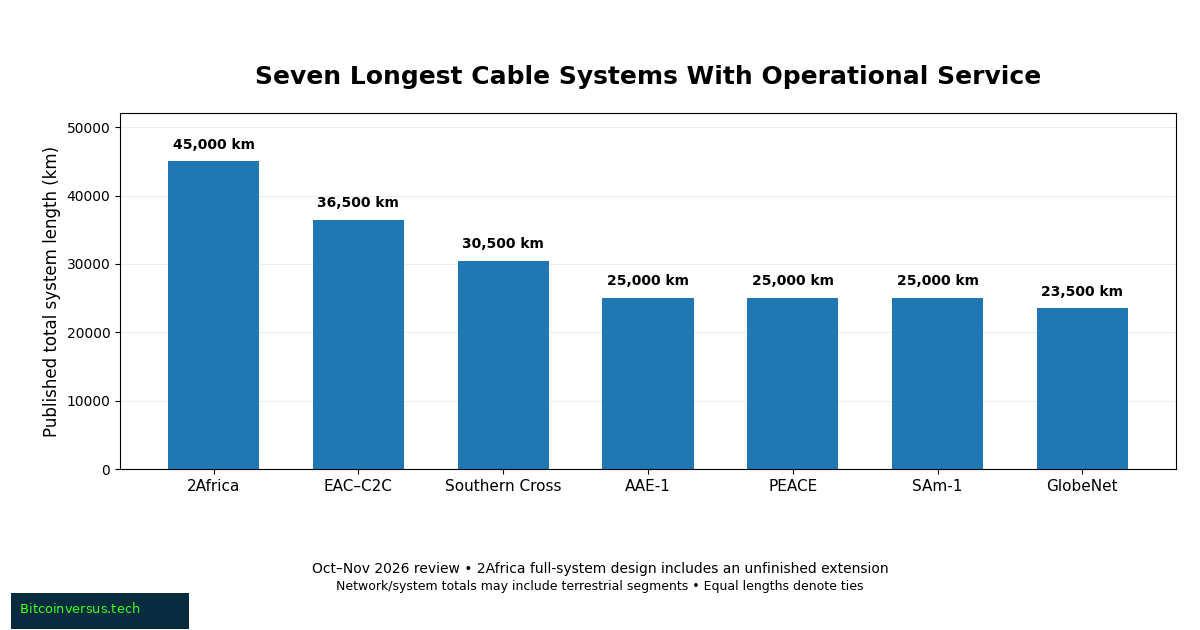
The Seven Longest Operating-Core Cable Systems
1. 2Africa — 45,000 km proposed full-system span. Meta reported completion of 2Africa’s core system in November 2025, connecting Africa with Europe and parts of Asia and the Middle East. The complete 45,000-km figure includes its Pearls expansion, which was still unfinished during 2026. It is therefore a full-project length, not 45,000 km independently verified as lit and operational. The consortium reports that core routes have reached service-ready status in most landing countries.
2. EAC-C2C — 36,500 km. Telstra’s East Asia Crossing/City-to-City system connects Japan, South Korea, Taiwan, Hong Kong, mainland China, Singapore and the Philippines. The network entered service in November 2002. Its extensive branching provides multiple paths, although individual routes can suffer faults and repairs.
3. Southern Cross Cable Network — 30,500 km. The long-running Pacific ring links Australia, New Zealand, Fiji, Hawaii and the United States. The published length includes approximately 28,900 km of submarine cable and 1,600 km of terrestrial connections. Southern Cross continues operating alongside its newer NEXT system; total network length must not be mistaken for a single submarine strand.
TeleGeography, “Boom, Bottleneck, or Both? An Update on Global Subsea Connectivity,” Capacity Europe 2026. Official industry research presentation on subsea investment and bandwidth; background context rather than a verification of individual landing points.
Joint 4th. Asia Africa Europe-1 (AAE-1) — 25,000 km. AAE-1 links East and Southeast Asia with the Middle East, Africa and Europe through Egypt. The consortium describes 100-Gbps transmission technology and at least 40 Tbps of design capacity. Capacity is not the same measurement as physical route length.
Joint 4th. PEACE Cable — 25,000 km. PEACE links Asia, East Africa and Europe. China Mobile International activated the extended Singapore-to-France route in September 2024 after earlier segments had entered service. Published lengths describe the whole multi-segment system.
Joint 4th. South America-1 (SAm-1) — approximately 25,000 km. Operator Telxius maintains a ring connecting the United States with Latin American Atlantic and Pacific coastlines. The system includes roughly 22,000 km undersea and 3,000 km inland. A 2025 U.S. FCC license renewal confirms continued operation.
7. GlobeNet — 23,500 km. The V.tal-operated system connects parts of North and South America, Bermuda and the Caribbean. It entered service in 2000, and recent monitoring identifies the cable as active. GlobeNet’s loop length greatly exceeds the distance used by any single packet crossing part of the network.
Why Record Length Does Not Guarantee Faster Connections
Optical propagation delay rises with physical distance, and traffic can cross only a fraction of a system’s branching layout. Longer systems can improve geographical reach and resilience while introducing more repeaters, maintenance complexity and landing dependencies. Pluggable optical equipment and high-capacity transceivers help operators increase useful throughput without changing a cable’s physical span.
Route diversity matters because fishing gear, anchors and seabed activity can damage long-haul connections. Related BitcoinVersus.Tech reporting examines new Arctic fiber routes, U.S. subsea cable manufacturing and fiber-optic testing. The retired 39,000-km SEA-ME-WE 3 system is excluded: operators ended its service in December 2024. Planned-only Meta Project Waterworth is likewise excluded.
Primary sources: TeleGeography, October 28, 2026 map; Meta Engineering, 2Africa core completion; AAE-1 consortium; Telxius SAm-1 operator profile; TeleGeography 2026 cable investment analysis.
BitcoinVersus.Tech Editor’s Note
Published November 8, 2026. The Top 7 orders named cable systems with operational service by their published overall system lengths. It is not a ranking of fully commissioned subsea-only fiber kilometers. The 45,000-km 2Africa figure includes its incomplete Pearls extension; Southern Cross and SAm-1 figures include onshore portions. System dates, cable lengths and completion states were cross-checked against operator reporting and industry databases. The cover is original conceptual artwork, not an engineering drawing of a particular deployed cable. The two TeleGeography videos provide research context, not independently verified live network performance.
We volunteer daily to ensure the information on this platform is Verifiably True. If you would like to support the research, please scan QR code.

To support independent reporting, make an optional donation of 5,000 satoshis. Scan the original QR from another screen with a Bitcoin wallet, or use a compatible saved-image scanner on mobile. Verify destination 3C9o19EH5HSiwEPyCTmEKzxhNCbo2X6TTb and amount before sending.
BitcoinVersus.Tech is not a financial advisor. Financial coverage is provided purely for informational purposes.


Leave a Reply