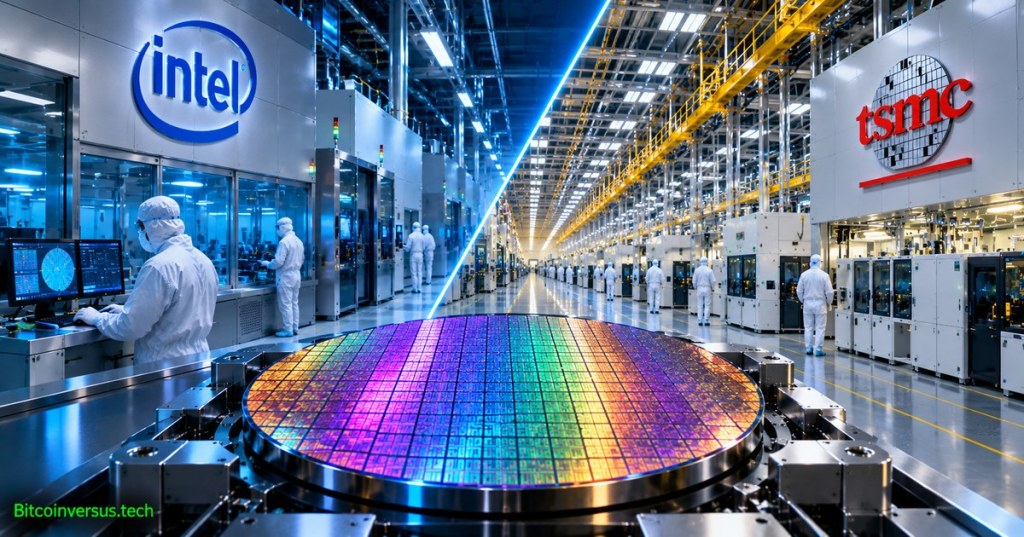
Only $411 million of Intel Foundry’s $6.697 billion third-quarter 2026 revenue came from outside customers, according to Intel’s October 30 regulatory filing. The external share was approximately 6.1%, exposing the commercial challenge behind Intel’s effort to compete with Taiwan Semiconductor Manufacturing Company (TSMC): developing an advanced process is different from filling factories with paying customers.
Dwarkesh Patel, “Why Only 3 Companies Can Still Make Cutting-Edge Chips.” A short excerpt of the October 22 Intel fab-tour interview with CTO Pushkar Ranade, linked by the executive on October 26. Credit: Dwarkesh Podcast / YouTube.
Intel’s $6.7 billion foundry figure needs context
Intel Foundry generated $6.697 billion in segment revenue during July–September 2026, but approximately $6.3 billion reflected transactions inside Intel. External business contributed $411 million, or 411 ÷ 6,697 × 100 = 6.1%. Intel said most of the increase in outside revenue over the prior year came from a non-recurring foundry contract. The reported growth therefore does not, by itself, demonstrate a recurring pipeline of leading-edge third-party chip orders.
The segment also posted a $1.853 billion operating loss, improved from $2.321 billion a year earlier. Those are segment-level results, incorporating internal transfer activity and development costs—not losses on only the $411 million of external sales. Intel’s broader financial performance is covered in its October earnings-market report.
Why scale and yield reinforce each other
During Patel’s interview, Intel CTO Pushkar Ranade said approximately 80% of the cost structure of a built fab is fixed, describing why both utilization and manufacturing yield are pivotal. Yield measures the share of manufactured dies that meet specifications. With 1,000 candidate dies, improving yield from 60% to 65% lifts usable output from 600 to 650—an 8.3% increase without adding a wafer. Raising yield to 70% would produce 16.7% more good dies than the 60% baseline.
The die-count arithmetic is straightforward, but profit can respond disproportionately because expensive equipment, cleanrooms and engineering staff still must be paid for. Scale additionally lets engineers run more process experiments and distribute development costs over larger shipments. Intel identified TSMC, Samsung and Intel as the three remaining major companies pursuing the most advanced logic-manufacturing nodes; the classification is narrower than the entire worldwide foundry market.
TSMC Museum of Innovation, “TSMC Fab Tour,” February 22, 2024. Official historical manufacturing footage showing fab operations; not a measurement of 2026 production capacity. Credit: TSMC Museum of Innovation / YouTube.
TSMC’s scale is documented, but accounting differs
TSMC reported $46.72 billion in consolidated third-quarter revenue, a 66.4% gross margin and 4.476 million 12-inch-equivalent wafer shipments. Its full-year 2026 capital budget is $60 billion–$64 billion, according to the company’s October earnings discussion. TSMC’s customer-facing consolidated sales cannot be directly compared with Intel Foundry’s segment revenue, which largely consists of intragroup transactions. For wider context, BitcoinVersus.Tech’s foundry ranking uses a consistent earlier-quarter industry dataset.
Intel’s technology plan remains active. Its 18A process supports products already in high-volume production, while the successor 14A process and external-customer design kit remain in development. The 14A design-kit milestone is important but does not establish the outside orders, sustained yields or utilization required to match a larger foundry’s economics.
ASML, “Holistic lithography: Optimizing chipmaking from design to mass production,” June 23, 2026. Official process-control background; not independent verification of Intel’s financial results. Credit: ASML / YouTube.
Expansion faces a commercial test
TSMC and Intel both face long equipment lead times, but Intel also needs to secure committed third-party demand before justifying larger new-fab investments. In its filing, Intel said the pace of 14A expansion will depend on acceptable expected returns and future customer commitments. The site previously examined the physical equipment limits in the same interview’s separate supply-chain story and ASML’s equipment outlook.
Intel’s near-term test is measurable: recurring third-party foundry revenue, qualifying products on schedule, improving usable yield and sustainable factory utilization. The interview explains why those metrics—not process-node branding alone—determine whether a challenger can narrow TSMC’s advantage.
Primary sources and method: Intel Form 10-Q, filed October 30, 2026; Dwarkesh Patel’s October 22 interview transcript, 53:14 onward; TSMC Q3 2026 investor results; Intel’s October 29 quarterly earnings release. Calculations use segment revenue and external-sales figures reported in Intel’s regulatory filing.
BitcoinVersus.Tech Editor’s Note
Published November 8, 2026. The video is an excerpt of a broader October 22 Intel interview already covered separately by BitcoinVersus.Tech; the distinct reporting angle comes from October 30 foundry segment disclosures. Intel Foundry segment revenue includes intersegment transactions, while TSMC’s revenue is consolidated; the figures are not directly comparable market-share measurements. The example yield calculation holds candidate die count fixed and does not reproduce actual Intel yield measurements. Featured artwork is a conceptual depiction of Intel and TSMC facilities, not photographs of operating production lines. The other two videos are official educational background.
We volunteer daily to ensure the information on this platform is Verifiably True. If you would like to support the research, please scan QR code.

For an optional 5,000-satoshi contribution, scan the original QR with a Bitcoin wallet from a second screen. On a phone, save the QR image and choose a compatible wallet’s image-scanning feature. Confirm the destination 3C9o19EH5HSiwEPyCTmEKzxhNCbo2X6TTb and amount before sending.
BitcoinVersus.Tech publishes financial and industry information for research purposes, not personalized investment recommendations.


Leave a Reply