
More than three-quarters of humanity now uses the internet, according to estimates published by the International Telecommunication Union (ITU) on November 3, 2026. The Facts and Figures 2026 report estimates 6.3 billion users, up from a revised 6.1 billion in 2025. Approximately 2 billion people remain offline. The global adoption milestone conceals a much larger difference in access to advanced mobile infrastructure between rich and poor countries.
The gap between connectivity and coverage
Internet adoption in high-income economies exceeds adoption in low-income economies by 61 percentage points: 93% compared with 32%. The difference in 5G availability is wider, at 82 percentage points. The ITU’s release estimates that 86% of residents in the higher-income group live within reach of 5G service, compared with 4% in the lower-income group. Neither coverage measure represents the percentage of residents who subscribe to the technology.
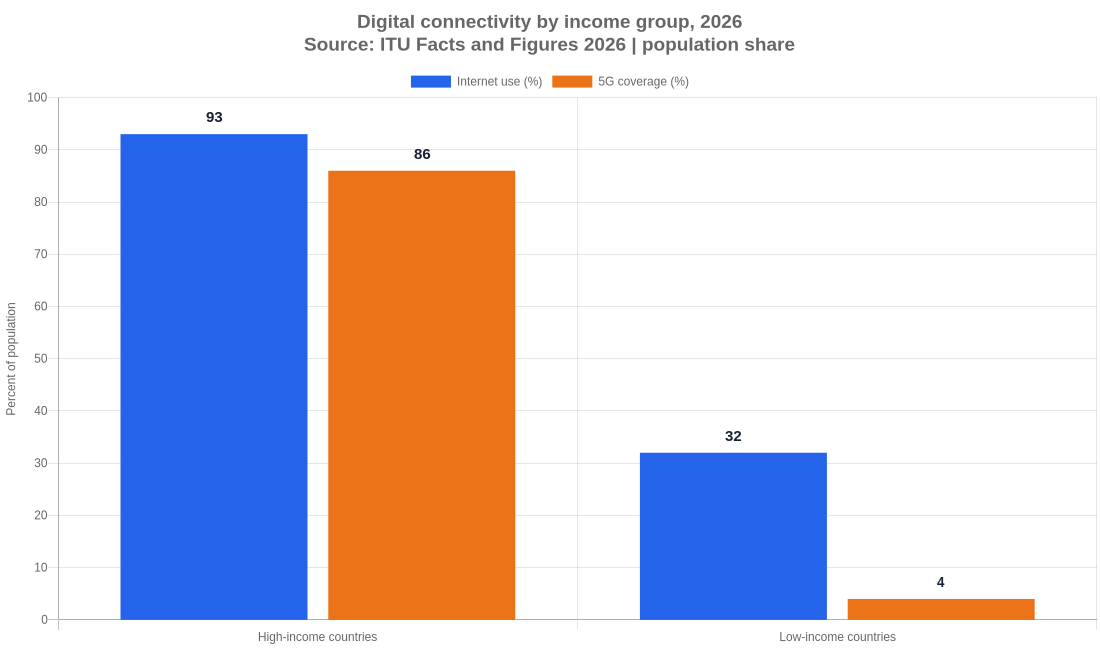
The engineering distinction is fundamental. A mobile network may cover a geographic area without every household possessing compatible equipment, paying for a service plan or receiving adequate signal quality indoors. Radio capacity is shared among active devices, so coverage alone cannot establish throughput, latency or reliability. Conversely, people may access the internet over Wi-Fi, older cellular standards or wired connections even where 5G is unavailable.
Why infrastructure economics matter
Building a network requires both the radio access layer and transport infrastructure. Towers connect to aggregation facilities, frequently over optical fiber or microwave links. The core network authenticates devices and routes traffic, while interconnection facilities exchange data among independently operated networks. Recent examples include 100G backbone connections in Nairobi, Open RAN interoperability testing, long-distance hollow-core fiber experiments and operational submarine cable systems.
Capital expenditure per potential customer can be higher in sparsely populated areas, especially when power supply and backhaul require separate construction. Shared infrastructure can improve project economics, but it does not automatically eliminate affordability barriers. The Internet Society’s November 13 analysis emphasizes the importance of affordable, reliable connectivity alongside physical availability.
The reported difference between rounded annual user counts is about 200 million, not an exact count of newly connected individuals. ITU revises historical estimates as additional information becomes available. Evaluating future progress therefore requires a consistent reporting vintage, alongside measures of actual use, service quality and affordability. For operators and policymakers, the goal is not simply to maximize the size of the coverage footprint, but to make useful connectivity economically accessible within it.
Featured illustration: ITU Facts and Figures 2026 promotional artwork.
We volunteer daily to ensure the credibility of the information on this platform is Verifiably True. If you would like to support to help further secure the integrity of our research initiative, please scan the QR code below.

For mobile scanning, open the article on another display and scan the QR code with a Bitcoin wallet. The voluntary donation amount is 5,000 sats. Verify the receiving address 3C9o19EH5HSiwEPyCTmEKzxhNCbo2X6TTb before sending.
BitcoinVersus.tech is not a financial advisor. This media platform reports on financial subjects purely for informational purposes.


Leave a Reply