
Worldwide sales of plug-in electric vehicles reached approximately 2.09 million units in October 2026, according to Benchmark Mineral Intelligence’s November 12 market report. The estimate covers battery-electric vehicles and plug-in hybrids in the passenger and light-duty markets. Sales rose 8% from October 2025 but fell 3% from September 2026. For January through October, the research firm reported 17.5 million sales, 5% above the equivalent period in 2025.
Where the vehicles were sold
China remained the largest regional market at approximately 1.14 million units, followed by Europe at 510,000. Markets outside China, Europe and North America accounted for roughly 300,000, while North America recorded 130,000. The rounded regional values total 2.08 million rather than the reported global 2.09 million; they are approximate components, not an independently reconciled exact total.
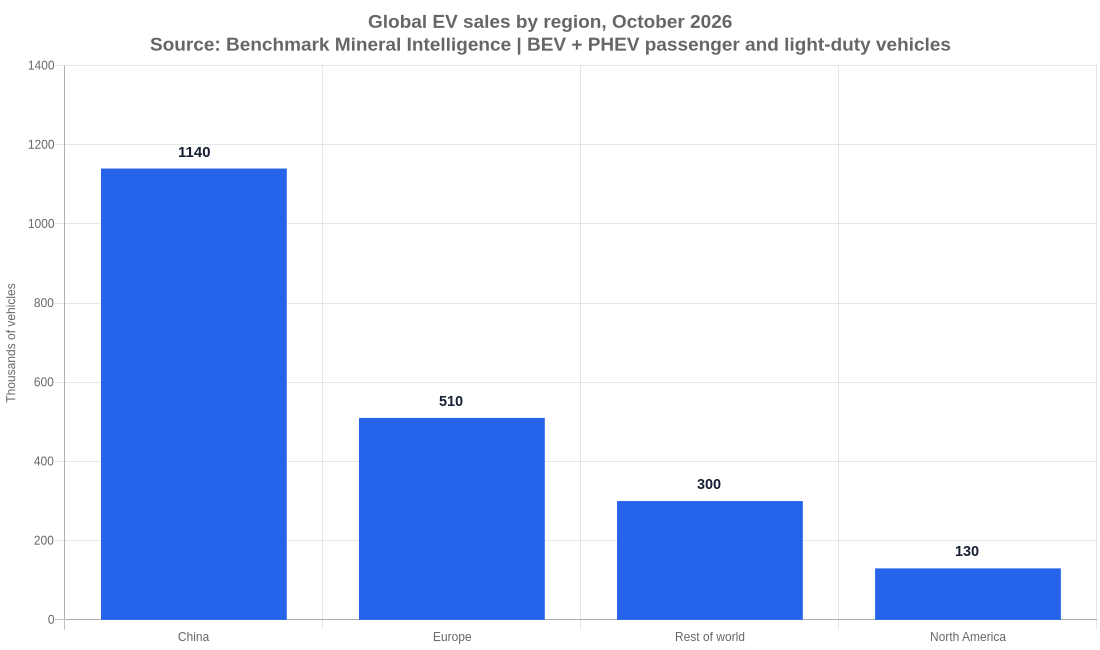
China accounted for about 54.5% of the global reported count. Europe represented about 24.4%, and the two markets together accounted for about 79%. Yet their annual growth moved in opposite directions: China contracted 12%, while European sales expanded 36%. Benchmark reported growth of 85% in the remaining markets and 24% in North America. Reuters’ coverage noted the importance of the easier U.S. comparison base following the expiration of federal purchase incentives in September 2025.
The implications for vehicle and battery manufacturing
Unit sales do not translate directly into battery demand because plug-in hybrids generally carry smaller packs than fully electric vehicles. A hypothetical 100,000 battery-electric vehicles equipped with 60 kWh packs would require 6 GWh of nominal battery capacity. The same number of plug-in hybrids with 20 kWh packs would require 2 GWh. Neither example estimates actual October battery production; the calculation isolates the effect of battery size.
The difference matters to manufacturers planning cell production, power electronics, motor capacity and charging infrastructure. Related engineering developments include European Union powertrain registration shares, BMW’s 800 V battery communications testing, Toyota’s manufacturing automation plans and utility-scale battery deployment. Stationary storage and vehicle batteries compete for some supply-chain inputs, but their respective demand figures should remain separate.
Regional sales growth can reflect policy changes, market composition or seasonal registration patterns rather than a uniform improvement in underlying demand. The next monthly release will provide another observation, but a reliable assessment of long-term electrification requires tracking year-to-date trends, battery capacities, price movements and the share of new vehicles sold. October establishes a positive annual comparison globally, not a synchronized recovery in every market.
Featured photograph: Benchmark Mineral Intelligence market-report artwork.
We volunteer daily to ensure the credibility of the information on this platform is Verifiably True. If you would like to support to help further secure the integrity of our research initiative, please scan the QR code below.

For mobile scanning, open the article on another display and scan the QR code with a Bitcoin wallet. The voluntary donation amount is 5,000 sats. Verify the receiving address 3C9o19EH5HSiwEPyCTmEKzxhNCbo2X6TTb before sending.
BitcoinVersus.tech is not a financial advisor. This media platform reports on financial subjects purely for informational purposes.


Leave a Reply