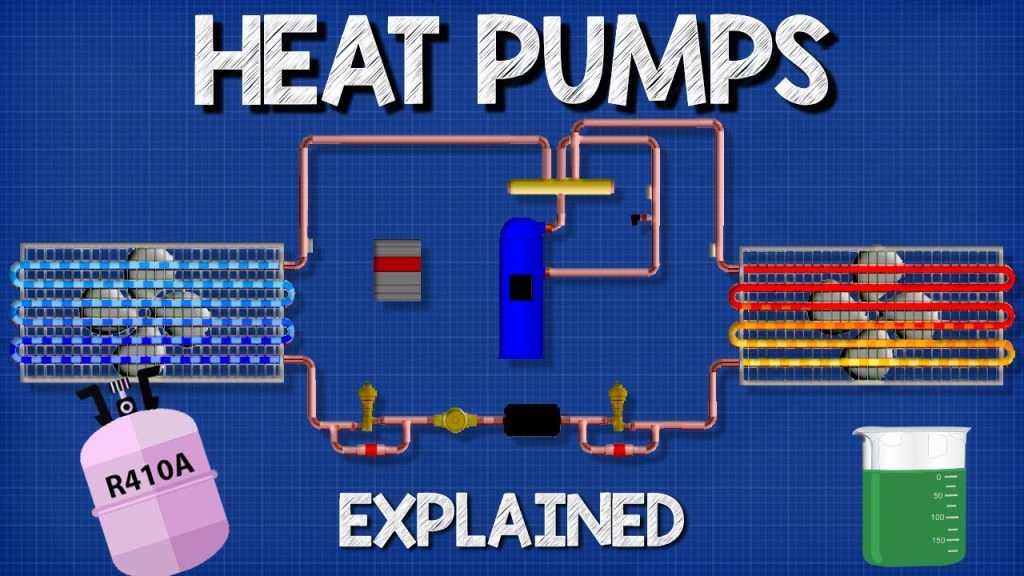
A heat pump moves thermal energy from a cooler reservoir to a warmer one by consuming work. The amount of work required depends strongly on the temperature difference the machine must overcome. Understanding that relationship helps explain why a low-temperature heating system may use less electricity than a high-temperature radiator circuit, even when both deliver the same amount of useful heat. The distinction extends the fundamentals in our heat pump overview.
The thermodynamic ceiling
For a reversible heating cycle operating between two ideal reservoirs, the maximum heating coefficient of performance is COP = Thot / (Thot − Tcold), where both temperatures are measured in kelvins. The result follows from energy conservation and the second law of thermodynamics, as explained in OpenStax College Physics. A COP of three means three units of useful heat are delivered per unit of work; two units originate in the colder reservoir. No energy is created.
Suppose the cold reservoir is 5°C (278.15 K). If the warm reservoir is 35°C (308.15 K), the ideal heating COP is approximately 10.27. Raising the warm reservoir to 65°C (338.15 K) doubles the temperature lift from 30 K to 60 K, reducing the theoretical ceiling to approximately 5.64. These are mathematical bounds, not equipment ratings. A real compressor, fan, pump and expansion device introduce irreversible losses.
A simple illustration makes the operational implication clear. Delivering 12 kWh of useful heat at an actual COP of four requires 3 kWh of electricity. At COP two, the same heat delivery requires 6 kWh. The actual COP must come from measurements or rated performance under comparable conditions. The Department of Energy’s efficiency definitions also distinguish instantaneous performance from seasonal ratings.
Why temperature lift matters beyond buildings
The temperature of the refrigerant at its evaporation surface must be below the source fluid, while its condensing temperature must exceed the receiving fluid. Heat exchangers consequently add approach-temperature differences to the lift. Poor heat transfer, restricted airflow and scale can increase compressor work. The principles behind heat exchanger temperature approach and coolant flow balancing also apply to industrial heat recovery.
Consider a data center supplying moderately warm water to a nearby district heating network. Raising the source temperature or reducing the required delivery temperature can reduce the lift. The proposed Jokkmokk AI heat-recovery project illustrates why thermal demand and its temperature specification matter alongside computing capacity. Operators should compare annual useful heat, total system electricity, seasonal conditions, refrigerant operating limits and backup demand rather than judging a system by a single favorable COP measurement.
We volunteer daily to ensure the credibility of the information on this platform is Verifiably True. If you would like to support to help further secure the integrity of our research initiative, please scan the QR code below.

For mobile scanning, open the article on another display and scan the QR code with a Bitcoin wallet. The voluntary donation amount is 5,000 sats. Verify the receiving address 3C9o19EH5HSiwEPyCTmEKzxhNCbo2X6TTb before sending.
BitcoinVersus.tech is not a financial advisor. This media platform reports on financial subjects purely for informational purposes.


Leave a Reply