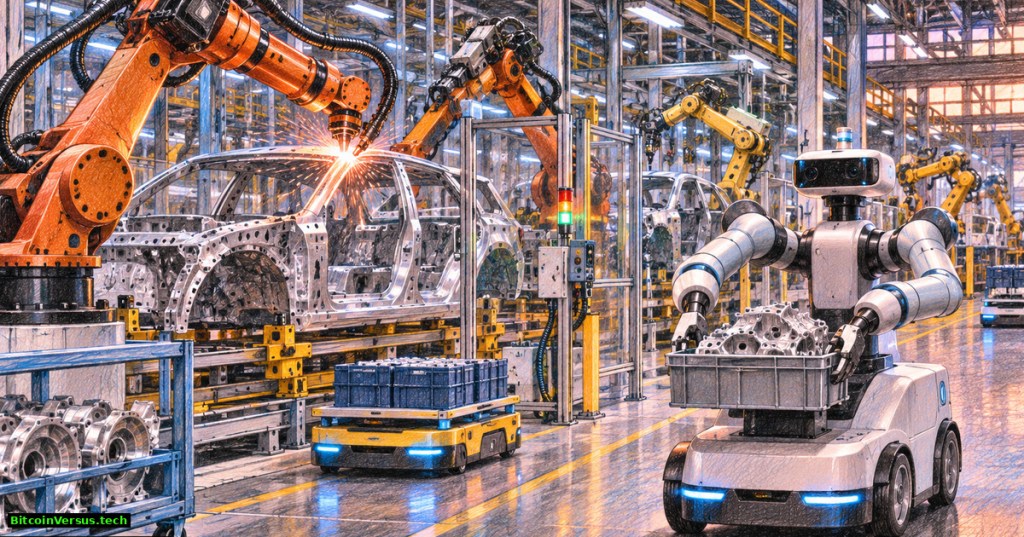
Toyota’s November 2026 investor presentation outlines a factory overhaul with estimated demand for 400,000 robots across Toyota, its group companies and suppliers from 2028 through 2040. The automaker wants a new Toyota Robotics organization operational in January 2027, transforming decades of manufacturing expertise into a potential business beyond cars. Crucially, the figure represents projected cumulative replacement demand, not robots already installed or firm orders.
The plan concerns conventional industrial arms, automated material movement and more advanced machines capable of working beside people. At a November 11 North American technology showcase, Toyota connected robotics with its factory-control systems, software platform Arene and production knowledge accumulated by skilled technicians. The ambition is industrial automation at supply-chain scale, rather than an overnight replacement of assembly workers.
Toyota Research Institute, February 2, 2026: company-produced footage explaining why researchers train robots in working factories. Historical research context, not a demonstration of the projected 400,000-unit deployment.
The 400,000-robot breakdown
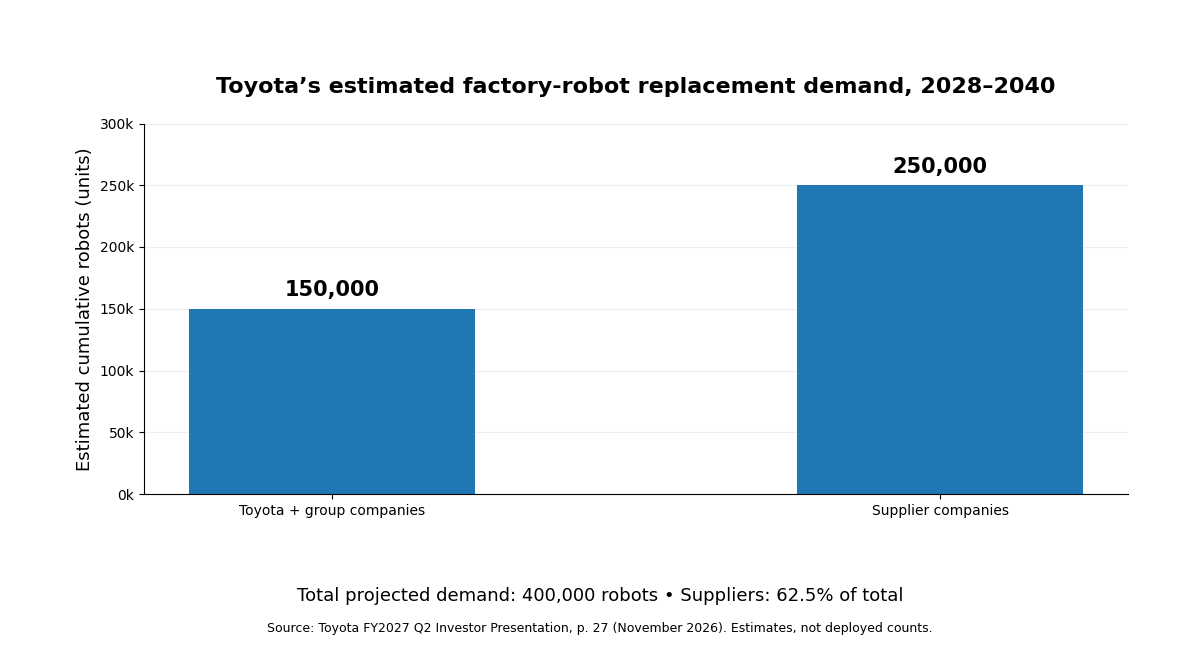
Toyota identifies 150,000 units of potential demand at Toyota Motor and group companies and 250,000 at suppliers. The supplier share is 62.5%, calculated as 250,000 divided by 400,000. The distribution reveals why Toyota sees a commercial opportunity: an automation platform proven in its own plants could be sold throughout a much larger industrial network.
The same presentation estimates approximately ¥1 trillion per year for renewal of aging production equipment beginning in 2028. Toyota describes a broad modernization requirement, not an exclusively robotic research budget, a guaranteed annual outlay or the unit purchase price of each machine. Reuters reported the earlier investment estimate in September; November’s investor materials add a clearer roadmap for building a standalone robotics business.
From fixed motions to physical AI
Toyota describes three stages of factory automation. FA 1.0 executes predefined repetitive work; FA 2.0 synchronizes production and logistics; FA 3.0 targets cooperation between human workers and robots. The critical software challenge is adaptability. A rigid arm can repeat a weld thousands of times, while changing boxes, awkward parts and unpredictable human movement demand perception, motion planning, reliable grasping and safeguards.
Boston Dynamics, August 20, 2025: original demonstration of Atlas using large behavior models developed with Toyota Research Institute. A research demonstration, not footage of production deployment.
A Toyota Research Institute collaboration with Boston Dynamics offers a technical glimpse of the approach. Their Atlas demonstration combines locomotion and manipulation using a large behavior model, an AI system that converts sensory observations and instructions into robot actions. The demonstration establishes research capabilities, not mass-production reliability. Toyota’s own ELEY mobile-manipulation work similarly aims to transfer dexterous skills into factory settings.
The initiative also puts Toyota into an increasingly competitive market. BitcoinVersus.Tech recently covered Hyundai’s consolidation of Boston Dynamics and GlobalFoundries’ plans for robotic chip-fab inspections. Meanwhile, Rockwell Automation’s AGILOX acquisition underscores the appeal of practical, mobile logistics robots. Advanced research and ordinary factory economics are converging.
The harder part is operating at scale
Factory deployment requires repeatable cycle times, machine guarding, predictable maintenance, low error rates, dependable spare parts and training for workers. Human-robot collaboration adds safety engineering around shared workspaces; visually impressive lab trials cannot replace production validation. Toyota’s approximately 18,000 skilled craft workers across 60 plants are an asset for collecting task knowledge, but successful deployment will depend on measurable outcomes: uptime, defects, throughput and total ownership cost.
Hagerty, May 11, 2026: original-access reporting inside Toyota’s GR factory highlights tasks still entrusted to skilled people. The film offers a useful contrast to the company’s future automation targets.
Toyota says internal plants will become the proving ground before sales broaden to other manufacturers and eventually additional industries. Recent heavy-machine robotics research illustrates the potential of learned motion control, although industrial demonstrations should not be confused with proven economics. The real test for Toyota Robotics will be how many tasks move beyond demonstrations and become safer, faster and less expensive in everyday production.
Sources: Toyota FY2027 Q2 investor presentation, especially pages 26–27, November 2026; Toyota USA Newsroom, November 11, 2026; Toyota Frontier Research Center, March 31, 2026; Reuters, September 18, 2026; Boston Dynamics technical background, August 2025.
Editor’s Note: Robot quantities and investment figures are company estimates and plans, not completed deployments or contracted expenditures. The original featured image is a conceptual colored-pencil illustration, not an identifiable Toyota facility. The three attributed videos show authentic earlier technology and manufacturing context rather than footage from the November 2026 investor presentation.
We volunteer daily to ensure the credibility of the information on this platform is Verifiably True. If you would like to support to help further secure the integrity of our research initiatives, please scan the QR code below

Disclaimer: Forward-looking robotics and investment projections may change. Technical descriptions are informational and do not constitute workplace safety, engineering procurement or investment advice. Bitcoin payments are voluntary and generally irreversible.


Leave a Reply