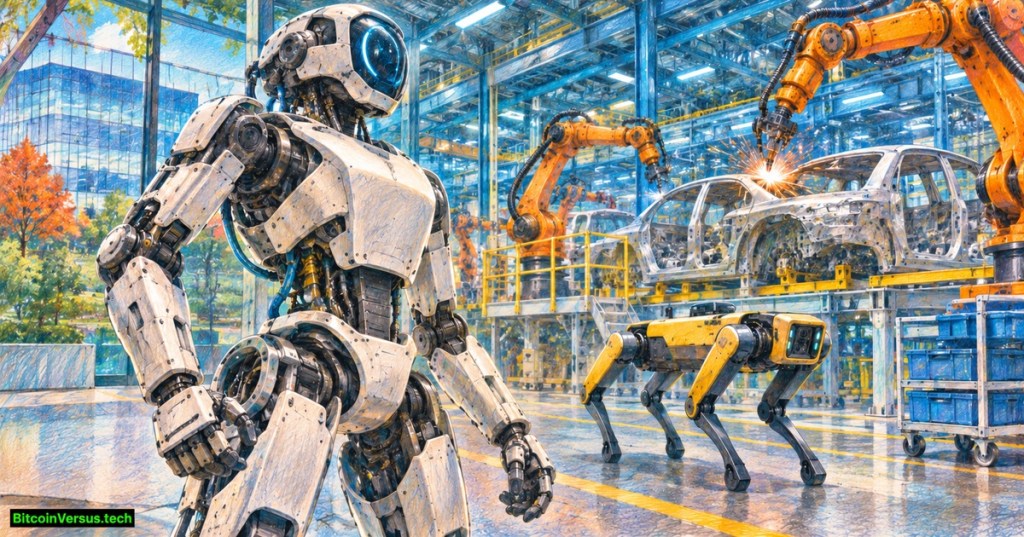
Hyundai Motor Group has completed its takeover of Boston Dynamics, acquiring the final 9.65% stake previously held by Japan’s SoftBank. South Korean reports dated November 17 and 18, 2026, cite Hyundai Glovis’s third-quarter regulatory filing, which says the share-related put and call options were exercised and extinguished. The result is full ownership by Hyundai-related companies and Executive Chair Euisun Chung, not a 100% direct stake held by Hyundai Motor Company alone.
The ownership change places the maker of Atlas, Spot and Stretch entirely within Hyundai’s corporate orbit as the automaker prepares to use humanoid robots in manufacturing. The development also leaves Hyundai’s shareholders exposed to an expensive question: how quickly can advanced robot research turn into sustainable sales? The Korea Herald and Aju Press separately reported the completed transfer.
Robotico Market’s original X post supplied with the news tip. The ownership finding is independently attributed to the reported Hyundai Glovis filing, not to social-media commentary.
How Hyundai reached 100%
Hyundai’s first major Boston Dynamics acquisition closed in June 2021, when the group and Chung together obtained a controlling 80% interest and SoftBank retained 20%. Subsequent changes left SoftBank with 9.65%. The seller invoked its contractual right to sell the remainder earlier in 2026; a July 16 Hyundai statement said the relevant parties were reviewing the transaction.
In the newly reported completion, Hyundai Glovis raised its stake by 1.08 percentage points to 12.47% at the end of the third quarter after investing 46.5 billion won during the quarter. Other stakes are held through related companies and Chung. The distinction matters for investors: ownership and financial exposure are distributed across multiple parties, rather than concentrated in one listed company.
Official Boston Dynamics video from January 2026 introducing the commercial Atlas humanoid. Product capabilities and demonstrations are not measurements of customer profitability.
Atlas moves toward Hyundai’s factory floor
Hyundai’s January 2026 robotics strategy targets Atlas deployment at Hyundai Motor Group Metaplant America in Georgia starting in 2028. The first planned work involves parts sequencing, with more demanding component assembly envisioned later. Reporting also describes a goal of 30,000 units of annual production capacity by 2028. Capacity is a target, not a confirmed number of robots manufactured or sold.
Boston Dynamics is already active beyond humanoids. Its four-legged Spot handles inspections, while Stretch works in logistics. BitcoinVersus.Tech recently covered GlobalFoundries’ Spot inspections and planned Atlas chip-factory testing, the revised Stretch logistics hardware, Atlas’s battery-swapping design and its rapid assembly experiments. Each application faces different requirements for safety, reliability and return on investment.
Revenue is growing, but losses are growing faster
According to Aju Press’s November 18 report, Boston Dynamics earned 54.7 billion won in third-quarter 2026 revenue, up from 38.5 billion won a year earlier. That is a 42.1% increase. Its quarterly net loss reached 237.8 billion won, compared with 112.3 billion won, a 111.8% increase in the magnitude of the loss.
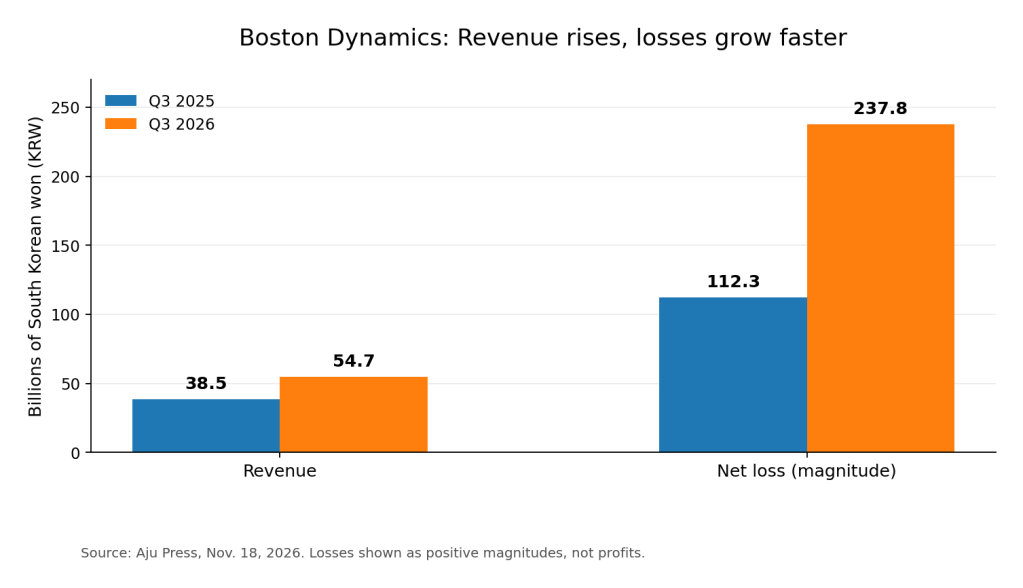
Across January through September 2026, reported sales reached 136 billion won while accumulated net losses totaled 626.6 billion won, about 4.6 times revenue. Research spending and production scale-up weigh on the business. A larger order pipeline alone cannot prove that humanoid manufacturing will become profitable; unit costs, uptime, service expenses and customer productivity will determine the economics.
Second X post supplied with the news tip, from Kalshi Finance. Market commentary is included separately from the company’s financial reporting and official manufacturing targets.
What full control changes
Full ownership gives Hyundai-related investors greater freedom to coordinate robotics hardware, actuators, factory testing, software and production budgets. It does not guarantee rapid adoption. Industrial humanoids must handle unpredictable environments safely, produce consistent results and demonstrate lower total operating costs than competing automation systems.
An eventual Boston Dynamics initial public offering remains speculation rather than a confirmed timetable. For now, the more important milestones are Atlas entering factory trials, real customer deployments and narrower operating losses. Full ownership makes Hyundai’s robotics strategy clearer, while its commercial outcome remains unresolved.
Sources and reporting
- The Korea Herald, November 17, 2026: ownership completion and Hyundai Glovis filing
- Aju Press, November 18, 2026: Boston Dynamics Q3 revenue and losses
- Hyundai Motor Group, July 16, 2026: official statement on SoftBank’s put option
- Boston Dynamics, June 21, 2021: original majority acquisition
- Hyundai Motor Group, January 5, 2026: Atlas and factory strategy
- Boston Dynamics, September 21, 2026: Metaplant training center and production plans
- Robotico Market, November 17, 2026: filing-based reporting
Editor’s Note: We volunteer daily to ensure the credibility of the information on our platform is Verifiably True. If you would like to support our work and the integrity of our research initiatives, please scan the QR code below to donate 5,000 sats.

For mobile scanning, open the article on another display and scan the QR using a Bitcoin wallet. Verify receiving address 3C9o19EH5HSiwEPyCTmEKzxhNCbo2X6TTb before sending.
BitcoinVersus.Tech publishes financial and technical journalism for informational purposes. It does not offer financial, investment, legal or engineering advice.


Leave a Reply