Boston Dynamics spent years making Atlas famous for acrobatics. The production version is being engineered around a much less theatrical problem: staying useful through an industrial shift.
According to Boston Dynamics’ current Atlas product documentation and official specification sheet, the electric humanoid is designed to work for roughly four hours on a battery, or about two hours during heavy lifting. When the pack is depleted, Boston Dynamics says Atlas can autonomously navigate to a station and complete its own battery swap in about three minutes.
The battery swap matters more than it sounds
A humanoid that can perform impressive motions but spends long stretches plugged into a charger is difficult to integrate into a production line. Boston Dynamics is instead treating energy replenishment as part of the robot’s normal operating cycle. The company specifies a 1.5-hour battery charge time, but the robot does not need to sit idle for that entire period if charged packs are available.
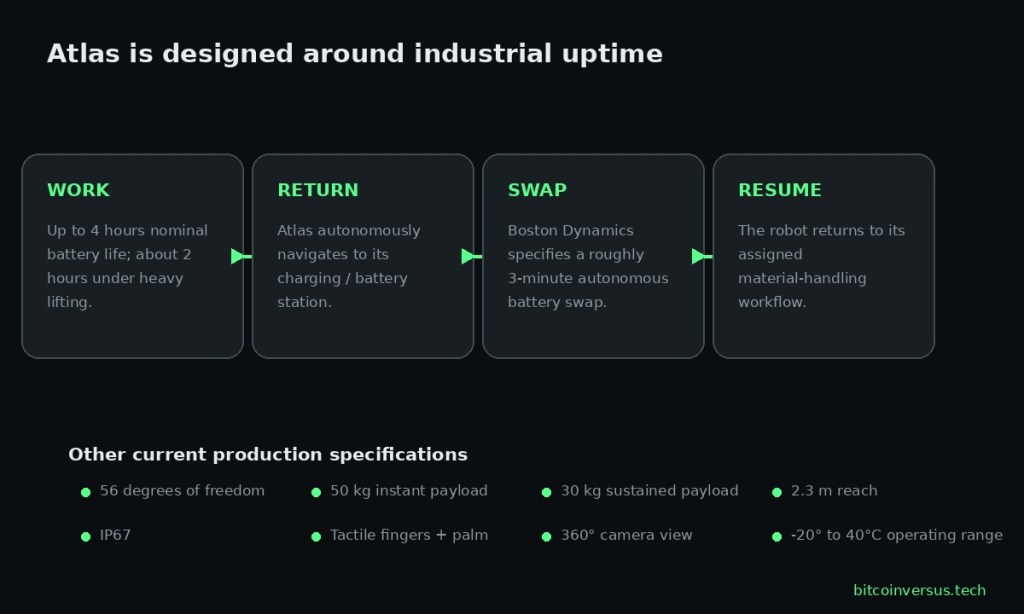
This puts Atlas closer to the logic of a warehouse vehicle or production asset than a research robot. The robot is expected to manage its own energy stop, return to work, and remain connected to fleet and manufacturing systems instead of requiring an operator to manually recharge it after every run.
The rest of the specification sheet is just as industrial
The production Atlas stands 1.9 meters (6.2 feet) tall, weighs 90 kilograms (198 pounds), and has 56 degrees of freedom. Boston Dynamics lists tactile sensing in the fingers and palm plus a 360-degree camera view. Those specifications are important because industrial manipulation depends on both accurate perception and reliable contact with objects.
Payload is specified at 50 kg (110 lb) instantaneously, 30 kg (66 lb) sustained, and 20 kg (44 lb) one-handed, with a reach of 2.3 meters (7.5 feet). That is enough to move beyond lightweight demonstration props into the material-handling range Boston Dynamics is targeting for factory work.
The company also lists an IP67 rating and an operating-temperature range of -20°C to 40°C (-4°F to 104°F). Atlas is built with modular, field-replaceable components, and Boston Dynamics even lists a customer self-repair certification path. That serviceability matters because the economics of industrial robots depend heavily on uptime and mean time to repair—not simply whether the robot can complete a task once.
Atlas is being designed to fit existing factories
Boston Dynamics is not asking factories to rebuild every workstation around the humanoid. Atlas is sized to operate in human-scale spaces and supports barcode scanning and RFID workflow integration. Its listed operating modes include autonomous control, VR teleoperation, and tablet control, while safety features include human detection and fenceless guarding.
The software side is also tied to enterprise systems. Boston Dynamics says its Orbit platform will connect Atlas to manufacturing execution systems and warehouse management systems, giving operators a way to monitor fleet performance and push learned tasks across multiple robots.
That industrialization effort is already visible at Hyundai. BitcoinVersus previously covered Boston Dynamics’ Atlas factory training center in Georgia, where robots are learning parts logistics and sequencing tasks. The company also recently appointed former Amazon AI executive Rohit Prasad as CEO as it pushes deeper into Physical AI.
One of the harder engineering constraints remains the humanoid actuator stack: joints, reducers, motors, sensors, thermal limits, and controls all have to survive repetitive work without becoming a maintenance bottleneck. Atlas’ specifications show that Boston Dynamics is now treating those practical limits as product requirements rather than research problems.
The real milestone is boring reliability
A robot that can flip, spin, or perform a choreographed demo is visually impressive. A robot that can repeatedly pick the correct part, carry it safely, swap its own battery, report its status to factory software, and be repaired quickly is much closer to becoming industrial infrastructure.
That is the more important version of Atlas to watch now. Boston Dynamics has largely solved the problem of making a humanoid look dynamic. The next test is whether it can make one predictable, serviceable, and productive enough to earn a permanent place on the factory floor.
Primary technical references: Boston Dynamics Atlas product page and the company’s official Atlas specification sheet.
Editor’s Note: BitcoinVersus.Tech covers robotics, industrial automation, AI hardware, computing, and infrastructure from an independent technical perspective.
Disclaimer: This article is for informational and educational purposes and does not constitute financial, investment, engineering, or product-purchase advice.


Leave a comment