DARPA has moved four more quantum-computing teams into the final stage of its Quantum Benchmarking Initiative, shifting the government program from reviewing roadmaps to directly checking whether proposed utility-scale machines can actually be built and operated as designed.
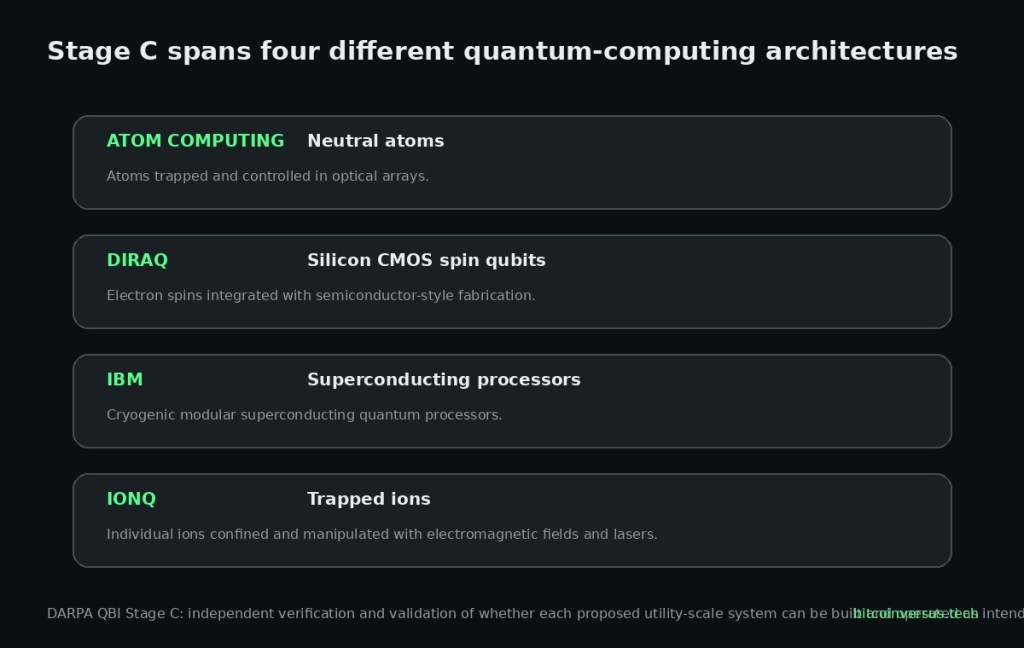
The four new Stage C participants are Atom Computing, Diraq, IBM, and IonQ. They represent four materially different hardware approaches: neutral atoms, silicon CMOS spin qubits, modular superconducting processors, and trapped ions. They join Microsoft and PsiQuantum, which previously advanced through DARPA’s US2QC precursor program. DARPA announced the promotions on October 7.
Stage C means verification, not a victory lap
DARPA is explicit that QBI is not a tournament designed to crown one company. The agency is evaluating each architecture on its own merits and wants to know whether any credible path can reach what it calls utility-scale quantum computing by 2033 — meaning the computational value of the machine exceeds its cost.
That distinction matters because the quantum-computing industry still has no settled winning architecture. Different platforms trade off coherence, gate fidelity, connectivity, control complexity, manufacturing difficulty, cooling requirements, and error-correction overhead in very different ways.
Stage B focused on whether each team’s research and development plan was internally credible: what had to be invented, where the technical risks were, what prototypes would reduce those risks, and whether the schedule could plausibly reach utility scale. Stage C changes the question from does the roadmap make sense? to does the hardware behave the way the roadmap says it should?
Four architectures, four different scaling problems
Atom Computing uses neutral atoms held in optical arrays. Neutral-atom systems can arrange large numbers of qubits in flexible geometries, but useful large-scale machines still need reliable state preparation, control, readout, entangling operations, and error correction across those arrays.
Diraq is pursuing electron-spin qubits in silicon using CMOS-compatible manufacturing concepts. The attraction is obvious: if quantum devices can exploit semiconductor processes that already exist at industrial scale, fabrication could become a major advantage. The difficult part is preserving quantum performance while integrating huge numbers of precisely controlled devices.
IBM is advancing modular superconducting processors. Superconducting circuits are among the most mature quantum platforms, but they require deep cryogenic operation, extensive control electronics, high-fidelity gates, and a path to connecting modules without letting communication overhead erase the benefit of scaling. BitcoinVersus previously covered IBM’s work with AMD on quantum-centric computing architectures.
IonQ uses trapped ions, which can offer strong qubit quality and long coherence times but face their own challenges in control, optical delivery, routing, and system-level scaling. IonQ has also been integrating its systems with conventional high-performance computing; BitcoinVersus recently covered its Superion 256 connection to an NVIDIA AI supercomputer.
Why DARPA’s test is unusually important
Quantum roadmaps are full of projected qubit counts, future error rates, architectural diagrams, and claims about fault tolerance. Those projections are necessary, but they are not the same thing as an independently verified machine. Stage C is designed to put government evaluators beside the companies as systems and subsystems are built, then test whether the physical results match the assumptions used in the development plan.
That makes QBI unusually useful because it is trying to evaluate the whole path to a useful system rather than rewarding one headline metric. A processor with more physical qubits is not automatically closer to usefulness if its error correction, control stack, interconnects, cryogenics, calibration burden, or operating cost make the full machine impractical.
Data Center Dynamics notes that the four teams join Microsoft and PsiQuantum in the final validation phase. DARPA also says more companies can still advance later; Stage C is not a closed list of permanent winners.
What comes next
The most important output from Stage C will not be a marketing ranking. It will be evidence: whether hardware milestones arrive, whether error and control assumptions survive contact with larger systems, whether modularity works where promised, and whether the total machine can approach useful operation at a cost that makes sense.
DARPA says it increasingly expects that someone will build a utility-scale quantum computer by 2033. The unresolved question is which architecture — or architectures — can survive the engineering required to get there. Stage C is where that question starts becoming much harder to answer with slides alone.
Editor’s Note: BitcoinVersus.Tech covers computing, semiconductors, infrastructure, engineering, and emerging technology for informational and educational purposes.
Disclaimer: This article is informational and does not constitute financial or investment advice.


Leave a comment