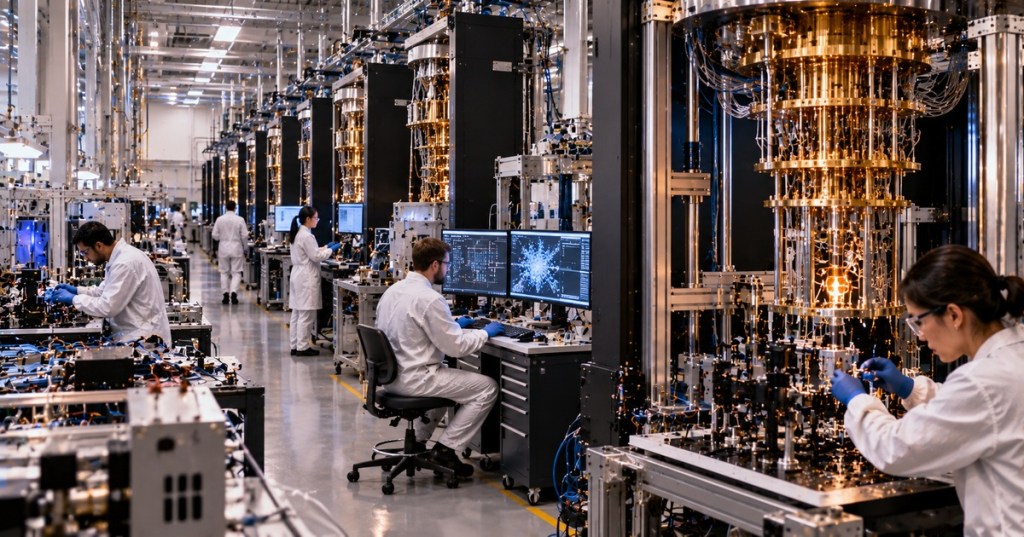
PsiQuantum has received a conditional commitment for up to $150 million from the U.S. Department of War’s Office of Strategic Capital to expand its 140,000-square-foot PsiFactory in Milpitas, California. The proposed financing would support test equipment, system-integration infrastructure and advanced cryogenic hardware used to build and validate prototypes for the company’s photonic fault-tolerant quantum-computing architecture.
Key Takeaways
- The commitment is for up to $150 million, but it is not a final funded loan.
- PsiQuantum says the money would expand its 140,000-square-foot Milpitas manufacturing and prototyping hub.
- The financing would support component test equipment, system assembly and integration infrastructure, and advanced cryogenic systems.
- The loan sits alongside a $125 million DARPA agreement announced in July and a finalized $100 million Commerce Department award announced in September.
- Final financing still depends on financial, legal, technical and regulatory conditions.
The primary source is PsiQuantum’s October 8 announcement. The Office of Strategic Capital announced the same conditional commitment the same day.
The Money Would Go Into Hardware, Not Just Research
PsiQuantum says the proposed financing would be used for physical manufacturing and prototype infrastructure inside PsiFactory. The company specifically lists test equipment for components and full assemblies, infrastructure for system assembly and integration, and advanced cryogenic systems.
That makes this different from a conventional early-stage quantum research grant. The funding is aimed at the industrial layer between chip fabrication and a complete fault-tolerant machine: testing, assembling, networking and validating hardware at scale.
PsiQuantum Is Betting on Photonics
PsiQuantum’s architecture uses photons as qubits and is built around silicon photonics rather than superconducting circuits or trapped ions. The company says its Omega chipset is manufactured at GlobalFoundries’ fab in Malta, New York, and that its systems can scale through standard telecom optical fiber.
That manufacturing strategy connects quantum computing directly to the semiconductor supply chain. BitcoinVersus.Tech recently covered Xanadu and GlobalFoundries moving another photonic quantum platform toward scalable chip production. Both companies are betting that mature semiconductor manufacturing can help quantum hardware move beyond bespoke laboratory systems.
The Loan Adds to a Growing Federal Stack
The conditional OSC financing comes after two other significant U.S. government agreements. PsiQuantum announced a $125 million expanded agreement with DARPA in July under the Quantum Benchmarking Initiative, and in September it finalized a $100 million Commerce Department award under the CHIPS and Science Act.
BitcoinVersus.Tech covered DARPA moving four additional quantum architectures into final hardware validation. PsiQuantum and Microsoft were already in that final verification stage through the earlier US2QC pathway, which DARPA folded into the broader QBI effort.
Milpitas Is a Prototype Factory, Not the Final Quantum Computer
PsiFactory in Milpitas is a manufacturing, testing and system-integration hub. It is not the same thing as the utility-scale quantum systems PsiQuantum plans to deploy in Chicago and Queensland, Australia.
The distinction matters because quantum-computing announcements often blur chips, prototype systems and complete machines. Milpitas is where the company develops and validates the hardware building blocks that would eventually feed into larger deployed systems.
Manufacturing Is Becoming the Quantum Battleground
Quantum competition is increasingly about more than qubit physics. Companies now have to prove they can manufacture chips repeatably, package them, cool them, control them and assemble enough hardware into systems that outperform conventional computing on useful workloads.
BitcoinVersus.Tech also reported that IBM’s quantum foundry is already running 300mm wafers. The common theme is industrialization: quantum companies are moving from experimental devices toward manufacturing systems that resemble semiconductor and data-center infrastructure.
What Is Still Unproven
The new financing does not prove that PsiQuantum has built a commercially useful fault-tolerant quantum computer. It also does not guarantee that the company will receive the full $150 million.
PsiQuantum says the final loan will only be executed if it satisfies the financial, legal, technical and regulatory conditions in the conditional commitment. The announcement also does not disclose the final loan interest rate, repayment schedule, collateral package or how much company co-investment will ultimately be required.
Data Center Dynamics independently reported that the financing is aimed at expanding PsiQuantum’s Milpitas manufacturing and prototyping operation and remains conditional rather than funded.
Bottom Line
The October 8 announcement is another sign that the U.S. government increasingly views quantum computing as an industrial manufacturing problem as much as a research problem. PsiQuantum’s proposed $150 million loan is aimed at the factory equipment, cryogenics and integration infrastructure needed to turn photonic quantum components into complete prototype systems.
The next milestone is financial close. Until the conditions are satisfied and a final loan is executed, the $150 million remains a conditional commitment rather than money already received.
Editor’s Note: The $150 million figure, 140,000-square-foot Milpitas facility, proposed uses of funds and conditional status come from PsiQuantum and the Office of Strategic Capital. The financing is not guaranteed. References to future utility-scale systems remain company plans unless independently validated through hardware testing.
Support independent reporting: BitcoinVersus.Tech volunteers daily to help keep its research verifiably true. Bitcoin donation address: 3C9o19EH5HSiWEPyCTmEKzxhNCbo2X6TTb.
BitcoinVersus.Tech is not a financial advisor. This media platform reports on technology and financial subjects for informational purposes.


Leave a Reply