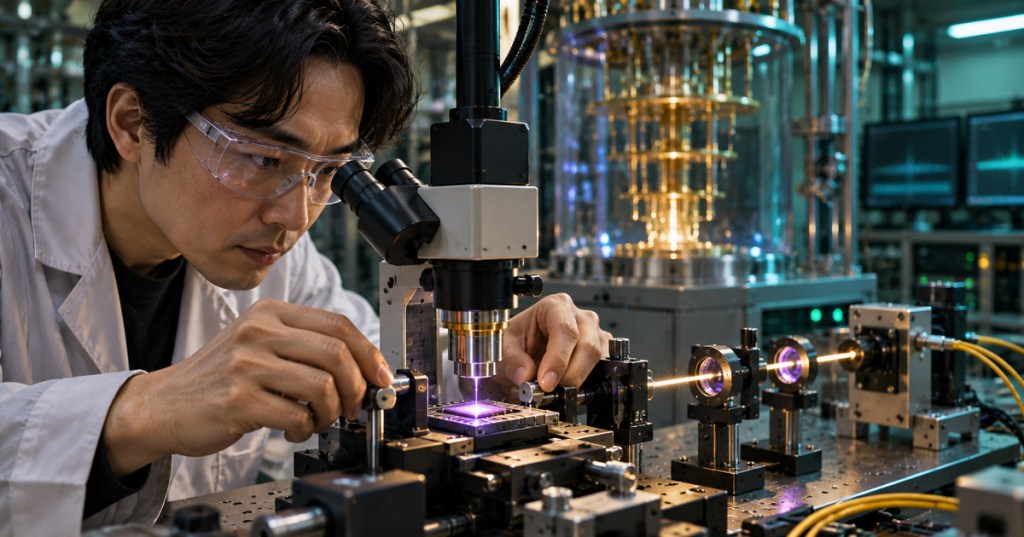
German quantum startup NVision reported a significant advance on October 28, 2026: researchers prepared, controlled and optically read the spin of one engineered organic molecule. The peer-reviewed Nature study demonstrates a molecular building block for quantum computers, while a new partnership with HyperLight aims to put such molecules onto photonic chips. A working large-scale processor has not yet been demonstrated.
NVision’s official research presentation explains the single-molecule spin–photon breakthrough and proposed chip architecture. Source: NVision Quantum, October 2026.
One molecule, controlled with light
The team chemically designed a carbene molecule whose electron spin encodes quantum information. A laser can prepare and read its state, while microwave pulses control it. Researchers detected individual emitters in a carefully engineered crystal at 4.5 kelvin—approximately −269°C—not at room temperature. Unlike approaches that read signals averaged across many molecules, this experiment addresses a single quantum emitter.
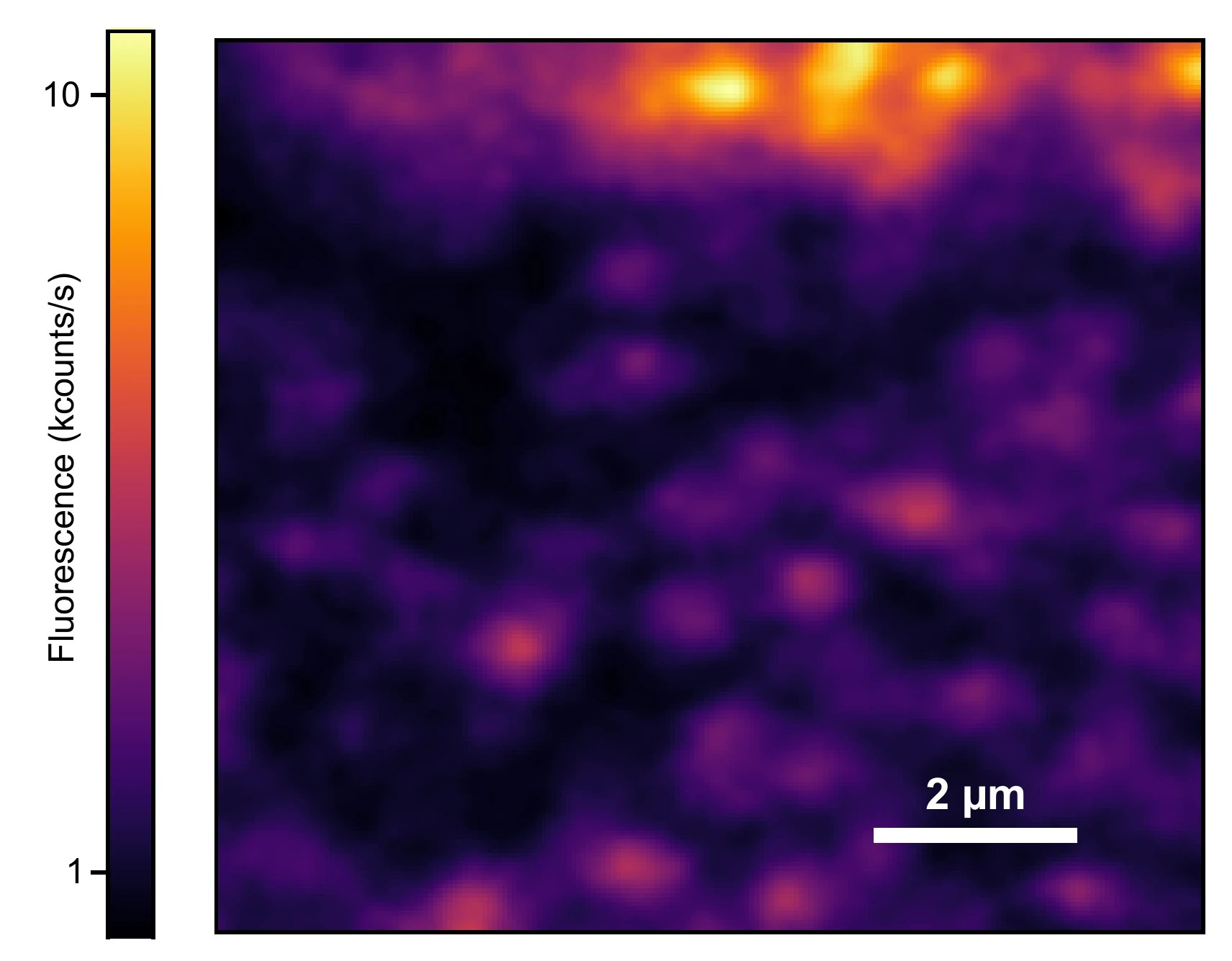
Original microscopy shows isolated light-emitting molecules. Adapted from Roggors et al., Nature (2026), via NVision.
That distinction matters for quantum processors, which must manipulate identifiable qubits rather than population averages. Other approaches include Google’s superconducting-qubit experiments and IonQ’s quantum-memory interconnect. The new molecular method remains at an earlier stage.
How long can the qubit remember?
NVision reports a measured spin coherence time of 12.2 microseconds using Hahn-echo pulses and 2.2 milliseconds using an XY8 protective pulse sequence. That is roughly a 180-fold difference between measurement protocols on the molecular system—not a measured 180-fold advance over a competing processor.
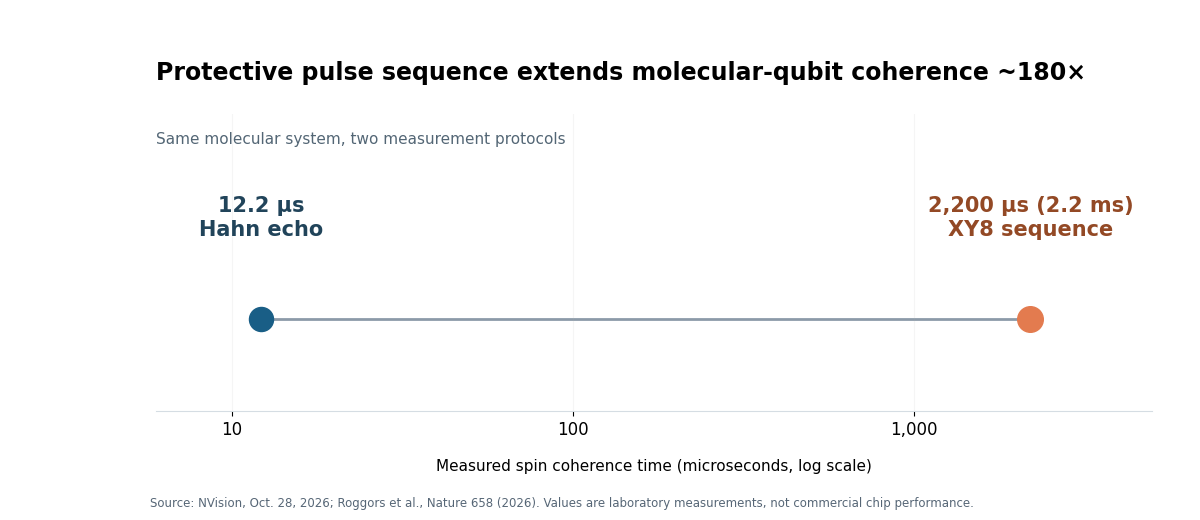
SmartChart log-scale paired-dot comparison. Data: Roggors et al., Nature (2026), and NVision’s technical explanation; units are microseconds.
The paper also reports a narrow optical linewidth and single-photon emission—properties useful for connecting qubits through light. Those links could eventually complement photonic quantum-chip manufacturing and work on optical communications. Optical networking is not itself proof of fault-tolerant quantum computing.
A proposed path from chemistry to chips
NVision and HyperLight plan to deposit molecular material onto thin-film lithium-niobate photonic circuits. NVision says it screened more than 150 molecular candidates, synthesized 40 and is targeting an integrated-chip demonstration in late 2026. The approach draws on thin-film production techniques rather than requiring every qubit to be fabricated as an isolated solid-state defect.
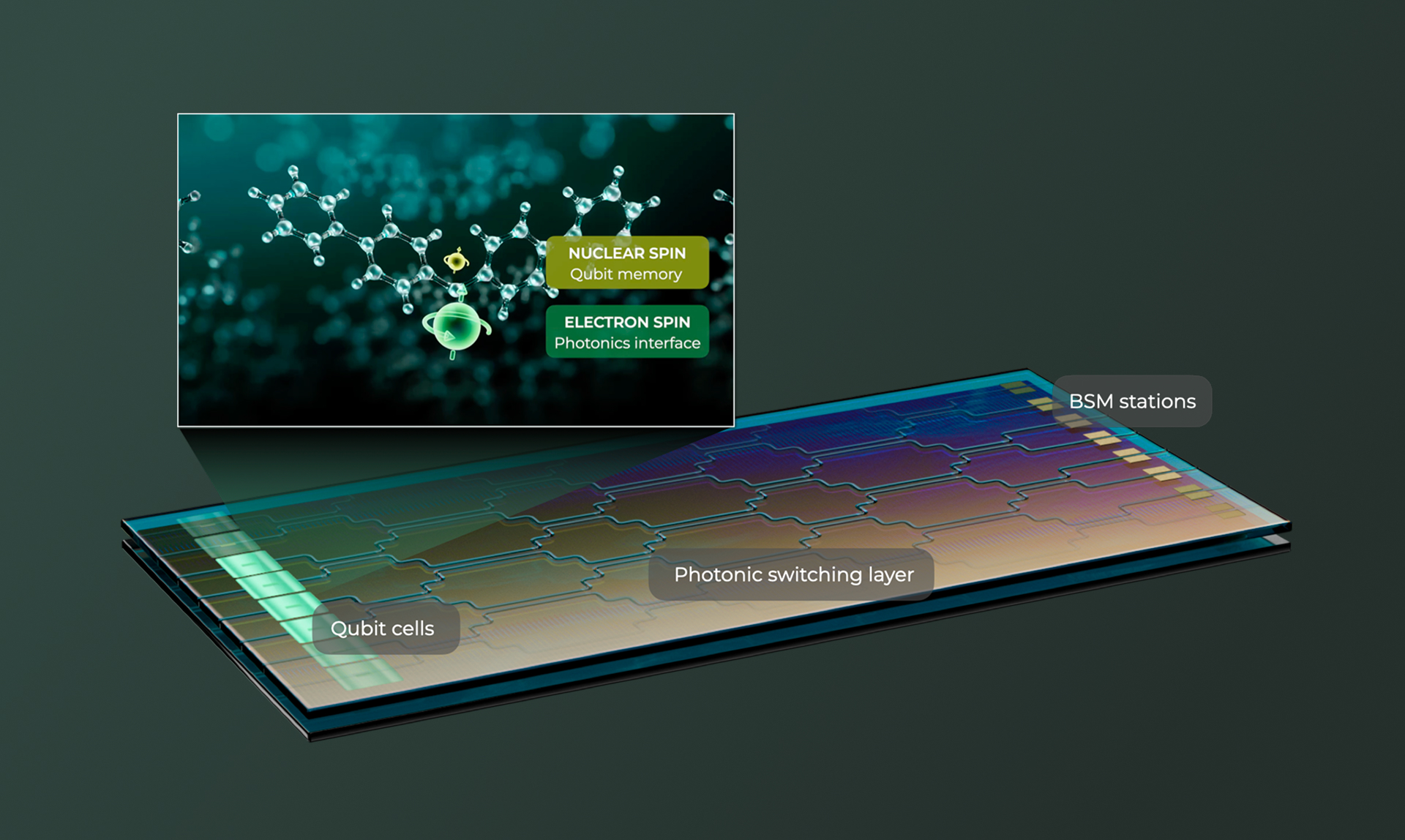
Official NVision conceptual illustration of molecular-qubit cells and photonic switching. This is an architecture proposal, not a finished quantum computer.
The partnership joins a broader push toward foundry-compatible photonic processors and optical switching hardware. But practical two-qubit gates, reliable links between molecules, chip-scale integration and error correction remain to be shown. NVision’s thousand-qubit targets are roadmap ambitions, not achieved capacity.
Support BitcoinVersus.Tech
We volunteer daily to ensure the credibility of the information on this platform is Verifiably True. Please scan the original QR code below to donate 5,000 sats if you would like to support our independent reporting. For best results, open this page on a laptop or larger screen.

On mobile, display the QR code on another screen to scan it with a Bitcoin wallet; alternatively, use a wallet’s saved-image QR-scanning feature if available. Bitcoin donation address: 3C9o19EH5HSiwEPyCTmEKzxhNCbo2X6TTb.
BitcoinVersus.tech is not a financial advisor. This media platform reports on financial subjects purely for informational purposes.


Leave a Reply