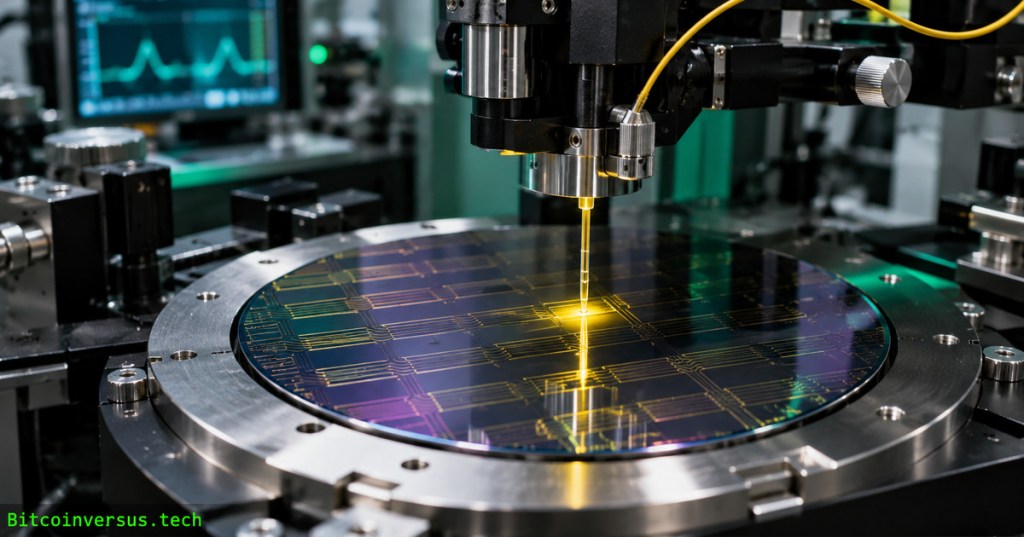
Photonic quantum computers depend on keeping photons alive as they cross networks of optical components. On November 10, 2026, Toronto-based Xanadu and photonics manufacturer HyperLight reported an optical-switch insertion loss of 7 millidecibels (mdB), compared with their previously announced 20 mdB benchmark. The 65% reduction concerns an individual switching component, not the error rate or processing speed of a completed quantum computer.
Video: Xanadu fabrication engineering executive Elliott Ortmann explains the reported optical-switch loss milestone. Source: Xanadu official YouTube link circulated November 11, 2026; playback not independently confirmed.
Why seven millidecibels matters
An optical switch redirects a beam between paths inside a photonic circuit. In thin-film lithium niobate (TFLN), applied electric fields alter the material’s optical response, allowing fast routing without mechanically moving a mirror. Xanadu says the new switch was fabricated using HyperLight’s TFLN Chiplet platform on a high-volume wafer manufacturing line. Its announcement describes favorable yield and repeatability, but provides no numerical yield, sample size or independent replication data.
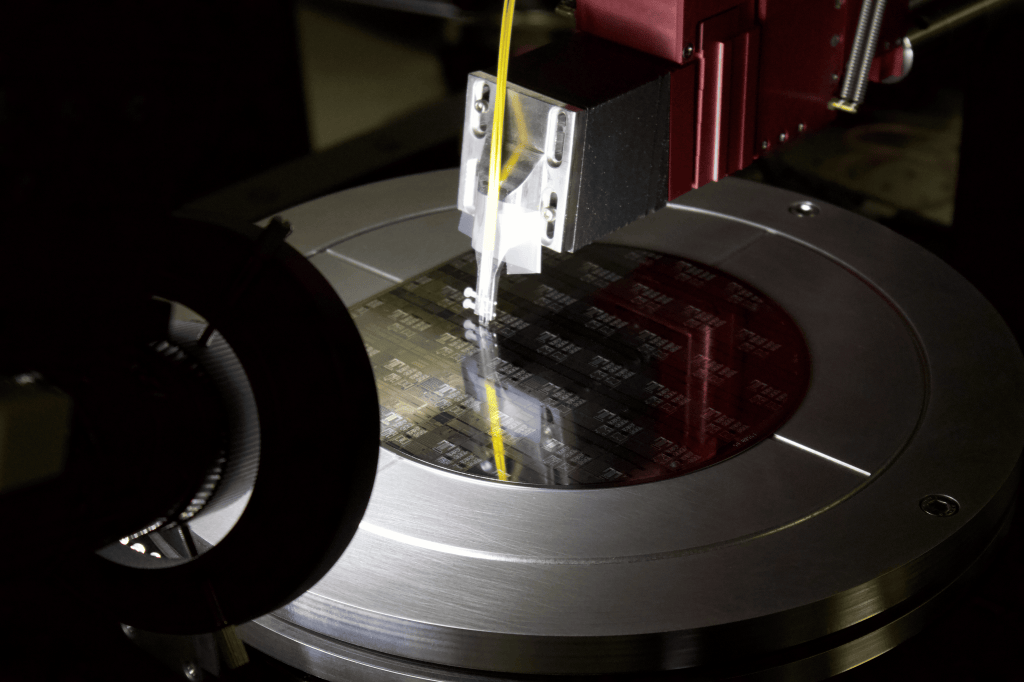
The measurement uses a logarithmic scale: 7 mdB equals 0.007 decibel, not a 7% power loss. Converting loss to transmitted optical power with T = 10−L/10 gives approximately 99.84% transmission at 0.007 dB and 99.54% at 0.020 dB. A small component-level difference becomes increasingly important when many switches are traversed in succession.
What cumulative loss could mean
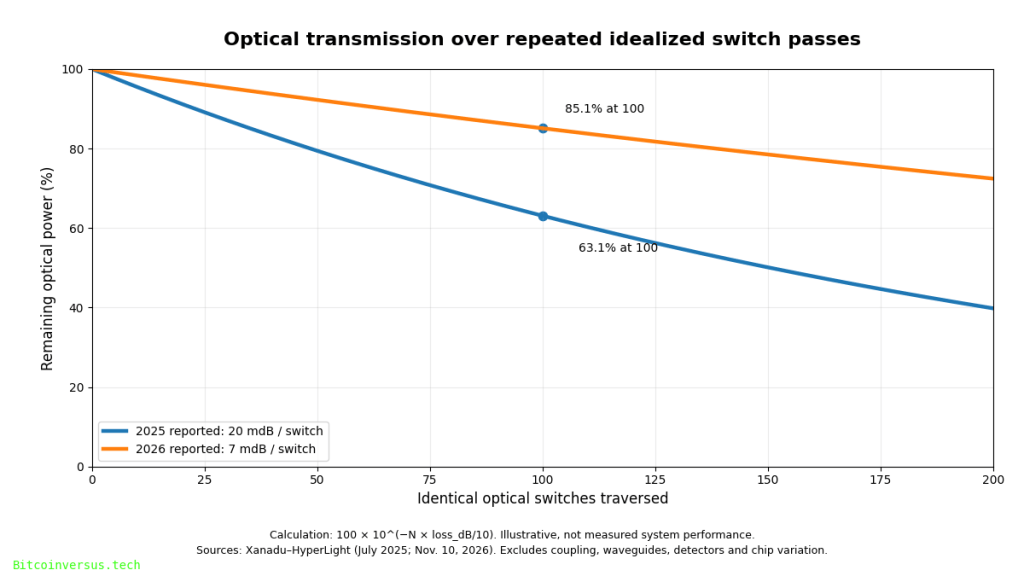
Under an illustrative assumption of 100 identical, independent switch passes, and ignoring every other optical loss, calculated transmission improves from about 63.1% at 20 mdB to 85.1% at 7 mdB—a difference of 22.0 percentage points. The model describes compounded optical attenuation, not a measured quantum circuit. It does not predict logical-qubit counts, application speedups or fault-tolerant operation.
The 2025 result was also presented as compatible with scalable fabrication, so the new development is primarily the lower reported switch loss rather than the first use of a production-capable line. Prior Xanadu–GlobalFoundries manufacturing coverage tracks a separate photonic-chip partnership. An earlier NVision–HyperLight report examined molecular qubits, not the new low-loss switch.
One switching result is not a complete machine
Quantum photonic hardware faces additional attenuation from waveguides, coupling between fibers and chips, packaging and detectors. Quantum states also cannot simply be repaired by adding ordinary optical amplifiers. Xanadu has not disclosed enough measurement conditions to establish whether the 2025 and 2026 devices were tested under identical optical wavelengths, drive settings or packaging assumptions. A peer-reviewed device characterization and full-system benchmarks would strengthen comparisons.
Classical networking provides useful context but should not be conflated with quantum computation. Earlier 81.92-Tb/s silicon-photonics research measured data transmission, while PsiQuantum’s optical switching system targets data-center traffic. Neither establishes performance of Xanadu’s quantum processor. Meanwhile, IBM’s Nighthawk roadmap illustrates a different, superconducting-qubit scaling approach.
Greater manufacturing scale and lower component loss could eventually reduce the hardware overhead needed for photonic computing. Actual production economics, deployed system efficiency and potential AI data-center applications remain forecasts rather than verified outcomes. The next decisive evidence will be repeatable multi-wafer results, packaged-device loss measurements and demonstrations of improved quantum-computing reliability.
Source documentation: Xanadu and HyperLight, November 10, 2026; Xanadu and HyperLight, July 29, 2025; Quantum Index, independent technical discussion.
BitcoinVersus.Tech Editor’s Note: We volunteer daily to ensure the credibility of the information on this platform is Verifiably True. If you would like to support to help further secure the integrity of our research initiatives, please donate using the QR code provided

Optional donation: 5,000 satoshis (0.00005 BTC). On a phone, display the original QR code on another screen and scan it using a Bitcoin wallet; alternatively, use a wallet that supports scanning saved QR images. Verify the receiving address and amount inside the wallet before sending.
BitcoinVersus.Tech is maintained by volunteers. BitcoinVersus.tech is not a financial advisor. This media platform reports on financial subjects purely for informational purposes.


Leave a Reply