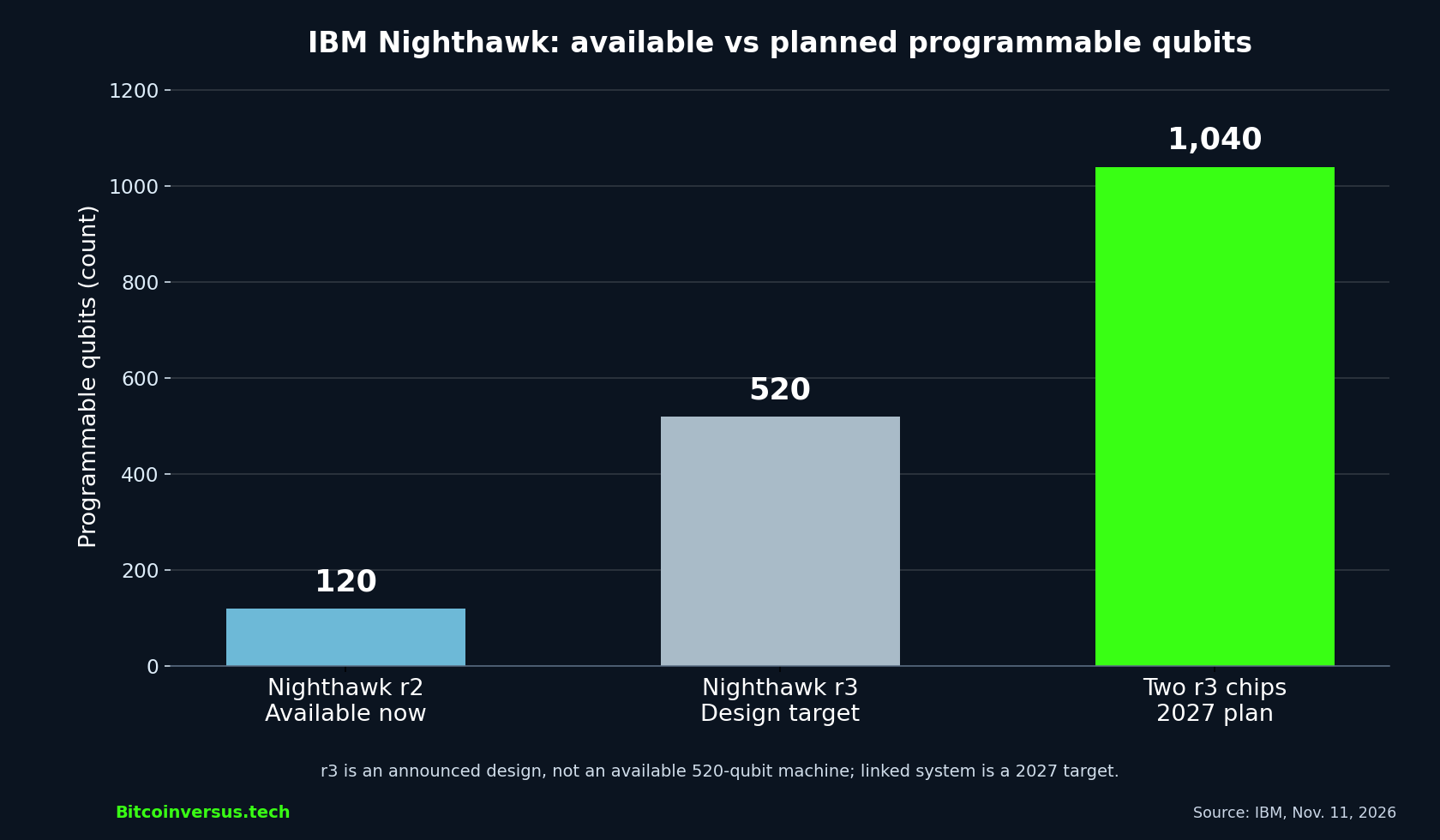
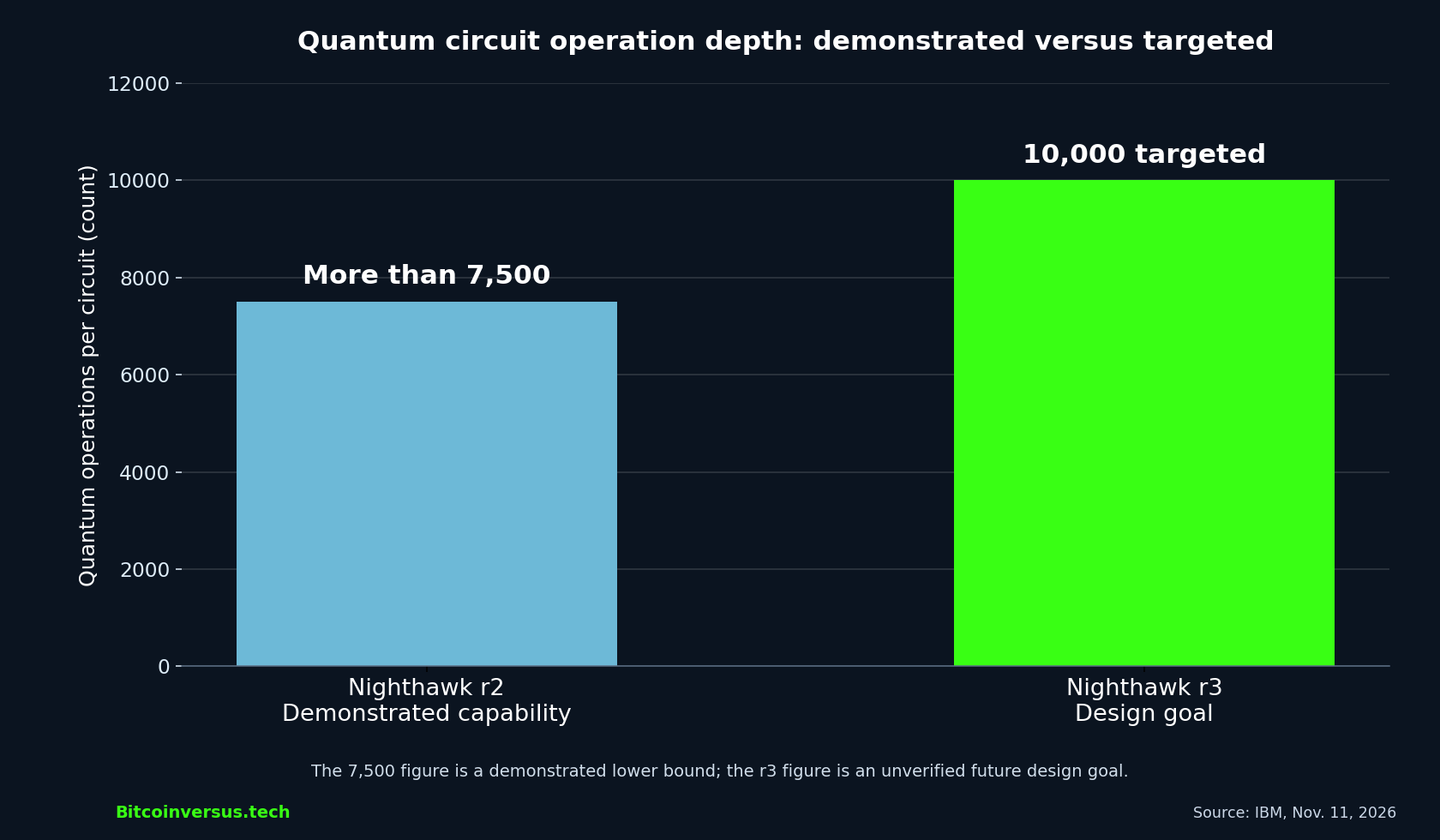
IBM announced a new Nighthawk r3 quantum processor design on November 11, 2026, targeting 520 programmable qubits and circuits containing 10,000 quantum operations. The company plans to link two r3 processors into a 1,040-programmable-qubit system in 2027. Neither machine is operational today. The announcement combines new engineering targets with performance results from Nighthawk r2, the existing 120-programmable-qubit processor used by researchers and commercial partners.
A 4.33-fold increase is planned, not achieved
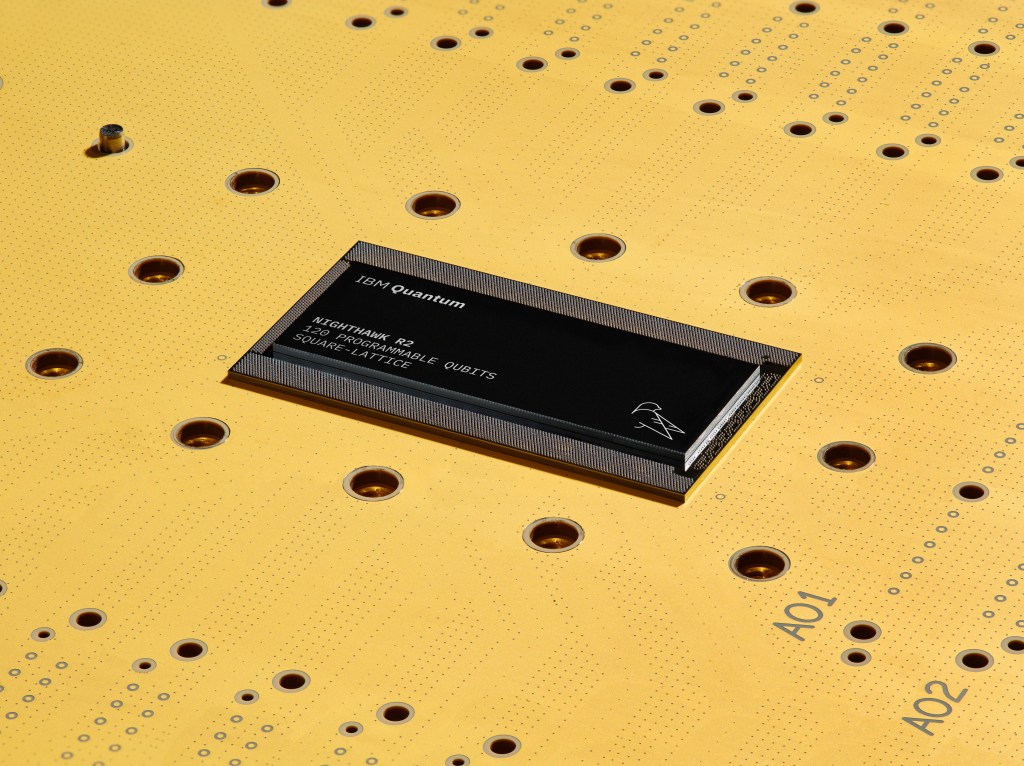
Nighthawk r2 supports 120 programmable qubits. Dividing the proposed r3 figure by 120 yields 520 ÷ 120 = 4.33 times as many programmable qubits per processor. A pair would offer 1,040, or 8.67 times r2’s count. IBM also specifies 2,034 total physical qubits for the planned r3 processor, including quantum elements beyond its 520 programmable qubits. Physical-qubit totals must not be presented as equivalent to available programmable qubits or error-corrected logical qubits.
A quantum algorithm needs more than a large register. Connectivity determines how easily gates can act between qubits; noise, calibration, error mitigation and repeated sampling determine whether useful results can be extracted. Earlier BitcoinVersus.Tech coverage of IBM’s operational Nighthawk r2 installation in Chicago documented the distinction between installed hardware and future quantum-system plans.
What the existing processor actually demonstrated
IBM reports that Nighthawk r2 can deliver up to 100,000 circuit samples per second and execute accurate circuits containing more than 7,500 quantum operations across 120 programmable qubits. IBM says customers and research partners have executed over 34 billion circuits on r2, with reported workload improvements reaching 19 times those of earlier IBM processors. Such figures are workload-specific and company-reported; they do not establish a universal 19-fold advantage against classical supercomputers.
Among disclosed examples, energy company E.ON reported a 15-fold speedup on a quantum-machine-learning grid-optimization workload compared with earlier work using IBM Heron. IBM reported a 12-fold improvement for a materials simulation involving Oak Ridge National Laboratory. Algorithmiq’s heterogeneous-material experiment ran eight times faster than its Heron version. Different circuits, baselines and measurement conditions prevent treating the three percentages as head-to-head product rankings.
Linking chips is the harder engineering problem
IBM’s r3 design includes ten chip-to-chip connectors called l-couplers. A 2026 experiment linked Nighthawk r1 processors with four such couplers and achieved up to 99.3% quantum-state transfer fidelity. IBM seeks 99.9%; the reported best result remains 0.6 percentage points below that target. The company also linked two cryogenic modules and cooled the combined installation below 15 millikelvin in under five days. Those modularity tests do not constitute a completed 1,040-qubit computer.
IBM’s recent collaboration with AMD and Oak Ridge places quantum and high-performance classical hardware together for error-correction research. Scaling remains dependent on decoders, cryogenic control electronics, precision fabrication and reliable module-to-module communication. A separate 300-mm quantum fabrication program addresses manufacturing repeatability, not proof of fault tolerance.
The updated IBM Quantum Platform also integrates classical computing for post-processing. IBM cites a sample-based quantum diagonalization workflow executed approximately five times faster while performing 100 times more calculations, and an automated 608-million-sample biological modeling workflow completed about 33 times faster than without automation. Workflow speedups cannot be attributed to the quantum processor alone.
IBM targets the fault-tolerant Starling system for 2029. As an earlier review of competing quantum architectures explained, successful engineering requires useful error-corrected operations, not merely more physical devices. BitcoinVersus.Tech’s processor comparison further distinguishes quantum operations from classical instructions. The near-term proof points will be an available r3 chip, reproducible circuit fidelity, successful multi-chip operation and documented application outcomes.
Sources and calculations: IBM official announcement, November 11, 2026; IBM Quantum Developer Conference technical report, November 11; IBM processor documentation; Barron’s independent coverage, November 11. Arithmetic: 520/120 = 4.33; 1,040/120 = 8.67; 99.9% − 99.3% = 0.6 percentage points. Partner performance figures are attributed to IBM’s announcements, not independently replicated tests.
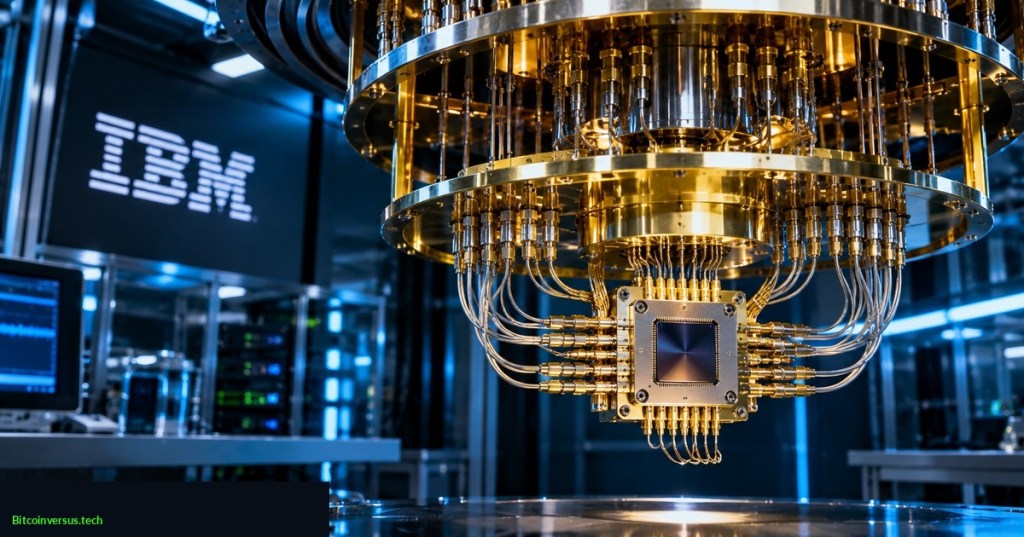
Editor’s Note: IBM’s 520 programmable qubits, 2,034 total physical qubits, 10,000 operations and 2027 two-processor configuration are design targets, not commercially demonstrated specifications. The 120-programmable-qubit r2 and its reported workloads exist; partner speedups are not universal benchmarks or proof that r3 is operational. Transfer fidelity of 99.3% represents a reported best experimental outcome, below the 99.9% objective. The 1200 × 630 cover is a conceptual illustration rather than a photo of a completed r3 chip. An official IBM r2 chip photograph and two original zero-baseline charts appear in the story. IBM’s video is manufacturer-linked background, not an independently tested r3 demonstration; live playback and real-device mobile layout have not been verified.

BitcoinVersus.Tech is volunteer-run and publishes independent educational technology reporting. An optional 5,000-satoshi donation supports continued research. Scan the original QR from a second screen using a compatible Bitcoin wallet; on mobile, use a wallet supporting QR scanning from a saved image. Independently verify recipient address 3C9o19EH5HSiwEPyCTmEKzxhNCbo2X6TTb and the amount before payment. Bitcoin transactions are generally irreversible.
We volunteer daily to ensure information on the BitcoinVersus.Tech platform is Verifiably True. Coverage is for educational and informational purposes and does not constitute financial or investment advice.


Leave a Reply