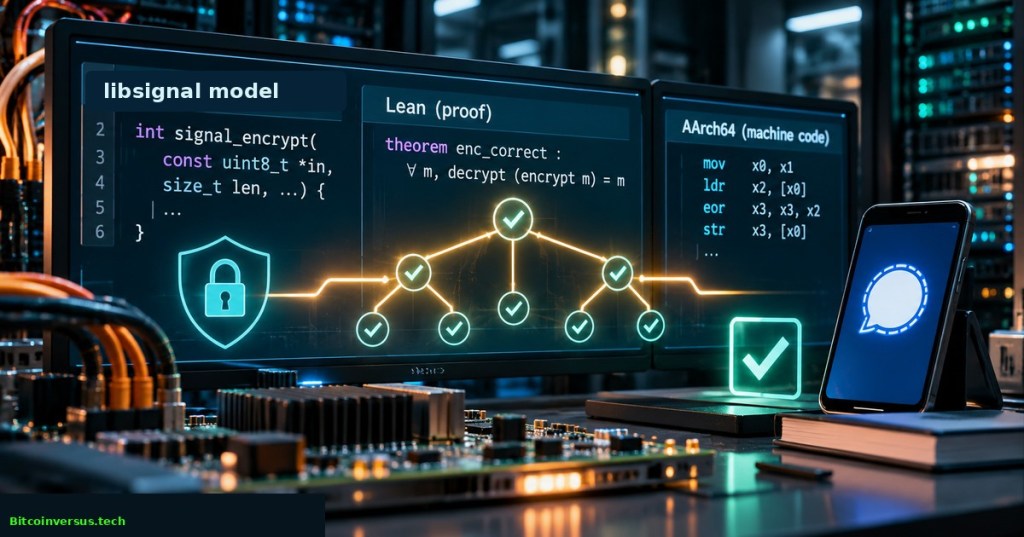
Google DeepMind announced AlphaProof Code on November 10, 2026, reporting that AI agents generated approximately 6.5 million lines of Lean proof code in four weeks to verify key security properties of Signal’s cryptographic implementation. Researchers worked from human-approved mathematical requirements to compiled AArch64 instructions, extending verification beyond an abstract protocol description. The result concerns a specific build of the libsignal reference library under defined assumptions, rather than every application, device or possible attack.
The proof reaches compiled machine instructions
The researchers linked unmodified Rust-based libsignal into a command-line harness and compiled it for AArch64 Linux. AlphaProof Code then modeled execution in Lean, an interactive theorem prover. AI agents proposed proofs, while Lean’s checker accepted only arguments matching a held-out, human-reviewed specification. As the published technical paper explains, the compiler does not have to be assumed correct for the proved properties: a relevant compilation error would cause verification to fail.
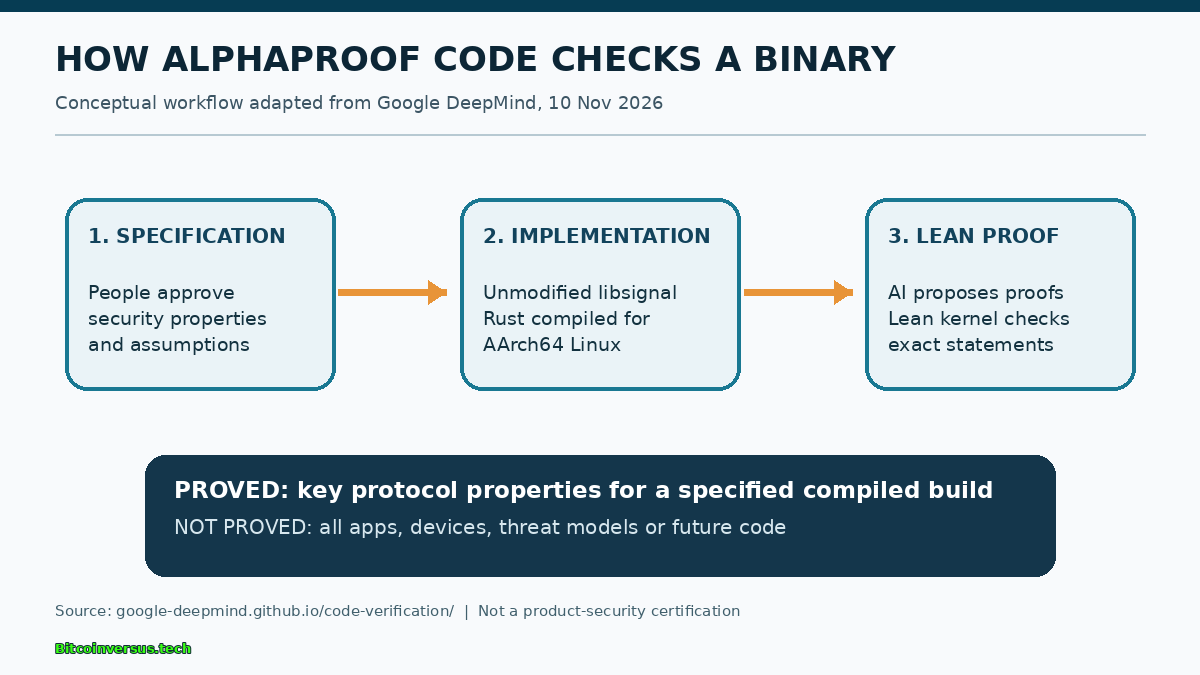
Signal’s handshake and ratchet were evaluated
The verification covers the post-quantum extended Diffie-Hellman handshake, known as PQXDH, and Signal’s Triple Ratchet. Researchers report proofs concerning confidentiality, authentication, forward secrecy and recovery after key compromise. A symbolic analysis addresses a future quantum attacker for specified handshake properties, while computational guarantees use classical-attack models and cryptographic hardness assumptions. Neither model establishes universal post-quantum security across every conversation scenario.
The distinction matters alongside broader adoption of post-quantum cryptography in OpenSSL. Cryptographic algorithms, implementation correctness and end-to-end application security are separate layers. The paper explicitly excludes several cases, including multi-device state and certain initial messages, and its computational proof imposes restrictions on attackers and session behavior.
Six million lines do not mean zero vulnerabilities
The generated proof corpus measures engineering effort, not network throughput, encryption speed or a quantified reduction in exploitation risk. About 26,000 lines of trusted definitions and AArch64 semantics underpin the machine-checked proofs. Humans still decide which properties and assumptions deserve confidence. A mathematically valid proof of a weak specification can miss a serious defect, making independent review of the trusted foundation essential.
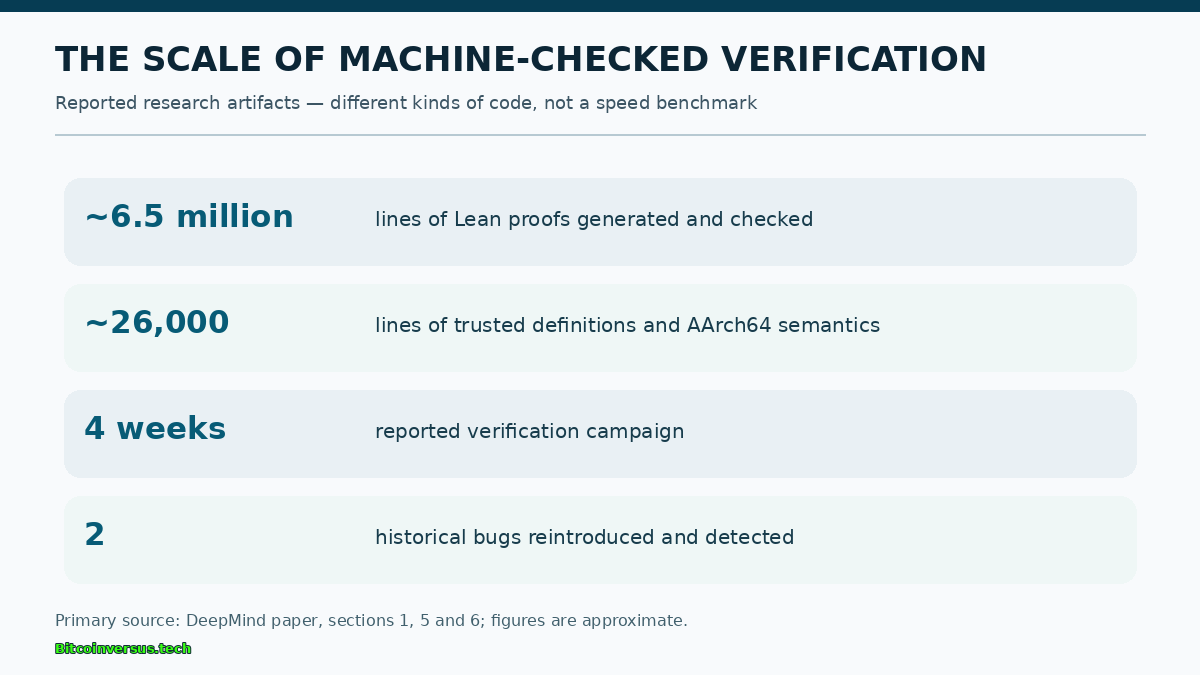
For a practical check, the team reintroduced two previously fixed libsignal bugs into isolated builds. The system produced machine-checked counterexamples showing that each altered binary violated its target security conditions. The experiment tests whether chosen specifications detect known faults; it is not a claim of newly discovered vulnerabilities in the shipping Signal app.
A possible new standard for critical software
Formal verification complements, rather than replaces, penetration testing, deployment audits and vulnerability remediation. Recent BitcoinVersus.Tech reporting on Microsoft’s proofs for AI-written Rust code and Anthropic’s model-inference verification shows distinct ways mathematical checks are entering software development. Meanwhile, CISA’s exploited-vulnerability warnings illustrate why proof coverage must coexist with operational defenses.
DeepMind has published the Lean artifacts and source repository for inspection. Independent reproduction, extension to other processors and coverage of complete mobile applications remain open tests. The demonstrated achievement is a conditional, machine-checked proof of specified cryptographic behavior—not a declaration that any messenger is impossible to hack.
Primary sources and verification: Google DeepMind announcement, November 10, 2026; AlphaProof Code technical paper; public verification repository. Independent reporting: The Register, November 10, 2026. Source statements describe research findings; no independent rebuild of the Lean development was carried out for the article.
Editor’s Note: The reported 6.5-million-line proof corpus, approximately 26,000 trusted lines, four-week campaign and two deliberate regression tests come from Google DeepMind’s November 10 paper and announcement. Coverage applies to a specified compiled libsignal harness, under symbolic or computational assumptions stated in the research. Human review of specifications remains necessary; no universal security or quantum-resistance guarantee is implied. Original illustrations are conceptual, source-labeled and carry Bitcoinversus.tech branding. The social-media post was identified through publicly indexed reporting, but a live browser embed and interactive playback were not independently validated.

BitcoinVersus.Tech is volunteer-run and publishes independent educational technology reporting. An optional 5,000-satoshi donation supports continued research. Scan the original QR using a second screen and a compatible Bitcoin wallet; on mobile, open a saved QR image with a wallet that supports image scanning. Confirm the recipient, amount and network inside the wallet before payment. Bitcoin transfers are generally irreversible.
We volunteer daily to ensure information on the BitcoinVersus.Tech platform is Verifiably True. Coverage is for educational and informational purposes and does not constitute financial or investment advice.


Leave a Reply