
Microsoft Research and GitHub Next have detailed PDD Kit, an experimental approach to checking whether AI-generated software actually follows a developer’s requirements. Their November 5, 2026 demonstration applies mathematical verification to a Rust web application rather than relying only on human code review and ordinary tests. The collaboration targets a growing engineering problem: coding agents can generate software faster than teams can inspect every changed line. Earlier BitcoinVersus.Tech reporting examined the human-review bottleneck in AI-assisted development.
Unit tests and integration tests evaluate selected inputs and operating conditions. Formal verification takes a different approach: a verifier checks whether implementation logic satisfies precise mathematical requirements across the inputs covered by its model. Neither method guarantees the full system is safe. An incomplete requirement or an incorrectly assumed dependency can undermine a valid proof. GitHub Next’s accompanying project description calls PDD Kit a research prototype, not a broadly released commercial product.
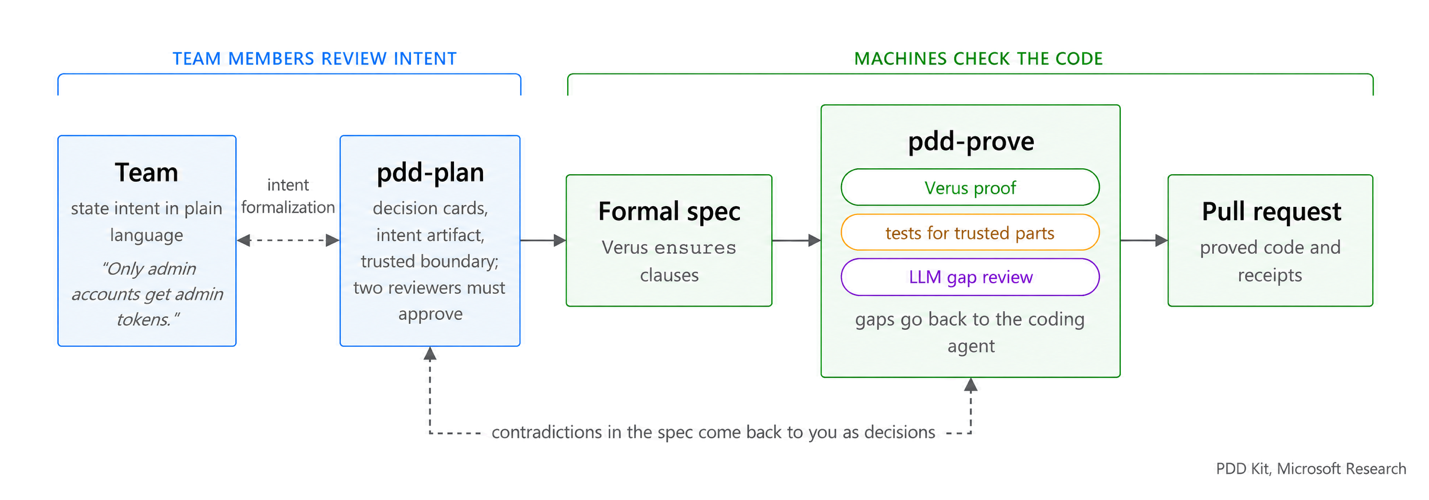
A formal contract for AI-written code
PDD Kit works alongside Chopin, GitHub Next’s collaborative planning environment. Engineers describe the behavior they want in ordinary language, review decision cards and approve an intent artifact. The system translates provable requirements into contracts for Verus, a formal-verification tool for Rust. An automated process then produces implementation code, proofs and tests for components outside the proof. The pull request records what was proved and what was merely tested. The approach complements, rather than replaces, the remote coding-agent workflows appearing in developer tools.
The researchers evaluated the approach on Pet Store, a roughly 5,000-line Rust full-stack application using Axum, SQLite and a Leptos/WebAssembly storefront. They focused on login authorization, including the requirements that incorrect passwords must not produce tokens and that only administrator accounts receive administrator tokens. PDD Kit raised a crucial question: should a correct password always produce a token? A system rejecting every login could satisfy the weaker wording while remaining unusable.
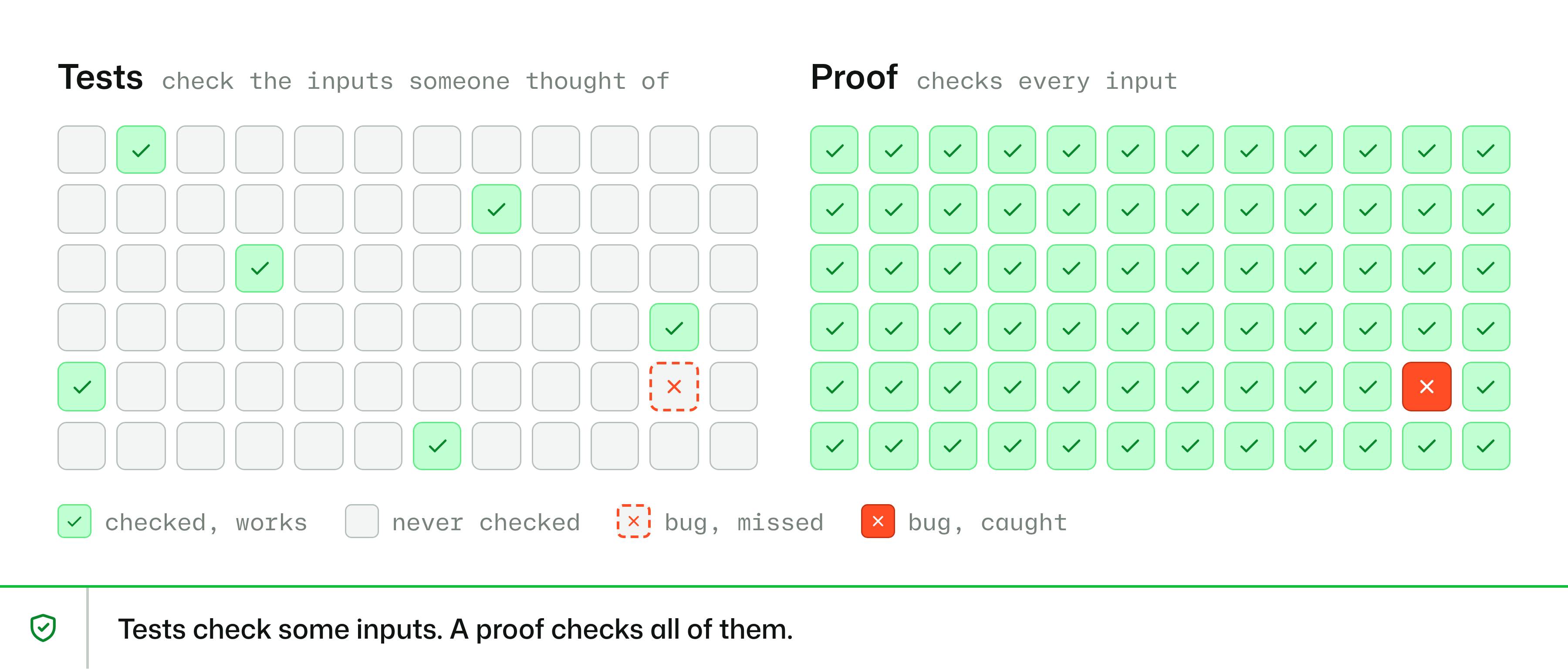
After the specification was clarified, the researchers say Verus formally checked five core functions: login_flow, login_core, lookup_target, decide_login and issue_token. Code changes that break the approved contracts can fail the verification step in continuous integration. Related Rust engineering lessons cover language-level safety rules; formal proofs address specified behavior beyond ordinary memory-safety guarantees.
The proof does not cover everything
The demonstration also identifies six trusted components outside the mathematical proof: database lookups, the bcrypt password-checking wrapper, the clock, token signing, database-error handling and request unpacking. Tests examine those assumptions, but the proof does not establish their correctness. The authors explicitly exclude guarantees about request completion, response speed, login-attempt rates and how unrelated endpoints interpret roles. A proof covering a carefully defined login function is not proof that an entire application is immune to attack.
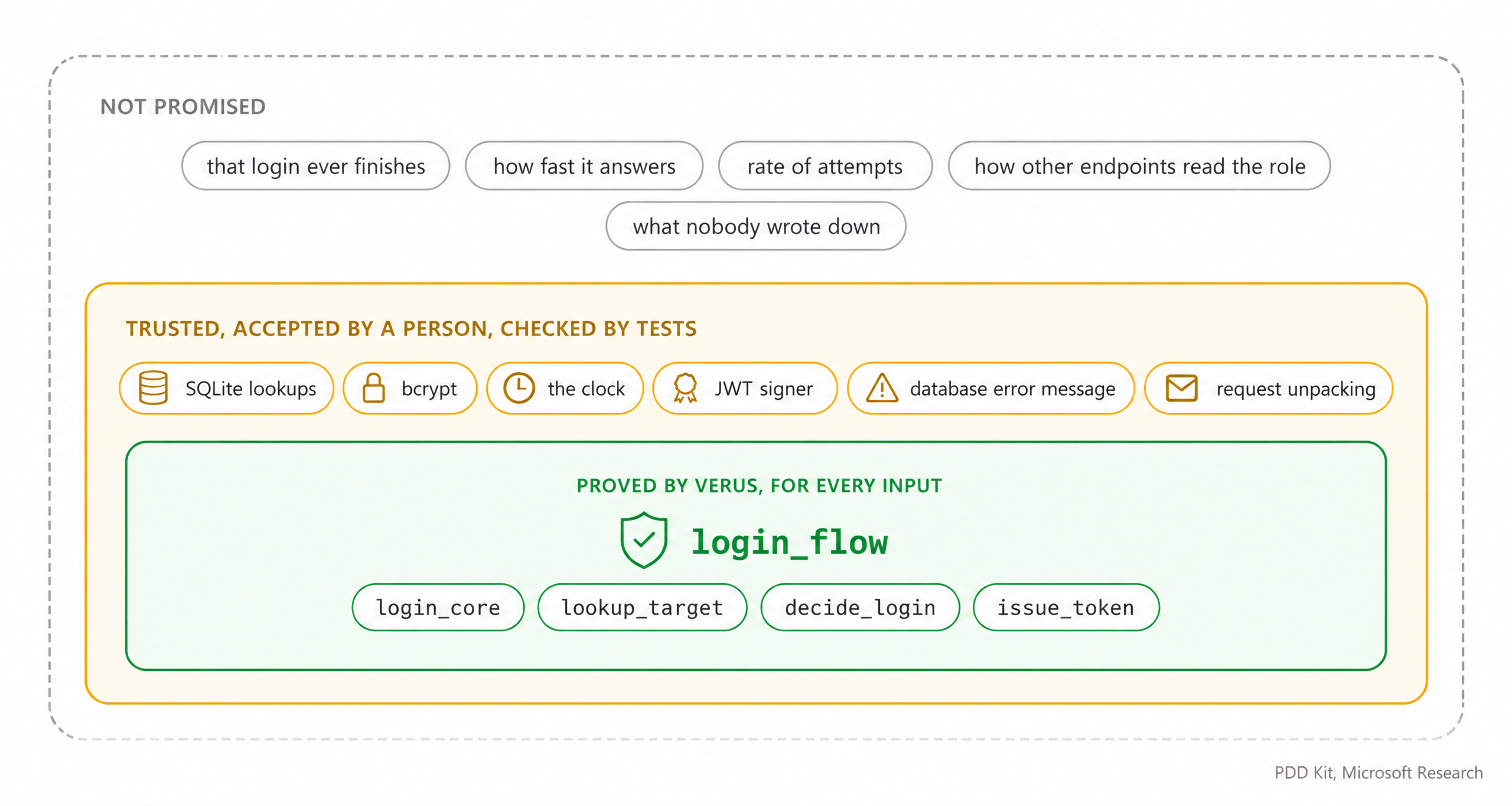
The distinction matters for real-world security. Verified-kernel engineering shows that rigorous reasoning and vulnerability remediation must coexist. Similarly, reports about large browser security-fix releases illustrate the range of faults that software testing, review and verification must confront. The prototype has not demonstrated universal protection against vulnerabilities across dependencies, user interfaces, deployment environments or unmodeled behavior.
Research preview, not a finished product
PDD Kit currently supports Rust verification through Verus. Microsoft describes the work as a research prototype, while a GitHub Next presentation characterizes access as a limited research preview. No general-availability date or public standalone PDD Kit download was confirmed in the announcements reviewed. Teams evaluating similar techniques can examine the publicly available Verus verifier, but should not confuse access to Verus with availability of the complete PDD Kit workflow.
The proposed shift is consequential: humans spend more review time specifying what software must do, while automated proof tools check whether generated code matches those approved requirements. Success depends on strong specifications, trustworthy interfaces and transparent records of unproved assumptions. Microsoft and GitHub Next have shown a focused login case study, not a measured industry-wide reduction in bugs, engineering cost or review time. Wider evidence will be needed before proof-driven coding can be treated as an established production standard.
Primary sources: Microsoft Research, November 5, 2026; GitHub Next’s PDD Kit project; GitHub Next Universe 2026 presentation; Verus source repository.
Editor’s Note: All product capabilities, demonstration results and limitations are attributed to Microsoft Research and GitHub Next; BitcoinVersus.Tech has not independently run PDD Kit or reproduced its proofs. The three diagrams are official source illustrations with credits. The 1200 × 630 featured artwork is AI-generated conceptual imagery, not a product screenshot. No unverified video embeds were inserted.
Support BitcoinVersus.Tech
To support independent technology reporting, scan the original donation QR below for an optional 5,000-satoshi contribution. On a phone, display the code on another screen and scan with a compatible Bitcoin wallet, or import the saved QR image if supported. Verify the destination and amount before confirming payment.

We volunteer daily to ensure the information on this platform is Verifiably True. If you would like to support the research, please scan QR code.


Leave a Reply