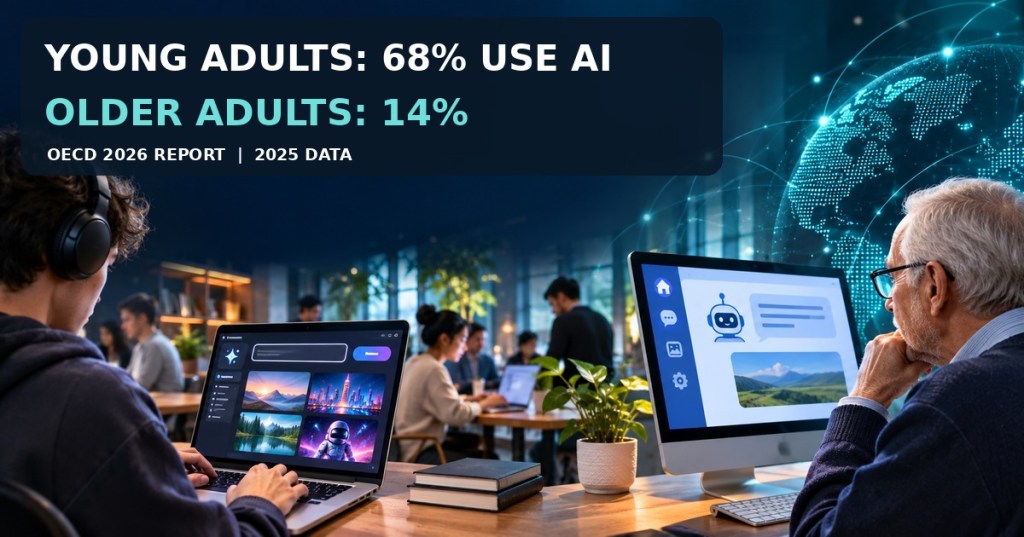
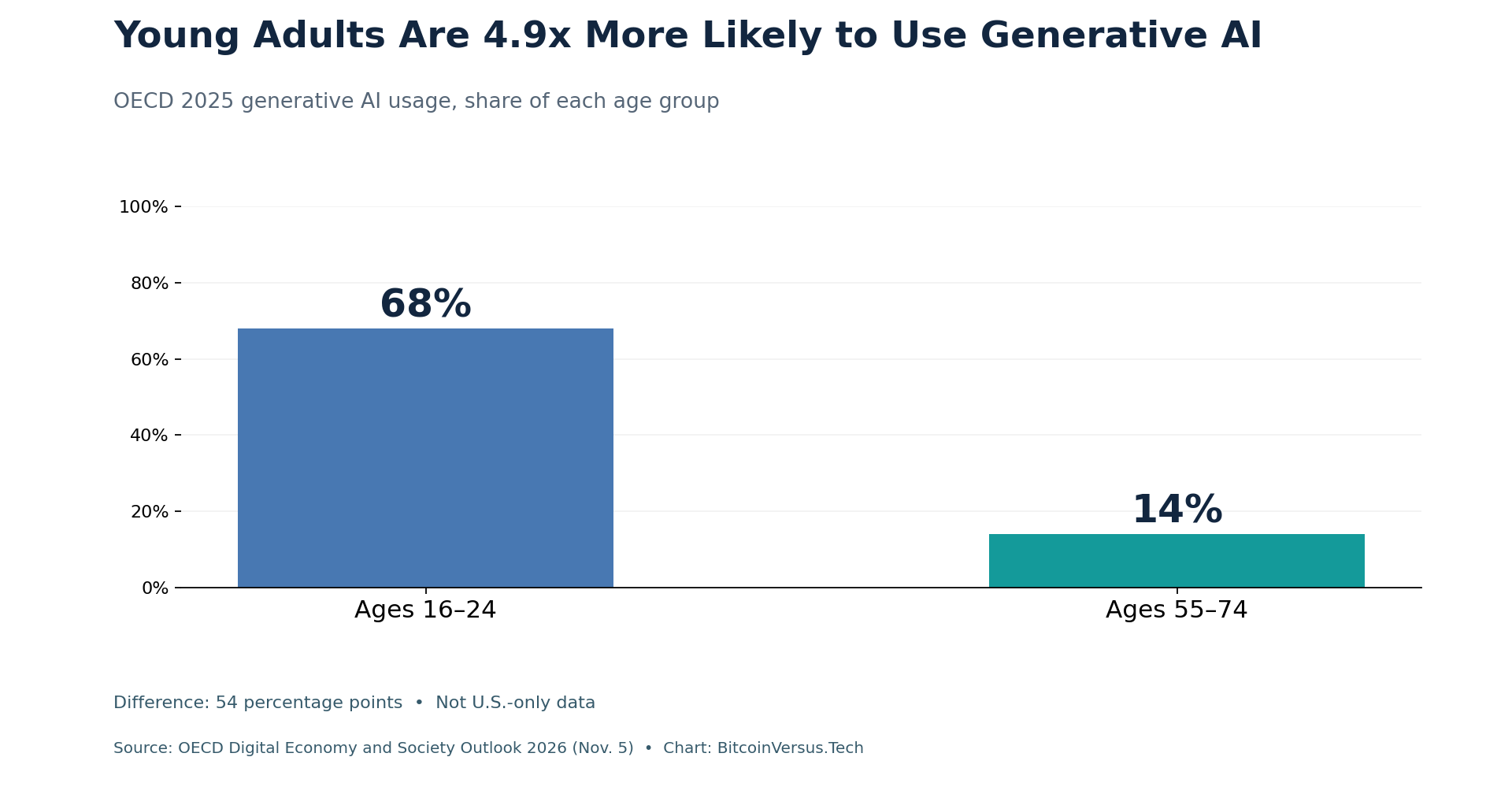
Generative artificial intelligence is spreading across advanced economies, but a substantial generational divide remains. Among people ages 16–24, 68% used generative AI in 2025, compared with just 14% of adults ages 55–74, according to the Organisation for Economic Co-operation and Development’s Digital Economy and Society Outlook 2026, released November 5. The 54-percentage-point difference is among the report’s clearest measures of uneven technology adoption.
Young adults are nearly five times as likely to use generative AI
The older cohort’s 14% usage rate is less than one-fifth of the younger group’s 68%. Expressed as a ratio, 68 divided by 14 is approximately 4.9 times. The percentages refer to people in OECD economies, not exclusively United States residents, and measure reported use of generative AI rather than everyday use of smartphones or the internet.
Across individuals of all ages, OECD estimates 37% used generative AI in 2025. The ageing and AI chapter identifies several adoption barriers: 43% of older adults perceived no need for AI, 12% lacked relevant skills, and 9% were unaware of the technology. Responses describe reported obstacles, not proof that older adults lack the ability to learn modern software.
Large companies are much further ahead
AI deployment also differs by business size. The OECD found that 20% of firms with at least 10 employees used AI, compared with 52% of large firms with 250 or more employees. The 32-point gap reflects reported organizational adoption, not a comparison of employees’ personal AI habits.
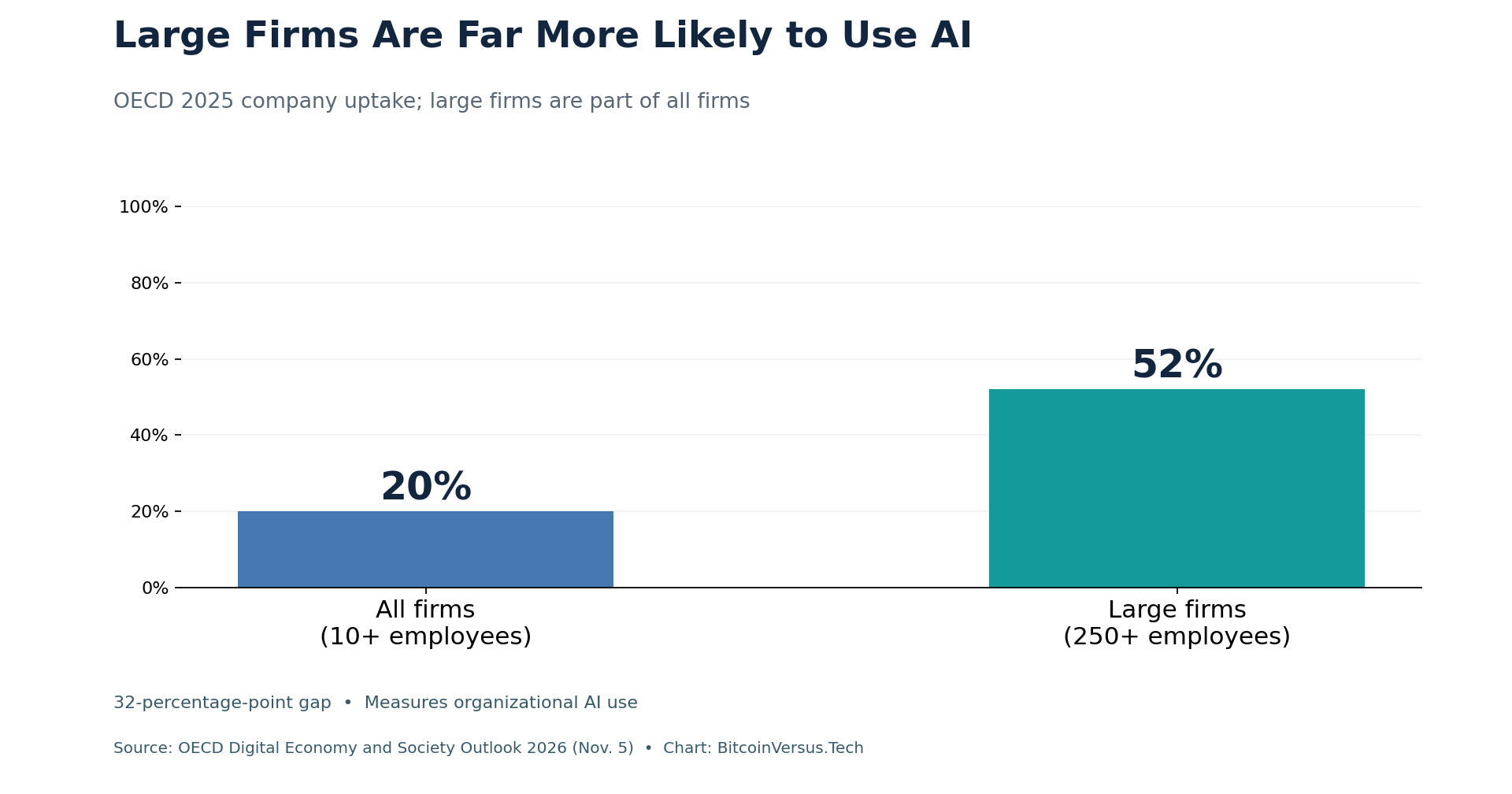
The OECD’s business analysis links unequal adoption to differences in financing, skills, infrastructure and the ability to integrate AI with existing systems. Cloud services are more widespread: over half of firms and more than 80% of large firms used cloud computing. Those findings complement BitcoinVersus.Tech’s earlier reporting on the productivity bottleneck in AI-assisted programming and corporate AI governance shortcomings. Adoption does not automatically establish productivity gains or trustworthy deployment.
Internet access improved, but the AI gap remains
Older adults are not simply disconnected. The share of OECD residents ages 55–74 using the internet climbed from 58% in 2015 to 87% in 2025, an increase of 29 percentage points. Basic connectivity has approached widespread adoption while generative AI use remains substantially lower.
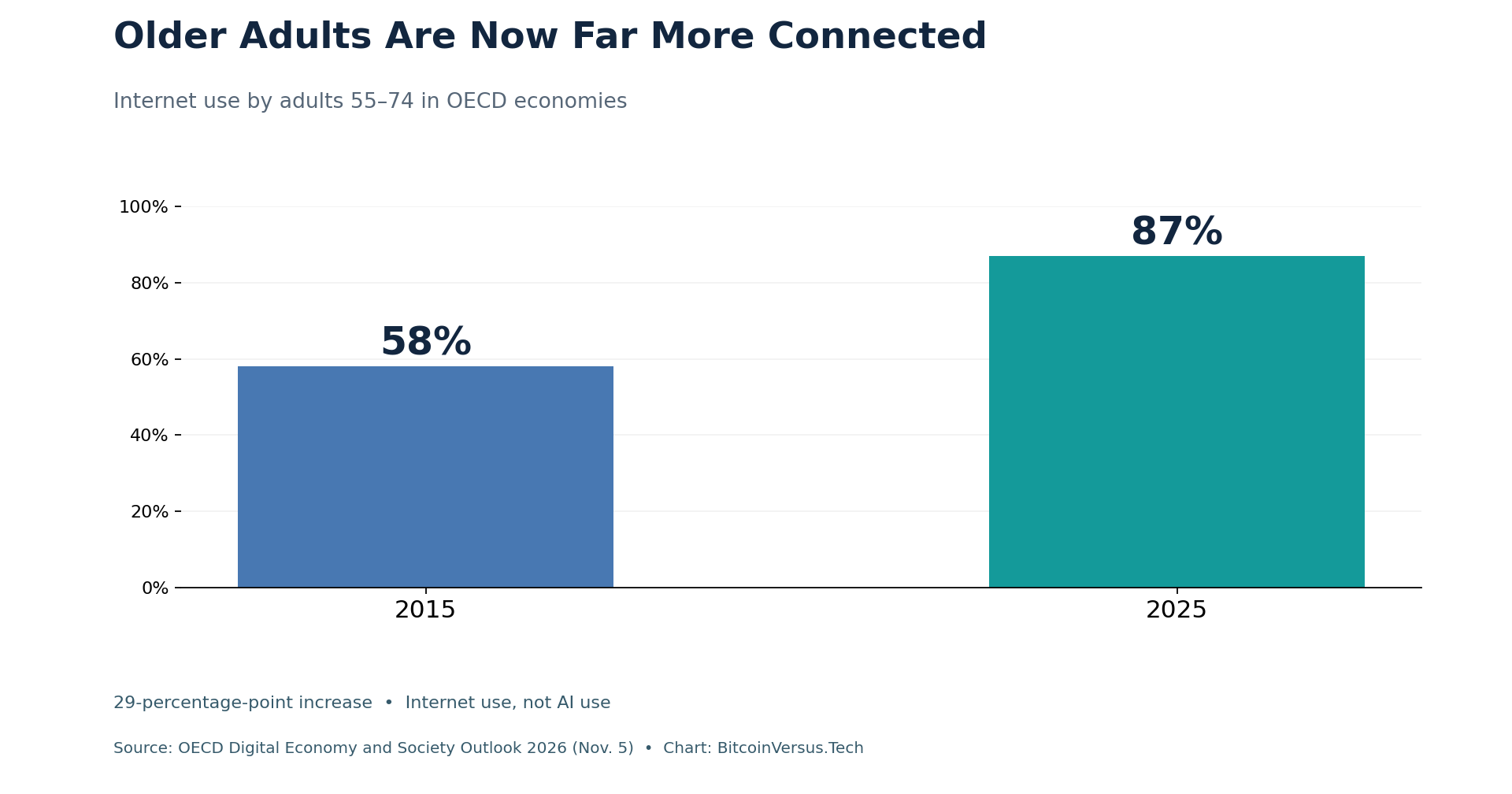
The distinction matters for service design. Banks, public agencies and technology companies increasingly introduce AI-assisted interfaces, but connectivity alone does not guarantee accessible tools, user confidence or adequate privacy protection. BitcoinVersus.Tech has previously covered public concerns about AI’s development speed and growing infrastructure demand from autonomous AI agents. Neither trend resolves the gap between access and effective use.
The OECD’s averages also combine country-level statistical observations with differences in reference years and survey definitions. They should not be read as a single worldwide census or a randomized experiment proving the causes of adoption. The report identifies training, accessible design and affordable infrastructure as policy options; whether those interventions close the gap requires additional evidence.
Editor’s Note: Published November 8, 2026. The figures for generative AI use among ages 16–24 (68%), ages 55–74 (14%) and all individuals (37%) were checked against the OECD’s November 5, 2026 press release and ageing chapter. The 20% and 52% enterprise figures were checked against the digital-technology diffusion chapter. The 58% to 87% rise in older adults’ internet use was checked against the same OECD research. Chart arithmetic: 68 − 14 = 54 percentage points; 68 ÷ 14 ≈ 4.86; 52 − 20 = 32 percentage points; 87 − 58 = 29 percentage points. Some country observations use the latest available year rather than 2025. All three charts are original reconstructions from OECD statistics. The featured image is an editorial illustration, not a documentary photograph of surveyed individuals.

To donate 5,000 sats, open the article on a separate display and scan the original QR code with a compatible Bitcoin wallet. On mobile, use another screen or your wallet’s supported image-scanning feature. Verify the destination 3C9o19EH5HSiwEPyCTmEKzxhNCbo2X6TTb before sending.
We volunteer daily to ensure the information on this platform is Verifiably True. If you would like to support the research, please scan QR code.
BitcoinVersus.tech is not a financial advisor. Technology reporting is informational and does not predict individual behavior or guarantee business returns.


Leave a Reply