
New polling suggests many Americans are uneasy about how quickly artificial intelligence is advancing, but the evidence does not show that Americans are simply rejecting AI. The clearer picture is one of growing use alongside growing concern about jobs, safety, privacy, and human control.
Unusual Whales is among the accounts highlighting this shift in public sentiment. Its October 11 post points to the broader question now surrounding AI: people increasingly use the technology while also asking whether its development is moving faster than institutions, workplaces, and safeguards can adapt.
Most Americans say AI is moving too quickly
The strongest recent evidence comes from AP-NORC’s latest national survey. Sixty-four percent of U.S. adults said AI technology is developing too quickly, while 27% said the pace is about right and 8% said it is moving too slowly.
The same survey found roughly eight in 10 adults consider keeping AI under human control and protecting U.S. workers important government priorities. The poll was conducted September 24–28 among 2,140 adults and carries a margin of sampling error of plus or minus 2.9 percentage points.
Concern does not mean Americans are anti-AI
That distinction matters. A person can use AI for work, search, coding, education, or entertainment and still believe the technology is advancing too quickly. Pew Research Center reported in June that chatbot use had risen substantially across U.S. age groups even while majorities remained skeptical about AI’s pace and long-term impact.
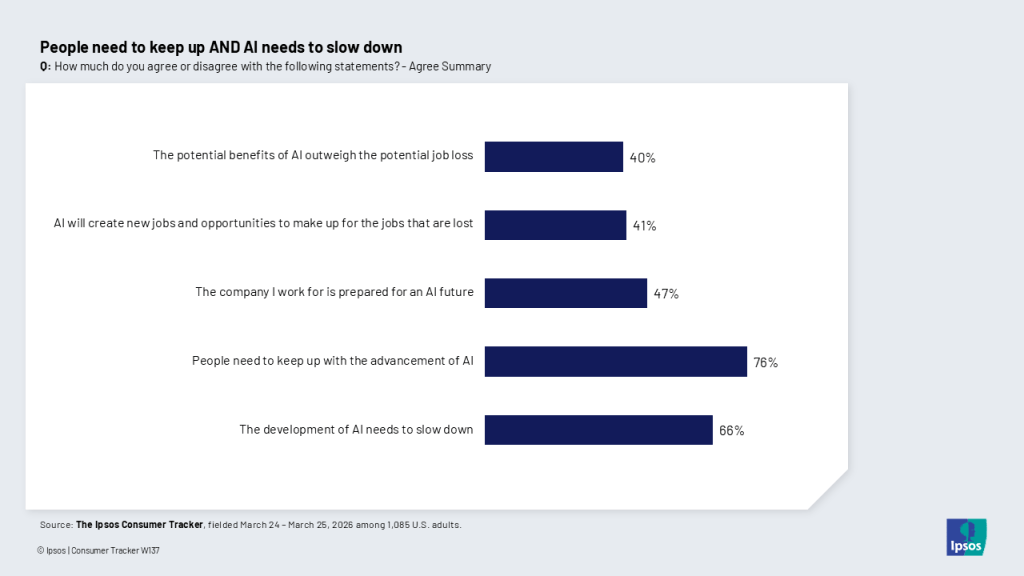
The earlier Ipsos survey shown above illustrates the same split. Most respondents agreed that people need to keep up with AI, while about two-thirds also agreed that AI development itself needs to slow down. Public apprehension, in other words, can coexist with adoption.
Safety and jobs remain major sources of unease
A separate Reuters/Ipsos poll published September 22 found that 73% of Americans were concerned AI companies were not doing enough to prevent serious harm. Fifty-five percent said slowing AI development would be a good thing, and 73% prioritized safe and responsible development over keeping ahead of other countries.
Those findings do not establish that AI will cause the outcomes respondents fear. They measure public expectations and concerns. Job displacement, misinformation, privacy, cybersecurity, environmental costs, and loss of human control are different risks, and the evidence for each one should be evaluated separately rather than grouped into a single claim that “AI is bad.”
The industry is responding to some of the same concerns
Some of the debate is already moving from abstract warnings toward engineering controls. BitcoinVersus recently covered Satya Nadella’s argument that advanced AI needs an emergency brake, as well as Microsoft’s move to sandbox AI agents on Windows 11. Both approaches focus on limiting what AI systems can do rather than assuming models will always behave correctly.
At the same time, apprehension should not erase the technology’s potential upside. AI can automate repetitive work, help people search large amounts of information, accelerate software development, assist scientific research, and enable new forms of entertainment. We have also examined the potential benefits of AI in video games, where adaptive characters and faster content creation could improve how games are built and played.
What the polling actually supports
The safest conclusion is narrower than “Americans are turning against AI.” Multiple surveys now indicate that large shares of the public think AI is advancing too quickly and want stronger attention to safety, jobs, and human oversight. At the same time, AI use continues to spread, and meaningful shares of Americans still view the technology positively or believe its current pace is acceptable.
That makes “apprehensive” a better description than “opposed.” The public appears to be asking for more confidence in how AI is deployed, who remains accountable, and what happens to workers and institutions as the technology becomes more capable.
BitcoinVersus.Tech Editor’s Note: Poll results measure opinion at a particular moment and can vary with question wording, sample design, and timing. The surveys cited here should not be treated as proof that Americans uniformly support or oppose AI. BitcoinVersus.Tech’s aim is to distinguish what the polling actually reports from broader interpretations of what it may mean.
Follow BitcoinVersus.Tech on X for AI, semiconductors, data centers, cybersecurity, Bitcoin mining, and emerging-technology reporting.
Support independent technology reporting: Bitcoin donations help fund BitcoinVersus.Tech research and publishing.
Disclaimer: BitcoinVersus.Tech provides technology news and analysis for informational purposes only.


Leave a Reply