
X’s November 4, 2026 engineering report describes replacing its long-running browser-rendered website with a streaming, server-rendered React application. In matched November 3 laboratory tests, the new application displayed the first individual post in 1.7 seconds on a simulated slow connection, compared with 21.7 seconds for the old version: approximately 12.8 times faster, or a 92.2% reduction in wait time. X is rolling the signed-in experience out country by country; the migration is not complete.
The comparison matters because downloading a webpage and displaying useful content are different events. The previous application, internally called rweb, delivered an initial shell before JavaScript fetched profile and post data. Its replacement sends a streamed HTML response containing the first posts, then hydrates interactive features. The older architecture did provide a responsive shared client and a substantial navigation cache; the newer design prioritizes initial content visibility.
Three Pages, Three Different Speedups
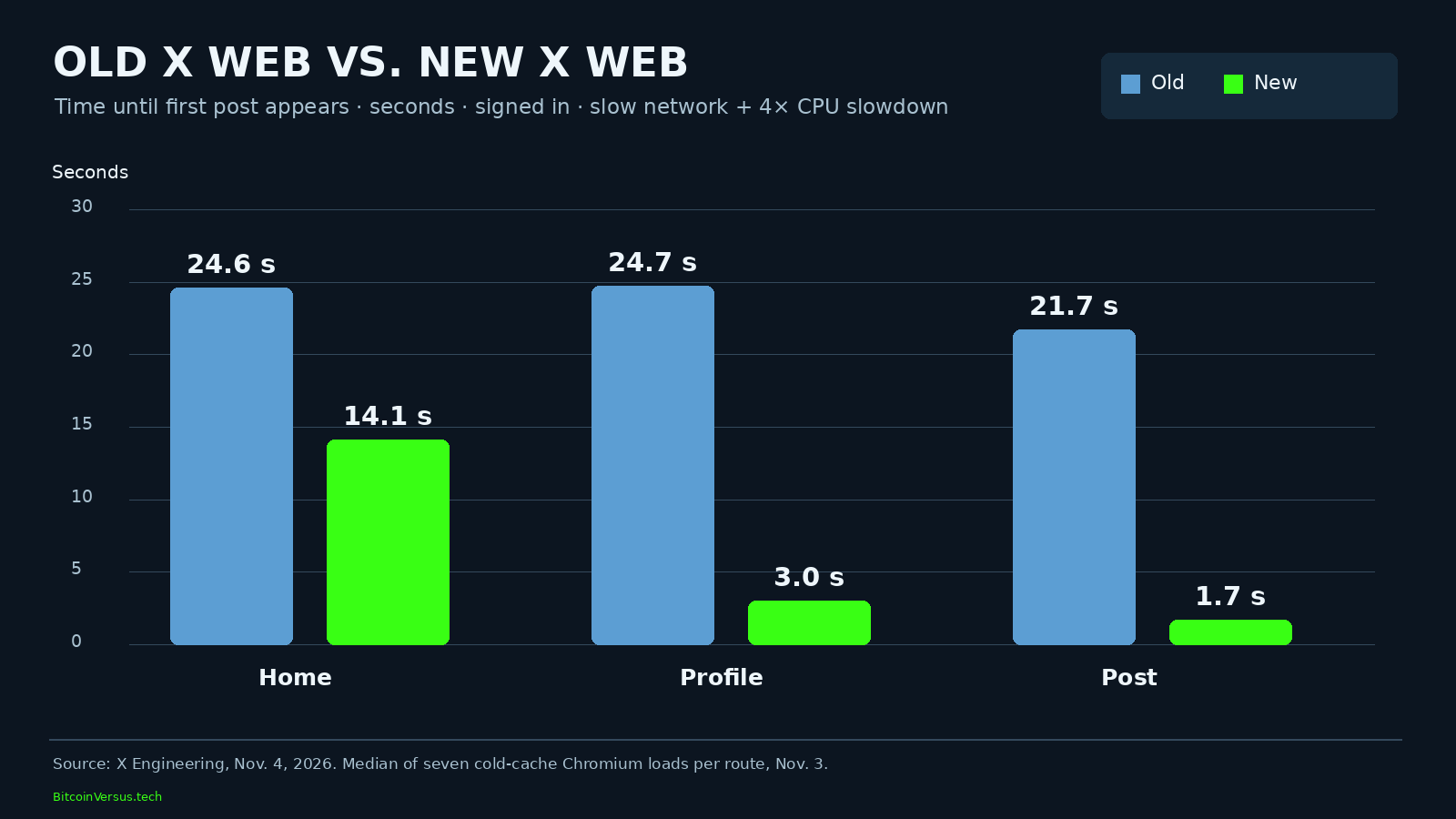
Engineers compared the same signed-in Home, @SpaceX profile and @SpaceX post routes on both versions, using a fresh headless Chromium instance, cleared cache and disabled service workers. Each page and configuration was loaded seven times. The slow profile applied 150 ms network latency, 1.6 megabits per second download, 750 kilobits per second upload and fourfold CPU slowdown. Figures are medians, not guarantees for individual visitors.
The new Home timeline improved from 24.6 to 14.1 seconds, a 42.7% reduction. The profile improved from 24.7 to 3.0 seconds, an 87.9% reduction. The individual post improved from 21.7 to 1.7 seconds, a 92.2% reduction. An earlier side-by-side recording reported 23.9 versus 2.7 seconds under different CPU settings; its result must not be mixed into the seven-run dataset.
A Smaller JavaScript Barrier
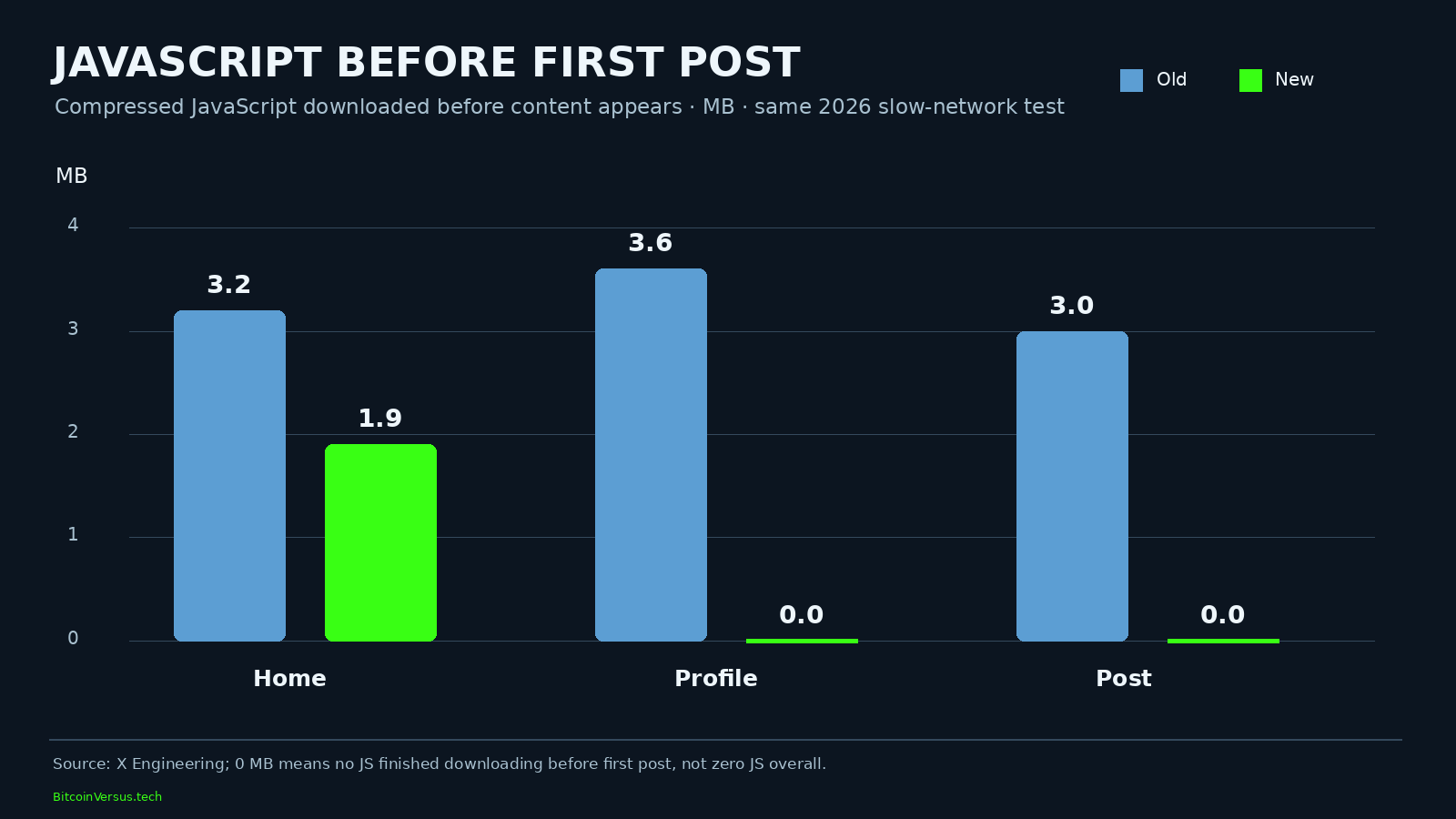
On slow-network tests, the old application downloaded 3.2 MB, 3.6 MB and 3.0 MB of compressed JavaScript before the first post on Home, profile and post pages, respectively. The new version needed 1.9 MB before Home appeared and zero completed JavaScript downloads before profile or post content became visible. Zero does not mean the entire page contains no scripts; server-rendered HTML simply arrives before their completion.
React’s streaming server rendering and Suspense explain the architectural change. X uses Vite, Rolldown, Relay, GraphQL, Fastify and Platformatic Watt on Node.js for the new application. The site’s move from three rendering services to one changes maintenance as well as first-load performance. Earlier BitcoinVersus.Tech reporting covered Node.js runtime evolution and Discord’s own software rewrite, with different outcomes and measurement methods.
Faster Is Not Universally Faster
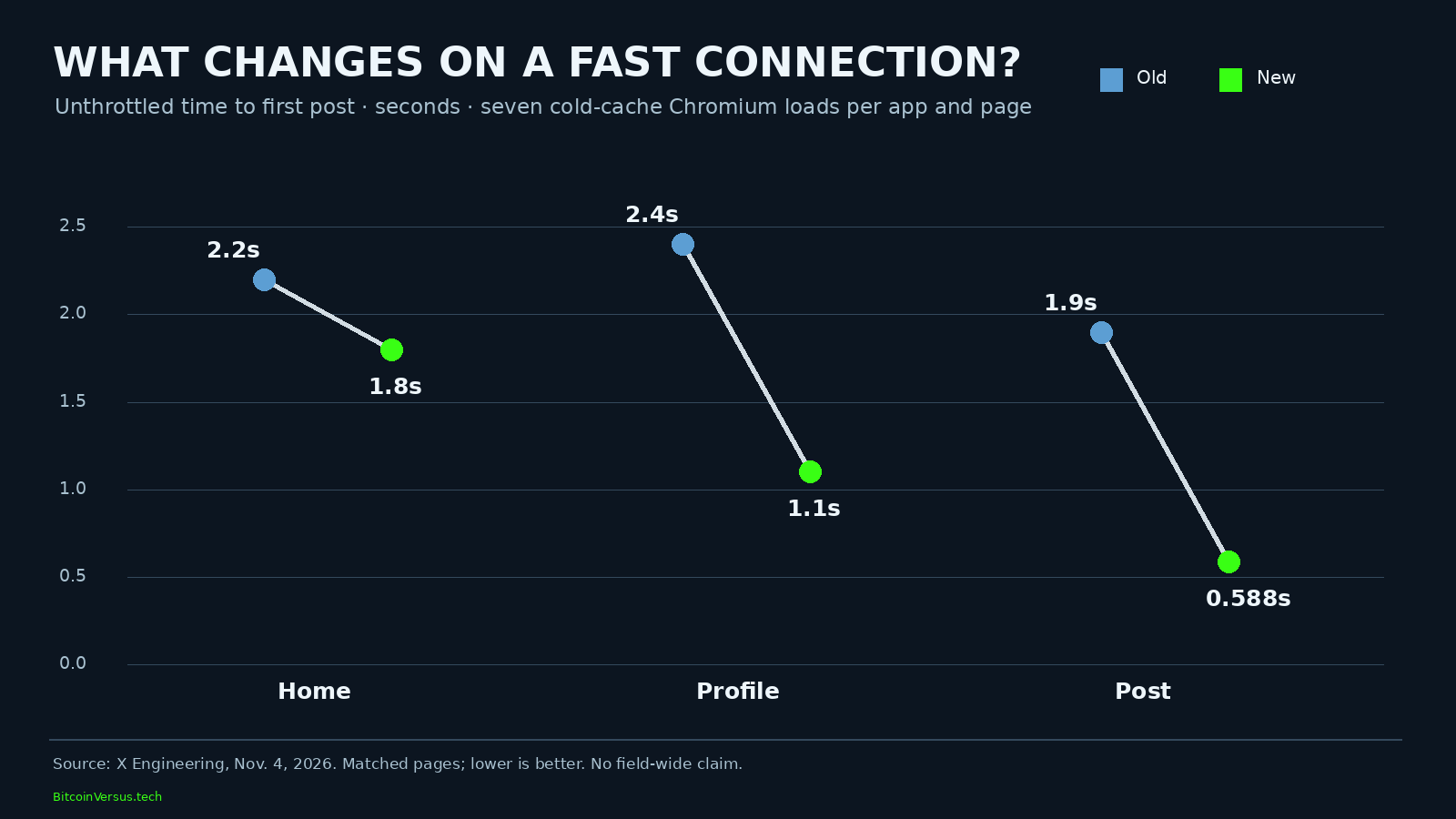
Without artificial throttling, Home improved from 2.2 to 1.8 seconds, a smaller 18.2% reduction. The profile fell from 2.4 to 1.1 seconds, and a post from 1.9 to 0.588 seconds. The new server also takes longer to deliver its first byte for some signed-in pages, because it fetches data and renders HTML before answering. A rapid old-app navigation could benefit from its warm client cache, which the cold-start test deliberately excludes.
X credits a small engineering team using AI coding agents for much of the rewrite, backed by automated checks and reviews. Those claims invite comparison with BitcoinVersus.Tech coverage of GitHub’s infrastructure redesign and AI-generated code verification. Neither article supplies a directly comparable speed benchmark.
Statistical Verdict
The new X application wins first-post visibility across all six matched page-and-network scenarios in the published laboratory sample. The strongest advantage occurs on slow profile and post loads; Home benefits less. X’s figures are company-reported medians from one test laptop, and production Core Web Vitals for the rolled-out population were not published alongside the comparison. As network latency and throughput vary, independent field measurements remain essential before claiming every user receives a twelvefold improvement.
Sources: X Engineering, November 4, 2026 (source data and experimental design); The Verge, November 5 (rollout reporting); React documentation and talk (historical technology background). Percentage calculations are derived from the reported medians.
BitcoinVersus.Tech Editor’s Note
Benchmark results were published by X on November 4, 2026, from laboratory runs conducted November 3, not independently replicated traffic studies. A cover graphic shows an editorial reconstruction, not an actual capture of the two tested browsers. React Conf’s 2021 presentation provides background only, and Jane Manchun Wong’s impression is qualitative.
We volunteer daily to ensure the information on this platform is Verifiably True. If you would like to support the research, please scan QR code.

To donate 5,000 satoshis, scan the original QR code from another display or use a wallet that scans saved images. Verify the receiving address 3C9o19EH5HSiwEPyCTmEKzxhNCbo2X6TTb and the amount before confirming.
BitcoinVersus.Tech is not a financial advisor. Financial subjects are reported for informational purposes only.


Leave a Reply