
November 2, 2026 — The Node.js project published Node.js 27.0.0-alpha.0.0.0 on October 29, launching a new annual release cycle for the JavaScript runtime. The developer preview arrives as Node.js 26 enters long-term support, shifting early experimentation toward an explicit six-month alpha period.
Under the previous system, major Node.js versions arrived twice yearly, and odd-numbered releases generally never became LTS. The new release policy makes every annual line eligible for LTS, aiming to simplify upgrades and reduce maintenance work for the project.
From Twice-Yearly Releases to a Longer Testing Window
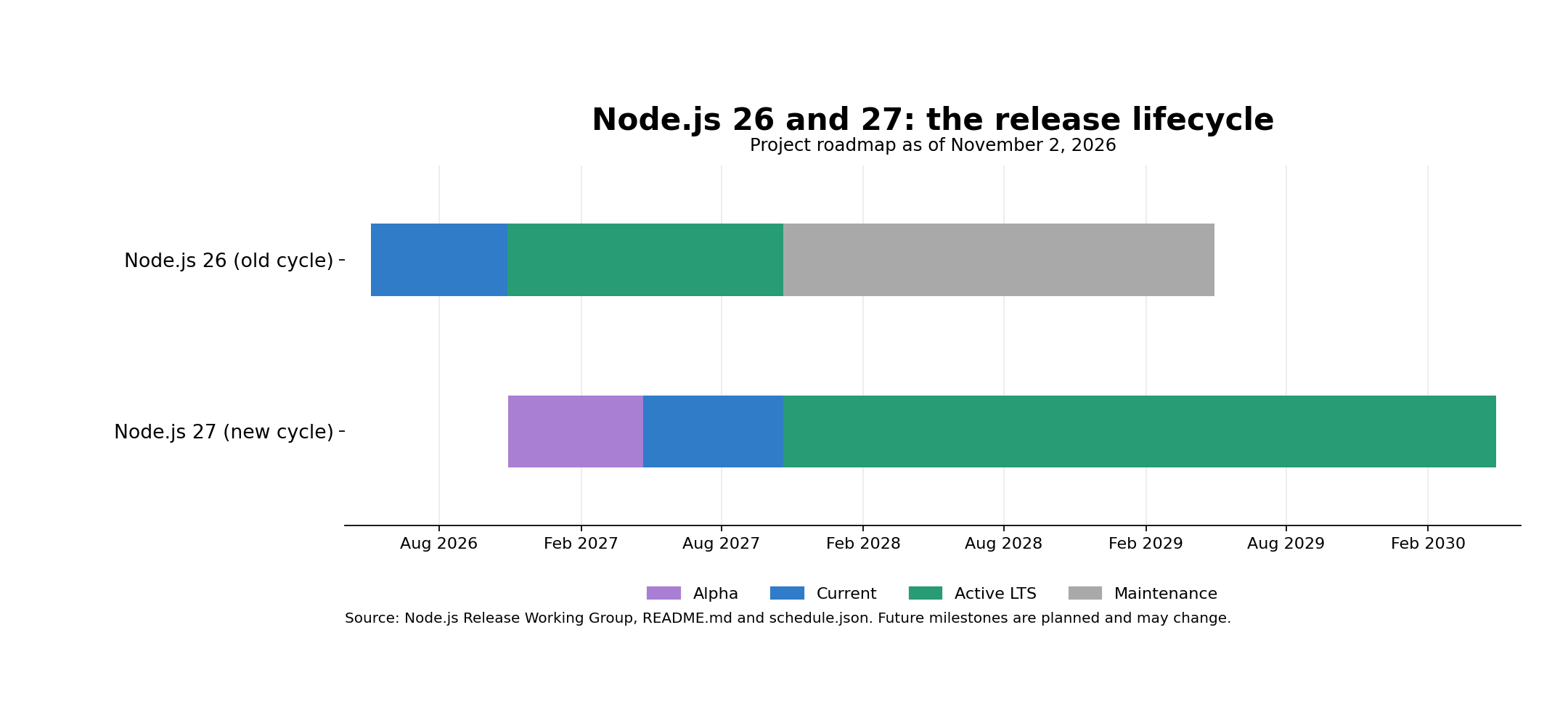
The Release Working Group’s roadmap schedules Node.js 27’s Current release for April 22, 2027, LTS promotion for October 20, 2027, and end of support on April 30, 2030. Those future dates are project targets.
The alpha already bundles V8 15.6.75.13, replacing Node.js 26’s V8 14.6. New default JavaScript features include Math.sumPrecise() and iterator helpers. Developers can test upcoming language behavior months before the Current release.
What Changes Inside Node.js 27
Several changes affect real servers. Without an explicit --max-old-space-size override, V8’s default heap limit becomes half the physical RAM, bounded between 256 MB and 4 GB. Node.js also raises its default HTTP keep-alive timeout to 65 seconds.
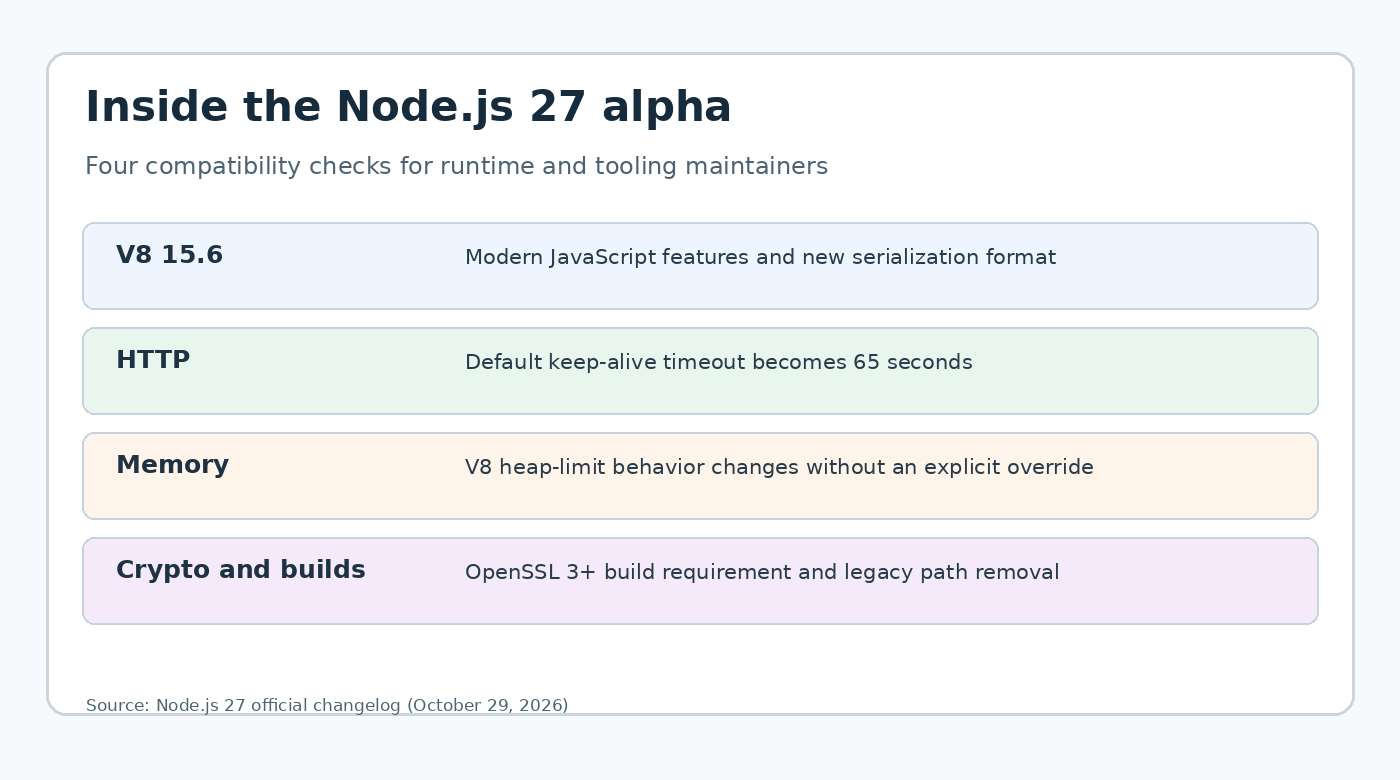
Serialization changes matter, too: v8.serialize(), structuredClone(), and postMessage() use a new format that older Node.js releases cannot read. Build configurations require OpenSSL 3 or newer, with multiple legacy cryptography paths removed.
For example, a caching service may need to retest serialized payloads, while an API server should inspect keep-alive behavior behind proxies. These are compatibility tests, not reasons to migrate production workloads immediately.
Practical Testing for Developers
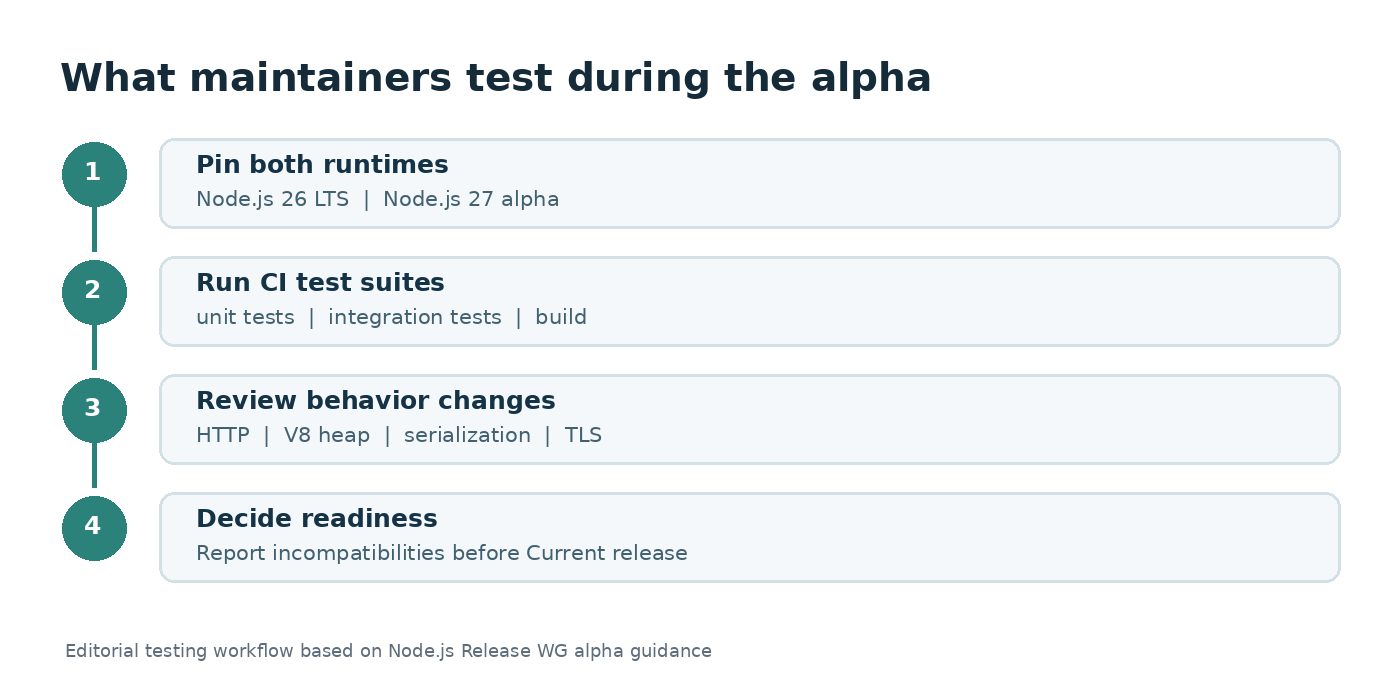
Maintainers should pin Node.js 26 LTS alongside the 27 alpha in continuous integration, run unit and integration suites, and report regressions while breaking changes can still be revised. The project uses Canary in the Gold Mine (CITGM) tests to probe ecosystem compatibility.
The change connects to our coverage of JavaScript language behavior, Node.js dependency security, competing JavaScript runtimes, and large-scale runtime engineering. Each raises the importance of testing dependencies and deployment assumptions.
Next, watch the alpha changelog, package compatibility reports, and the scheduled April transition. For production teams, the supported Node.js 26 line remains the practical baseline while the 27 series matures.
BitcoinVersus.Tech
BitcoinVersus.Tech Editor’s Note: We volunteer daily to ensure the credibility of the information on this platform is Verifiably True. If you would like to support our work and help further secure the integrity of our research initiatives, please scan the QR code below to donate 5,000 sats. For best results, scan the QR code from a laptop or larger screen.

Bitcoin donation address: 3C9o19EH5HSiwEPyCTmEKzxhNCbo2X6TTb. On mobile, open the QR on another screen or use your wallet’s saved-image scanner.
Disclaimer: BitcoinVersus.Tech reports technology, energy and financial developments for informational purposes only, not investment advice. Proposed AI architectures and future operational benefits require validation under real-world conditions.


Leave a Reply