
Node.js maintainers issued security updates on October 21, 2026, for a memory-corruption flaw in the Brotli decoder used to decompress web data. The defect, tracked as CVE-2026-111497, could expose servers, applications and cloud workloads worldwide when they decode specially crafted compressed input from an untrusted source.
Brotli was developed at Google and is commonly used to shrink HTTP responses and other data. The Red Hat security bulletin explains that affected deployments can include Node.js, browser components and native libraries. That does not mean every installation is remotely exploitable: the vulnerable decoder must process attacker-controlled data.
How an Invalid Brotli Block Can Become a Security Problem
The technical failure sits in the decoder’s block-switch logic. Instead of rejecting an invalid block transition, the streaming code could interpret it as a request for additional input and keep writing beyond a small internal buffer. Memory corruption might crash a process, expose information or, in favorable circumstances for an attacker, permit code execution. No particular outcome is guaranteed.
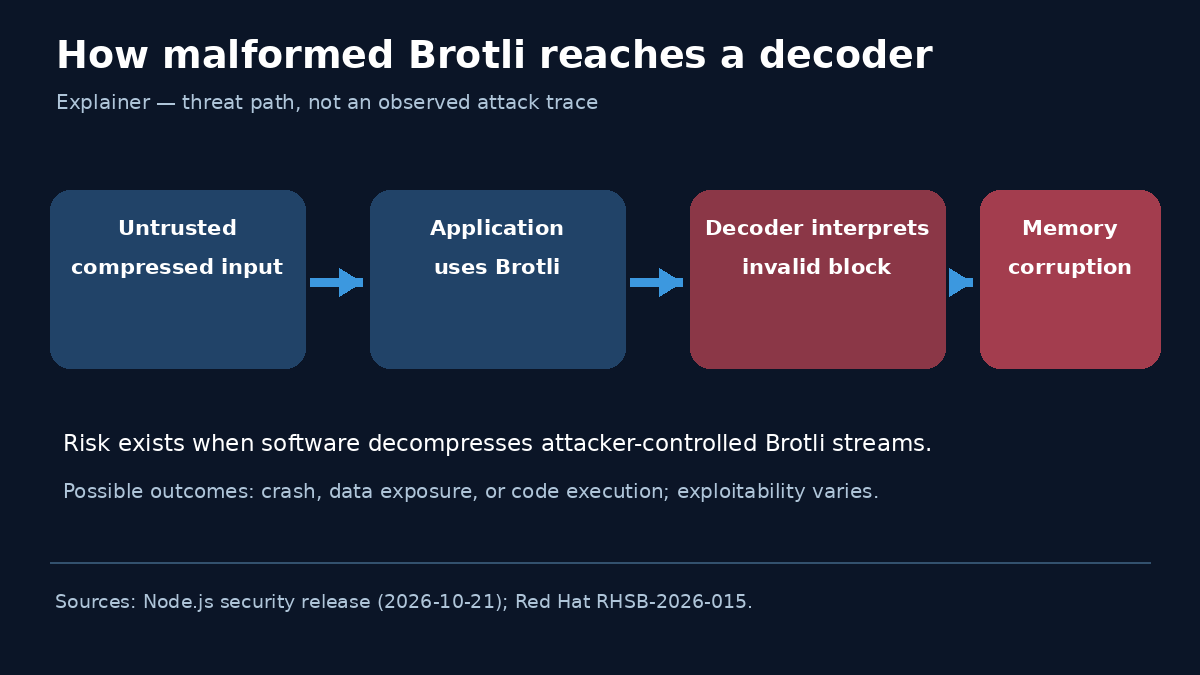
The disclosure lands amid other software-security incidents, including the recent PHP2Shell emergency updates and GitLab patch warnings. It illustrates why security teams need dependency inventories, not merely a list of visible applications: a flaw in a compression component can cross runtime and packaging boundaries.
Patch Releases and Cloud Exposure
Google’s Brotli releases include corrected versions 1.0.10, 1.1.1 and 1.2.1. Node.js shipped patches for supported 22.x, 24.x and 26.x lines. Microsoft’s .NET advisory notes that default ASP.NET Core and HttpClient behavior does not automatically decompress Brotli; exposure depends on enabled functionality and usage.
New Zealand’s cybersecurity agency reported active exploitation on October 29, although vendor assessments distinguish observed attacks from a reliable public demonstration of remote code execution. AWS also warned customers to rebuild affected container images and check bundled dependencies rather than assuming a managed platform update fixes every application.
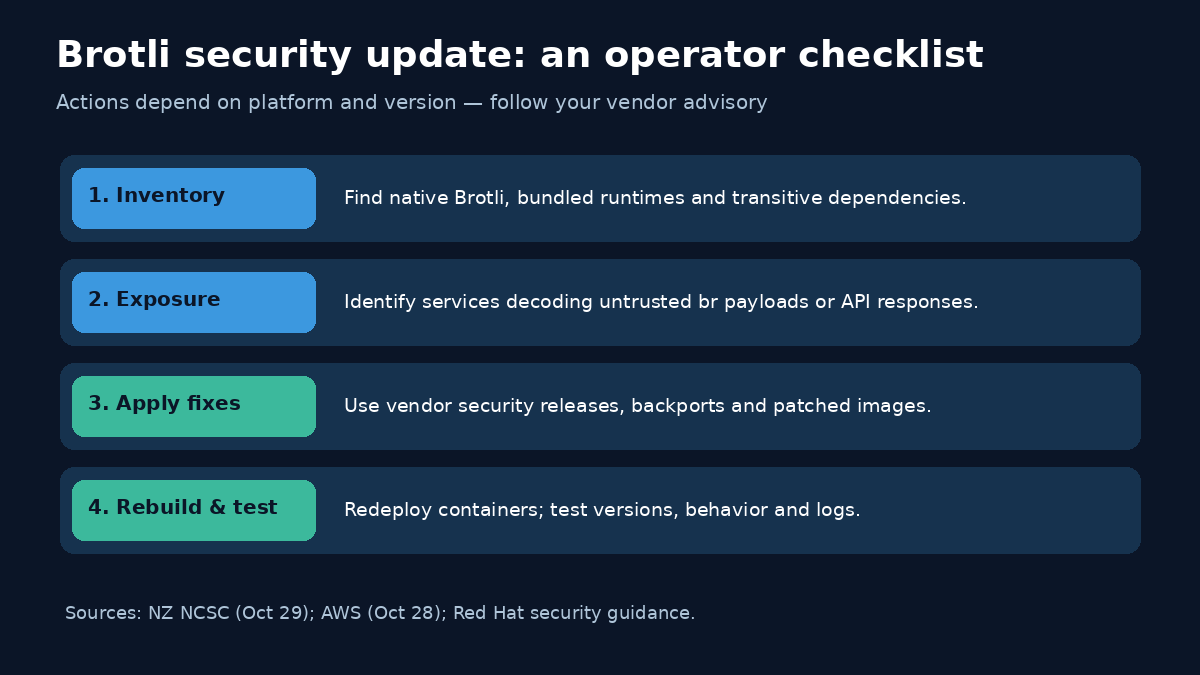
For administrators, the next steps are to identify exposed decompression paths, install vendor-supported fixes, rebuild deployments and test. Teams already following network segmentation and Linux infrastructure performance should add library-level patch verification to their operating checklists. Developers deploying JavaScript runtimes, including Deno-related platforms, should verify their own dependency trees rather than assume this Node.js advisory applies identically.
BitcoinVersus.Tech
BitcoinVersus.Tech Editor’s Note: We volunteer daily to ensure the credibility of the information on this platform is Verifiably True. If you would like to support our work and help further secure the integrity of our research initiatives, please scan the QR code below to donate 5,000 sats. For best results, scan the QR code from a laptop or larger screen.

Bitcoin address: 3C9o19EH5HSiwEPyCTmEKzxhNCbo2X6TTb. On a phone, open the QR image on another screen or copy and verify the address in your wallet before sending.
BitcoinVersus.tech is not a financial advisor. This media platform reports on financial subjects purely for informational purposes.


Leave a Reply