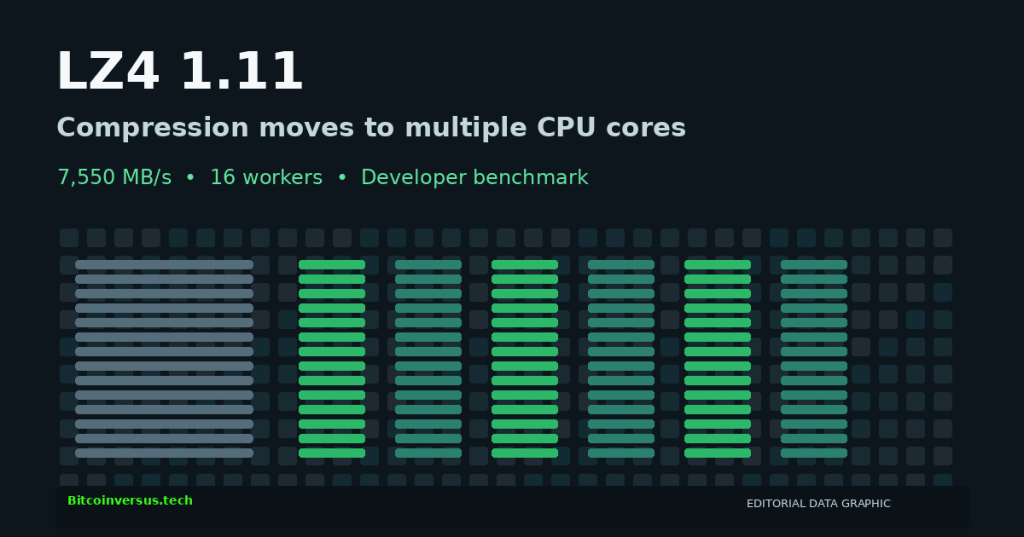
Open-source compression library LZ4 1.11.0, released November 4, 2026, has moved multithreaded compression into its application programming interface. The maintainers report 7,550 megabytes per second when compressing a 202 MB test archive using 16 workers on an AMD EPYC Genoa server. Against the same test’s single-worker result of 522 MB/s, the measured throughput is 14.46 times higher. The figures are project-published laboratory benchmarks, not guarantees for everyday software.
LZ4 is a lossless compression algorithm designed to reduce data size without changing its decoded contents. Its fast compression and decompression make it useful in data systems that value throughput and low latency. Earlier LZ4 1.10 supported parallelism in the command-line tool, but programs calling the underlying liblz4 library lacked the same built-in multithreaded frame-compression option. Version 1.11 introduces experimental LZ4F_preferences_t.nbWorkers support for applications that explicitly request worker threads.
How 16 workers reached 7.55 GB/s
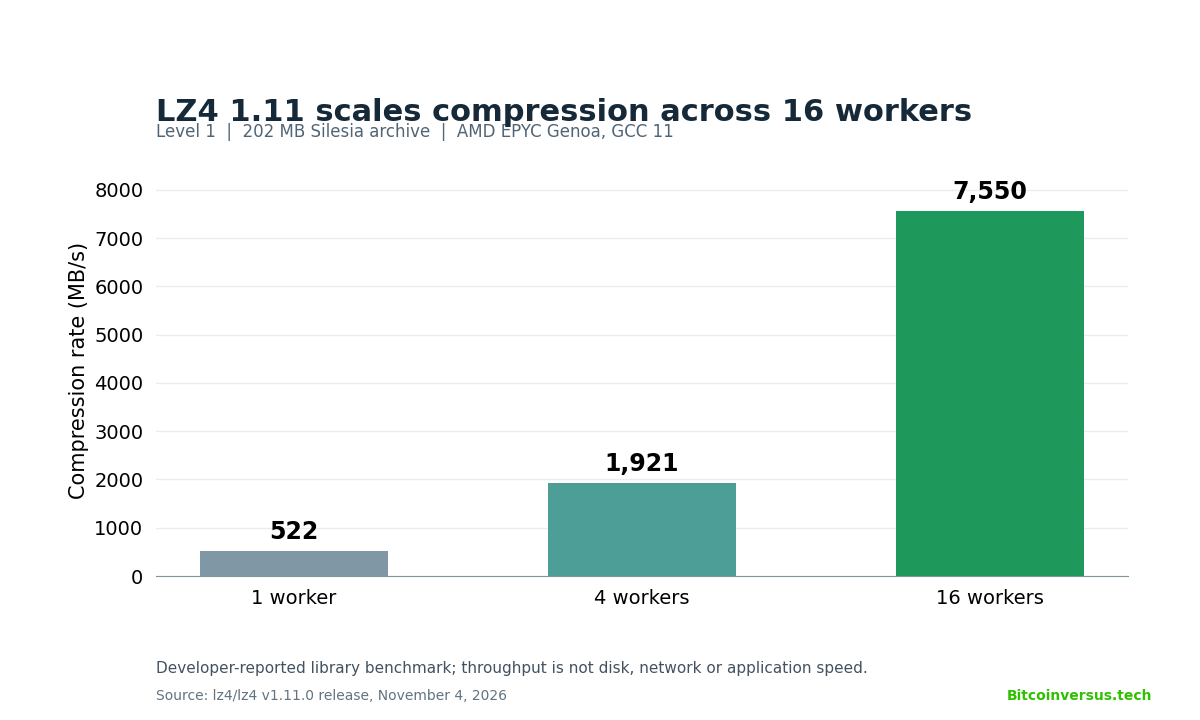
Project tests used AMD EPYC Genoa, GCC 11, a 202 MB Silesia test archive and level 1 compression. One worker achieved 522 MB/s; four reached 1,921 MB/s; and 16 reached 7,550 MB/s. Relative to one worker, the measured speedups are approximately 3.68× and 14.46×. The 16-worker result equals roughly 90% of hypothetical perfect linear scaling, but it is a measurement of compression throughput—not full-system efficiency, electric power or elapsed application startup time. CPU core and thread behavior helps explain why adding workers can improve throughput without guaranteeing equal gains.
Compression settings change the result. At level 9, the same project reported 28.5 MB/s with one worker and 436 MB/s with 16; at level 12, 10.6 MB/s rose to 154 MB/s. Higher levels generally trade speed for denser output, making direct comparisons across settings misleading. Compressed bytes remain identical across worker counts when data and other compression parameters are held constant, according to the maintainers.
Smaller database blocks show separate improvements
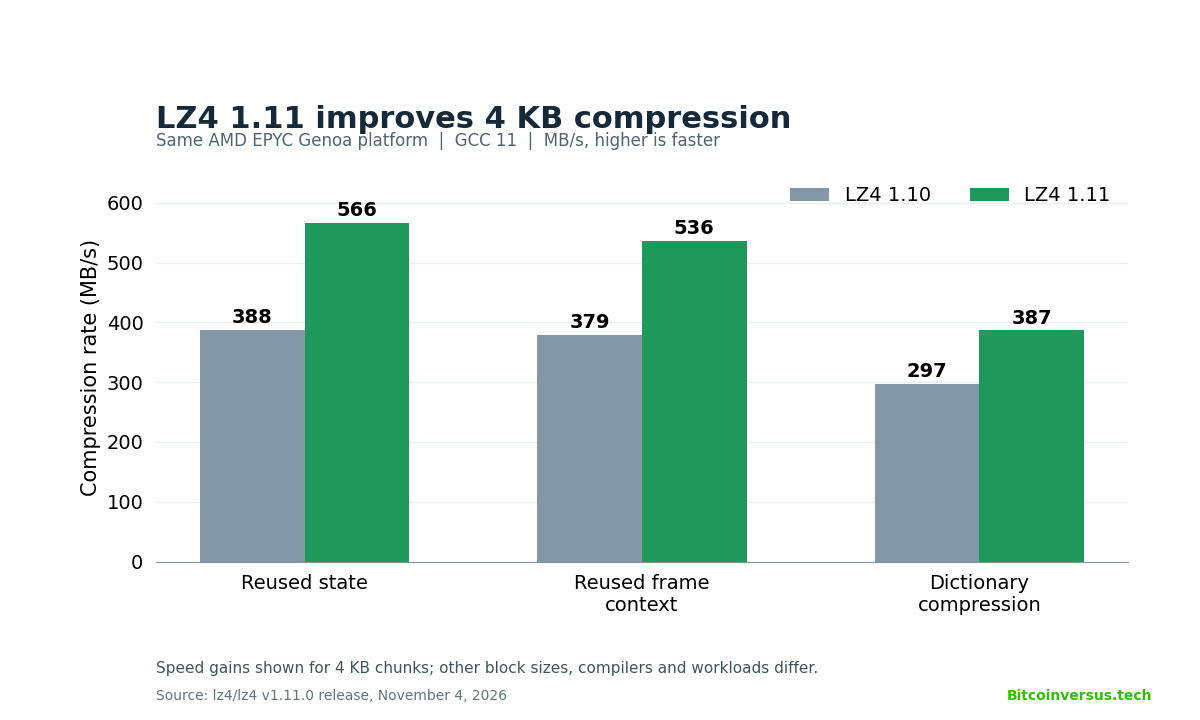
A second benchmark compares versions 1.10 and 1.11 on 4 KB blocks using the same server and compiler. Compression with reused state rose from 388 to 566 MB/s, a calculated 45.9% increase. Reused frame context improved from 379 to 536 MB/s, up 41.4%, while dictionary-assisted compression rose from 297 to 387 MB/s, up 30.3%. The test focuses on small blocks, not a universal 30%–46% acceleration for applications.
Database pages, cache entries and log records often move through software in small pieces. Reusing buffers or dictionary state reduces repeated setup work. The SQL database overview discusses how storage engines handle records and pages, while NUMA architecture helps explain why thread placement and memory locality may influence server benchmarks. No end-to-end database latency, disk transfer or customer workload speedup was measured in the LZ4 release.
What changes for software developers
The library’s new worker count field is explicitly labeled experimental. Multithreading is built into the dynamic library by default, but static library builds remain single-threaded by default unless configured otherwise. Applications must request parallel compression and validate CPU, memory and scheduling costs. The command-line tool also gains a --memory budget and improvements to sequential work such as frame checksums. Additional workers may stop helping when input, output or checksum processing becomes the limiting factor.
The maintainers report more than 850 commits since 1.10 and over 100 continuous-integration jobs validating changes. Reliability updates address rare corrupted streams, incorrect arguments and safer file handling. Related compression-library security reporting illustrates why deployment requires more than chasing a headline benchmark. LZ4 1.11 appears technically significant, but reproducible application-level tests remain necessary before extrapolating project results into production savings.
Primary source: LZ4 version 1.11.0 release notes, November 4, 2026. Supporting technical reference: LZ4 source repository and benchmark methodology. The published performance figures are attributed to the project’s maintainers.
Editor’s Note: Benchmark results originate from the LZ4 development project’s November 4, 2026 release tests. Throughput was measured with specified CPU, compiler, archive and compression parameters, not with independent production workloads. The 14.46× scaling and percentage improvements are calculations from released measurements. The new worker-count interface is experimental and may not be enabled in static builds by default. The featured visual is an original schematic data graphic, not generated photography or a vendor hardware image. No third-party repetition or mobile visual inspection is claimed.
Support BitcoinVersus.Tech
Optional support for research is available through the original approved 5,000-satoshi donation QR below. If reading on a phone, open the page on another display and scan the code using a compatible Bitcoin wallet, or use a supported wallet image-scanning feature. Check the recipient and amount before sending.

We volunteer daily to ensure the information on this platform is Verifiably True. If you would like to support the research, please scan QR code.


Leave a Reply