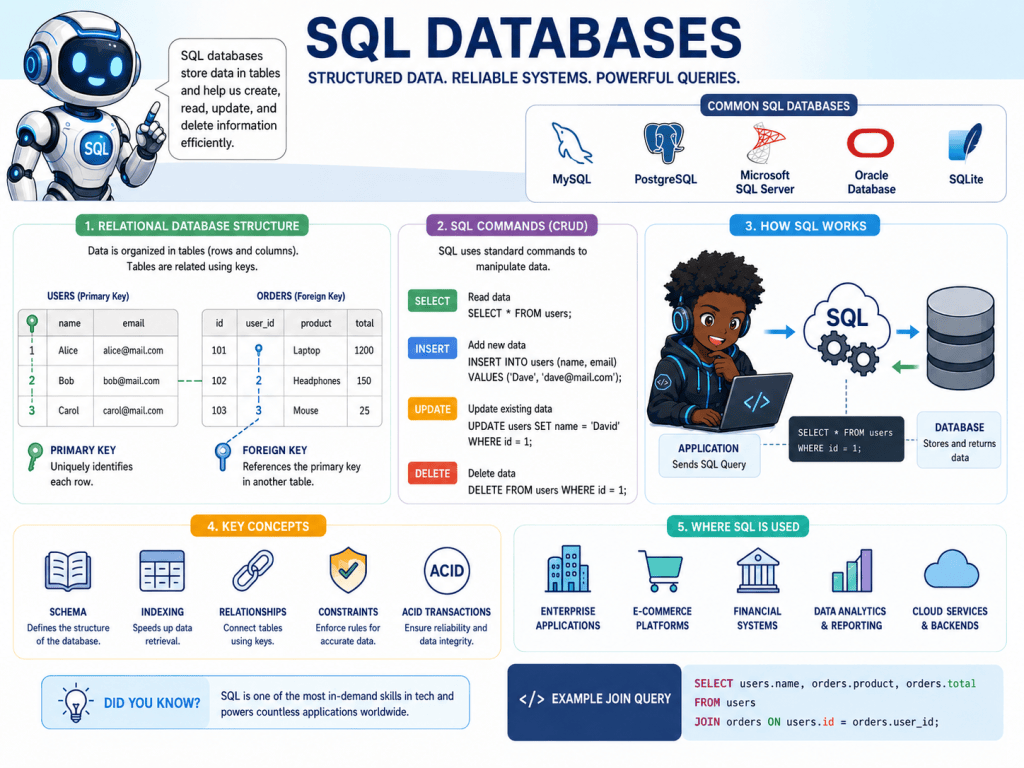
SQL databases are structured data-management systems that organize information into tables made up of rows and columns.
SQL, or Structured Query Language, allows developers, database administrators, analysts, and applications to create, retrieve, update, and delete data using standardized commands.
Popular relational database management systems include MySQL, PostgreSQL, Microsoft SQL Server, Oracle Database, and SQLite. Because relational databases use defined schemas and relationships between tables, they remain a foundational technology for applications that require consistent, searchable, and organized information.
A SQL database typically connects related datasets through primary keys and foreign keys, allowing applications to work with information distributed across multiple tables without unnecessarily duplicating data.
Developers can use commands such as SELECT, INSERT, UPDATE, DELETE, and JOIN to manipulate and analyze records.
Database concepts including indexing, normalization, transactions, constraints, stored procedures, and query optimization help improve reliability and performance as systems grow. SQL databases also commonly support ACID transaction principles designed to preserve data integrity when multiple operations occur simultaneously.
Modern SQL databases are used throughout cloud computing, enterprise applications, financial platforms, e-commerce systems, data centers, cybersecurity platforms, web applications, and analytics infrastructure.
They can operate on individual computers, dedicated database servers, virtual machines, containers, or managed cloud platforms.
Even as NoSQL and distributed data technologies have expanded, SQL remains one of the most important skills in software engineering and information technology because relational databases continue to power critical business and technical systems.
BitcoinVersus.Tech Editor’s Note:
We volunteer daily to ensure the credibility of the information on this platform is Verifiably True. If you would like to support to help further secure the integrity of our research initiatives, please donate here: 3C9o19EH5HSiwEPyCTmEKzxhNCbo2X6TTb
To donate 5,000 sats, open this page on another screen and scan the QR code below with your mobile Bitcoin wallet. If your wallet supports scanning a saved image, you can save the QR image and scan it from your phone instead.
BitcoinVersus.tech is not a financial advisor. This media platform reports on financial subjects purely for informational purposes.


Leave a Reply