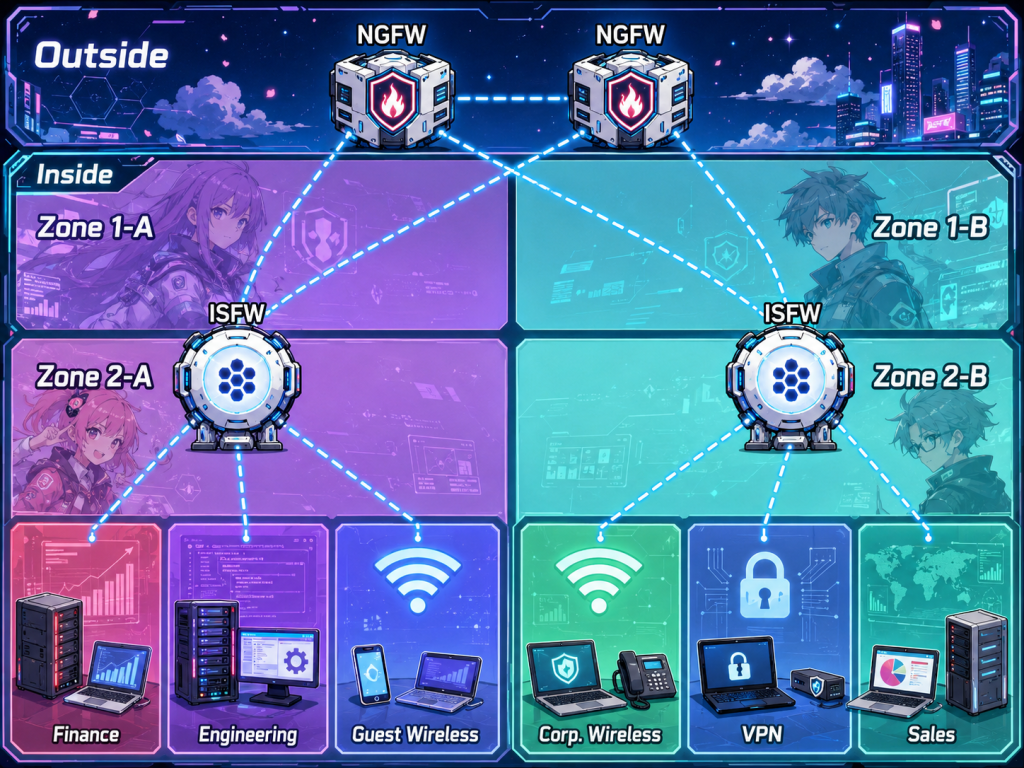
Network segmentation is one of the most important architectural functions of a modern firewall. Rather than treating an organization as one large trusted network, segmentation divides infrastructure into separate security zones based on department, device type, application, user group, or level of trust.
In the Fortinet example shown above, next-generation firewalls (NGFWs) protect the network perimeter while internal segmentation firewalls (ISFWs) divide internal resources into additional zones.
Finance, engineering, guest wireless, corporate wireless, VPN users, and sales systems can therefore operate within separate network boundaries while remaining part of the same enterprise infrastructure.
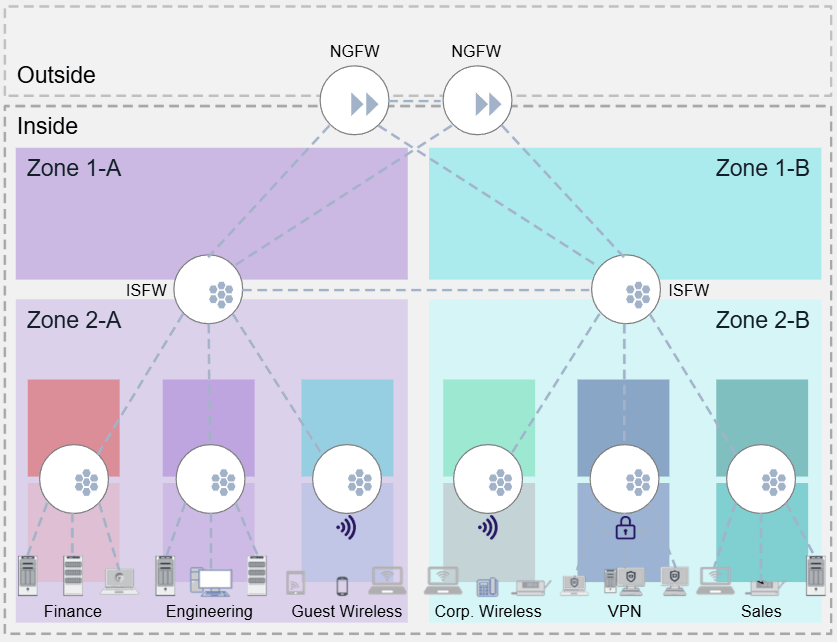
This design gives network administrators much more control over north-south and east-west traffic. Perimeter NGFWs primarily inspect traffic entering or leaving the organization, while internal segmentation firewalls can enforce policies on traffic moving between internal zones.
A device connected to guest wireless, for example, does not automatically need access to finance servers or engineering systems simply because both resources exist inside the corporate network. Firewall policies, authentication requirements, application controls, access rules, and security inspection can determine exactly which systems are permitted to communicate.
Segmentation is also an important cybersecurity strategy because it can reduce the potential blast radius of a compromised endpoint. In a flat network, an attacker that gains access to one device may have a larger environment available for lateral movement.
A segmented architecture introduces additional security boundaries that an attacker must cross. Sensitive workloads can therefore be isolated behind stricter firewall policies, while lower-trust systems such as guest devices or externally connected endpoints can be placed into more restrictive zones. This approach supports principles such as least-privilege access and Zero Trust by making network location alone insufficient for unrestricted access.
For network architects, the firewall is therefore more than an internet gateway. Modern firewalls can become enforcement points throughout the architecture, connecting security policy directly to the logical organization of the network.
VLANs, subnets, routing domains, wireless networks, VPN connections, server environments, and business departments can all be organized around defined security boundaries.
As enterprise networks expand into cloud platforms, remote connectivity, IoT, edge computing, and distributed data centers, effective segmentation remains a foundational method for maintaining visibility, controlling traffic flows, and protecting critical infrastructure.
BitcoinVersus.Tech Editor’s Note:
We volunteer daily to ensure the credibility of the information on this platform is Verifiably True. If you would like to support to help further secure the integrity of our research initiatives, please donate here: 3C9o19EH5HSiwEPyCTmEKzxhNCbo2X6TTb
BitcoinVersus.tech is not a financial advisor. This media platform reports on financial subjects purely for informational purposes.


Leave a Reply