
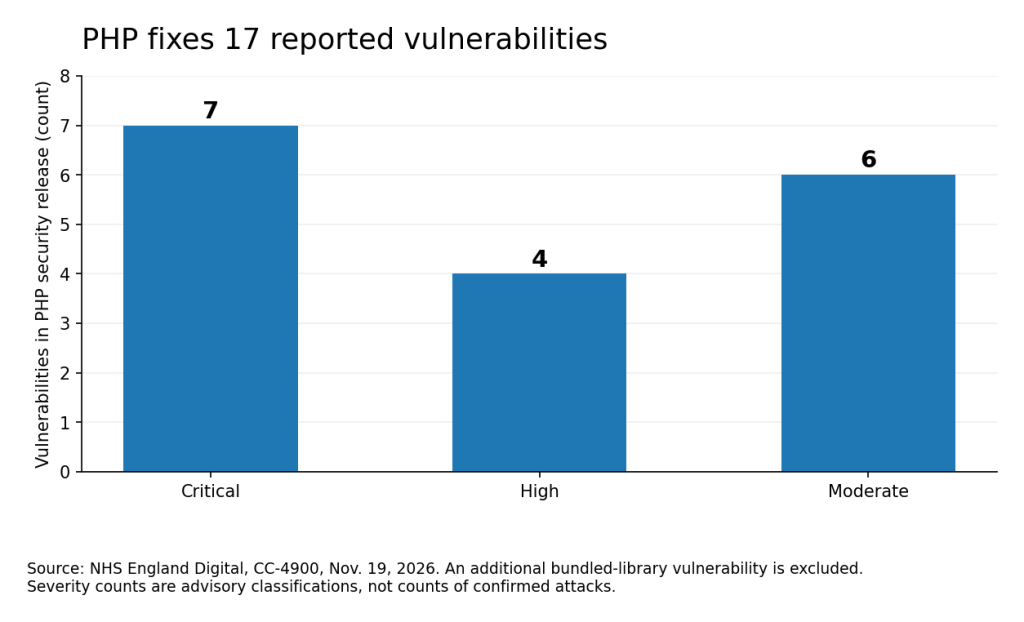
The PHP development team released four security updates on November 19, 2026, correcting vulnerabilities across the programming language used by millions of websites. NHS England’s cybersecurity team classified seven issues as critical, four as high severity and six as moderate, plus one issue in a bundled library. Some critical weaknesses could enable remote code execution under specific server configurations.
The fixed versions are PHP 8.2.36, 8.3.37, 8.4.28 and 8.5.13. The PHP project’s official release notices encourage users of each supported branch to upgrade. The new patches follow, but do not replace, October’s separate PHP2Shell emergency security updates.
Archival International PHP Conference talk by Arne Blankerts about nginx, PHP-FPM and server hardening, published in 2020. Educational background, not a demonstration of the November vulnerabilities.
What makes the new bugs dangerous?
One serious flaw, CVE-2026-129289, concerns PHP-FPM, a common service connecting web servers to PHP applications. Under conditions involving persistent backend connections and unread request data, specially constructed input could be interpreted as a separate FastCGI request. The PHP advisory describes a path to running attacker-controlled PHP code with worker permissions.
Standard nginx and Apache configurations that close their FastCGI connections after each request are not affected by the demonstrated PHP-FPM attack path. Another critical flaw, CVE-2026-129496, involves memory corruption in timezone error logging under particular startup conditions. The critical rating does not mean every installation is remotely exploitable.
What administrators should do
First, inventory PHP runtimes in web hosts, containers and embedded applications. Check the installed version, then upgrade through the operating system or hosting provider and restart the relevant PHP worker processes. Review the official changelog and applicable configuration advisories; temporary workarounds for one defect will not necessarily address the others.
For persistent PHP-FPM connections, disabling backend connection reuse can reduce exposure to the request-smuggling bug until patches are installed. Websites using WordPress should establish which PHP version actually runs on their hosting infrastructure. Updating a WordPress plugin alone cannot patch a vulnerable PHP interpreter.
International PHP Conference 2026 talk by Paul Dragoonis on PHP-FPM resilience and runtime configuration. Recorded before the November 19 security releases.
Why the release matters beyond PHP
Server security depends on multiple layers. BitcoinVersus.Tech recently covered an NGINX HTTP/2 patch, a Brotli decoder security flaw and safer PHP form handling. Different vulnerabilities demand different fixes across the web stack.
NHS England reports publicly available proof-of-concept material for multiple November vulnerabilities, making timely patch management worthwhile. Successful exploitation still depends on the affected component, configuration and application behavior. Operators should prioritize affected public-facing systems, verify patched versions and monitor their logs for anomalies.
Sources
- PHP Project, November 19, 2026, four security release announcements
- NHS England Digital, November 19, 2026, threat classification and remediation
- PHP Project security advisory for CVE-2026-129289
- PHP Project security advisory for CVE-2026-129496
- PHP 8 official changelog and fixed versions
Editor’s Note: We volunteer daily to ensure the credibility of the information on our platform is Verifiably True. If you would like to support our work and the integrity of our research initiatives, scan the QR code below to donate 5,000 sats.

For mobile scanning, open the article on another display and scan the QR code with a Bitcoin wallet. Verify receiving address 3C9o19EH5HSiwEPyCTmEKzxhNCbo2X6TTb before sending.
BitcoinVersus.Tech publishes technology and cybersecurity journalism for informational purposes and does not provide professional security, legal or financial advice.


Leave a Reply