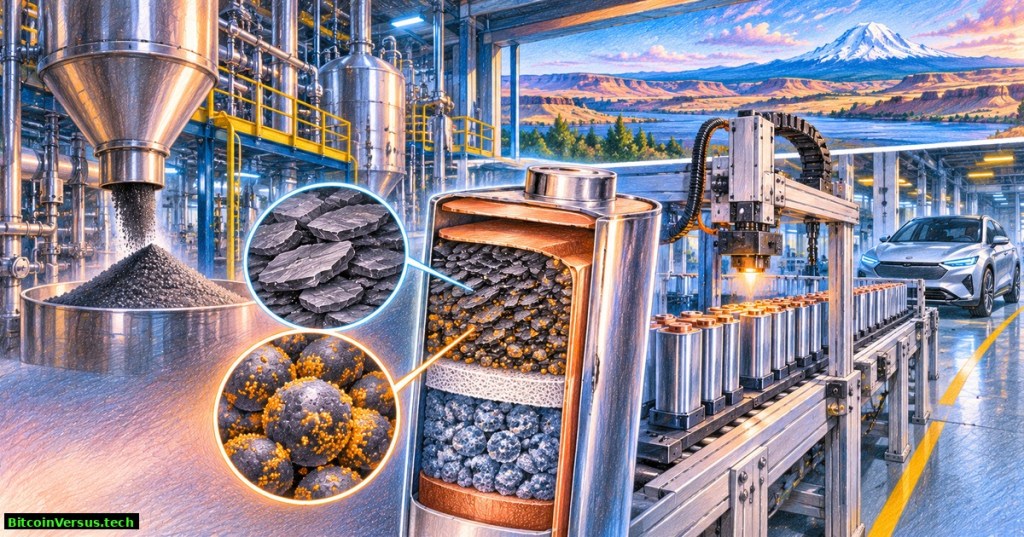
Battery-materials manufacturer Sila has signed a multiyear supply agreement with Panasonic Energy that could generate more than $1 billion in purchases over time. Announced on November 18, 2026, the deal connects Sila’s silicon-carbon anode plant in Moses Lake, Washington, with Panasonic’s American battery-cell manufacturing operations. It is a significant commercial commitment, but not $1 billion in completed deliveries or recognized revenue.
Sila’s official announcement identifies the material as Titan Silicon, a nanostructured silicon-carbon alternative to conventional graphite-heavy anodes. The company says supply will expand as manufacturing capacity and customer qualification allow. It did not publish annual order volumes, exact prices per ton, specific automobile models or a binding timetable for the full potential contract value.
Original Sila company video, October 2025, explaining how Titan Silicon was developed and scaled. Background on the anode technology; not footage of deliveries under the November 2026 agreement.
Why silicon anodes matter
During charging, lithium ions move into the negative electrode. Graphite is widely used because its structure can repeatedly accommodate lithium, but silicon can store considerably more lithium for a given mass. Replacing some graphite with engineered silicon could raise cell energy density, extend driving range or reduce battery weight without changing the entire lithium-ion architecture.
The complication is mechanical. Silicon expands substantially as lithium enters and contracts during discharge. Repeated swelling can fracture particles, disrupt electrical connections and accelerate unwanted reactions with the electrolyte. Sila says its engineered carbon structure helps control expansion, but cell-level range, cycle-life and fast-charge claims still require evaluation for each Panasonic design.
The partners are not meeting for the first time. Panasonic announced a procurement relationship in December 2023. The new multiyear offtake expands their commercial path toward US-produced material rather than announcing an entirely new chemistry discovered in November.
A factory in Washington and a customer in America
Sila’s Moses Lake facility began with roughly 2 gigawatt-hours of annual battery-equivalent material capacity, according to industry reporting, while much larger future expansion has been discussed. An ambition to reach 250 GWh is not current installed output, nor a confirmed Panasonic purchase volume. The site’s delivery reliability, quality control and actual operating rate will determine how quickly the agreement translates into shipments.
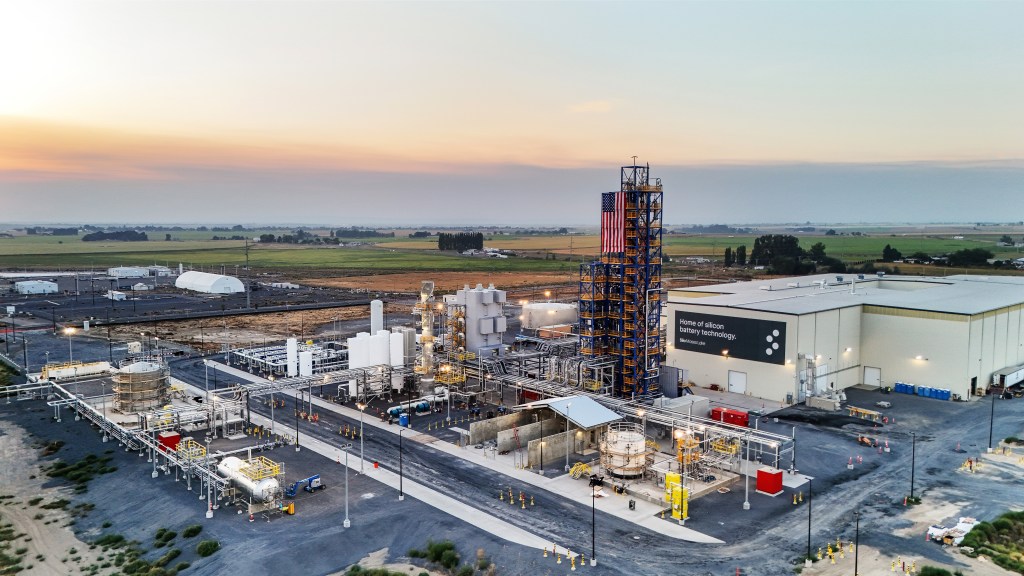
Sila received a conditional loan commitment of up to $1.4 billion from a US Defense Department program in August 2026. Manufacturing Dive also reported $300 million in equity financing secured in July. The proposed loan is separate from Panasonic’s potential purchasing value: adding the figures together would incorrectly treat financing and future sales as cash already earned.
Bloomberg Technology’s July 2025 interview with Panasonic North America CEO Megan Myungwon Lee at its Kansas battery plant. Archival manufacturing context; no footage of the November 2026 agreement.
What the agreement does not prove yet
An offtake agreement gives a manufacturer greater confidence that a customer may buy future output, often supporting investment decisions and supply-chain planning. Its stated potential value is not necessarily a guaranteed minimum. Neither Sila nor Panasonic disclosed the complete take-or-pay provisions, cancellation terms or qualification acceptance schedule.
The distinction matters in a battery market facing pricing pressure, competing anode chemistries and uncertain electric-vehicle demand. Silicon-carbon can also introduce cost and supply-chain challenges of its own. Manufacturers must demonstrate consistent particle quality, swelling control and long-term cycling in the precise cells being sold.
Related BitcoinVersus.Tech research covered BMW’s 800-volt battery communications test, Ford’s Michigan-made LFP battery prototypes, graphite-anode cycling research and modeled high-energy silicon-anode cells. The manufacturing approaches and evidence levels differ; none should be treated as equivalent performance measurements.
The next measurable milestones are Panasonic’s cell qualification, annual quantities of material actually shipped, verified production capacity and independent battery performance. The agreement signals meaningful customer interest in US-made silicon-carbon anodes. Whether it becomes a billion-dollar operating business remains a question for future delivery and financial records.
Sources and verification
- Sila, November 18, 2026, primary announcement of the Panasonic supply agreement
- Manufacturing Dive, November 19, 2026, independent coverage of contract and financing
- InsideEVs, November 19, 2026, context for manufacturing scale and silicon-carbon performance
- Panasonic Energy, December 2023, original procurement relationship
- Sila, August 7, 2026, conditional government financing announcement
Editor’s Note: We volunteer daily to ensure the credibility of the information on our platform is Verifiably True. If you would like to support our work and the integrity of our research initiatives, scan the QR code below to donate 5,000 sats.

For mobile scanning, open the article on another display and scan the QR code using a Bitcoin wallet. Verify receiving address 3C9o19EH5HSiwEPyCTmEKzxhNCbo2X6TTb before sending.
BitcoinVersus.Tech publishes technology, manufacturing and finance journalism for informational purposes, not financial, legal or investment advice.


Leave a Reply